




































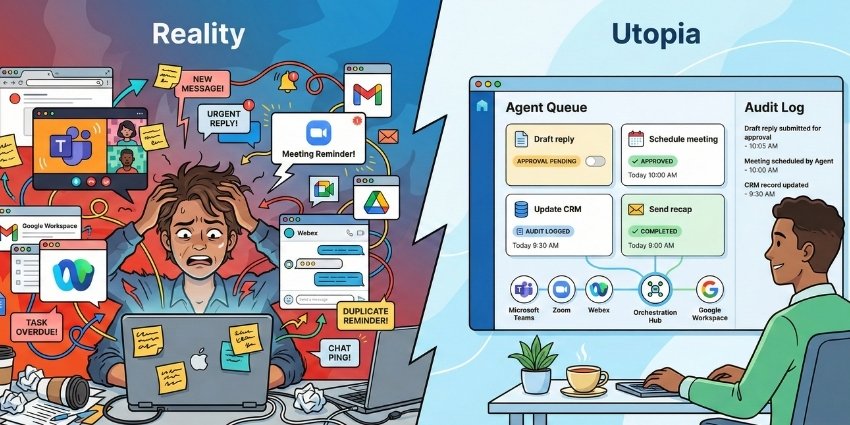
Google’s enterprise strategy is evolving as the demand for agentic AI grows, redefining the nature of workplace collaboration tools. Traditionally, enterprises have standardized on a limited selection of meeting, chat, and voice platforms, with Google not establishing itself as the primary UCaaS (Unified Communications as a Service) provider for large organizations. As the market shifts towards AI-driven orchestration layers that comprehend context and facilitate actions across various tools—such as email, calendars, and chat—Google sees an opportunity to position its Gemini platform at the forefront of this change.
Sundar Pichai, CEO of Google, emphasized this transformative vision, stating, “Gemini Enterprise is designed on the premise that true business transformation in the era of AI must go beyond simple chatbots.” The key to realizing this shift lies in addressing data access, governance, and evaluation. Without these foundational elements in place, the utility of AI-powered tools often diminishes after initial demonstrations.
While UCaaS procurement processes appear familiar—renewing calling plans, negotiating licenses, and addressing compliance requirements—the nature of work is evolving more rapidly than purchasing behaviors. Agentic AI is poised to extract value from conventional meeting grids by understanding the intent behind messages and documents, gathering contextual information across systems, and executing multi-step actions while alleviating the need for users to switch between applications.
This transformative phase signals a critical shift from reactive to proactive AI functionalities. In this context, autonomy emerges as the primary differentiator, rather than mere sophistication in communication. For Google, a potential pathway to success does not necessarily hinge on dominating the UCaaS market but rather on becoming the orchestrating layer that integrates seamlessly with existing tools used by enterprises.
Gemini Enterprise is portrayed as a subscription service designed to deploy AI agents within business workflows. This includes capabilities to interface with platforms like Box, Microsoft 365, and Salesforce, all without requiring coding expertise. This dual approach highlights Google’s intent to satisfy both IT departments, which seek governance in agent deployment, and business teams eager to automate processes without IT delays.
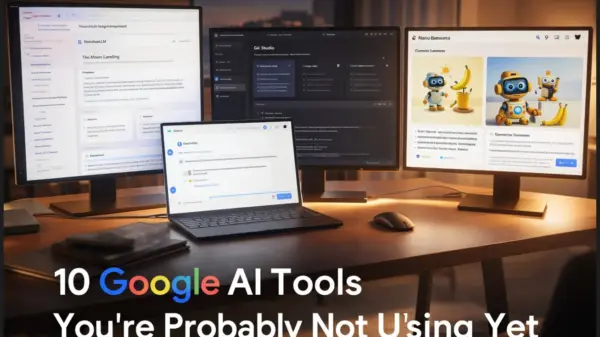
To facilitate this, Google is introducing Workspace Studio as a no-code agent builder embedded in applications such as Gmail, Drive, and Chat. Users can articulate their needs, and the system generates the necessary steps, as noted by Farhaz Karmali, Product Director for Google Workspace Ecosystem, who stated, “With Workspace Studio, you can build agents in minutes… from simple tasks to complex workflows — no coding.”
The competitive landscape for AI in collaboration tools is increasingly not just about feature enhancements but about architectural positioning. Companies like Zoom are exploring federated approaches that allow different AI models to be utilized based on specific tasks, which underscores a future where collaboration is rooted in orchestration rather than competition. Xuedong Huang, Zoom’s CTO, stated, “Our success reinforces a fundamental belief: the future of AI is collaborative, not competitive.”
As Google seeks to carve out its space within this dynamic environment, it aims to integrate agent creation and governance within its Workspace ecosystem, while also ensuring connectivity across various software suites. However, the rise of agentic AI isn’t without its challenges. For organizations looking to implement such systems, governance must evolve beyond static policies to encompass enforceable behaviors, including unified data access and identity management for agents.
As enterprises navigate this changing landscape, the potential exists for their tech stacks to become secondary to an overarching AI layer. This shift could lead to a situation where routine tasks are managed autonomously by agents, reducing reliance on traditional applications. The future may see employees interfacing primarily with these AI layers, rather than the applications themselves, fundamentally altering the nature of work in the process.
In this rapidly evolving ecosystem, organizations that fail to establish ownership and governance over their AI orchestration layers risk becoming passive participants in a landscape influenced by unregulated, ad-hoc implementations. The emergence of agentic AI promises to transform workplace dynamics, potentially superseding traditional UCaaS platforms as the preferred method for managing work.
See also Maximize Efficiency: Ethical AI Transforms Self-Storage Operations and Customer Trust
 PayPal Acquires Cymbio to Enhance AI-Powered Commerce, Transforming Retail Dynamics
 Chinese AI Models Gain 30% Market Share, Threatening U.S. Giants Like OpenAI and Google
 U.S. AI Strategy Must Navigate Uncertainty to Secure Global Leadership Against China
 Invest in AI’s Future: Equinix’s Stock Offers Solid Valuation Amid High Market Prices