















































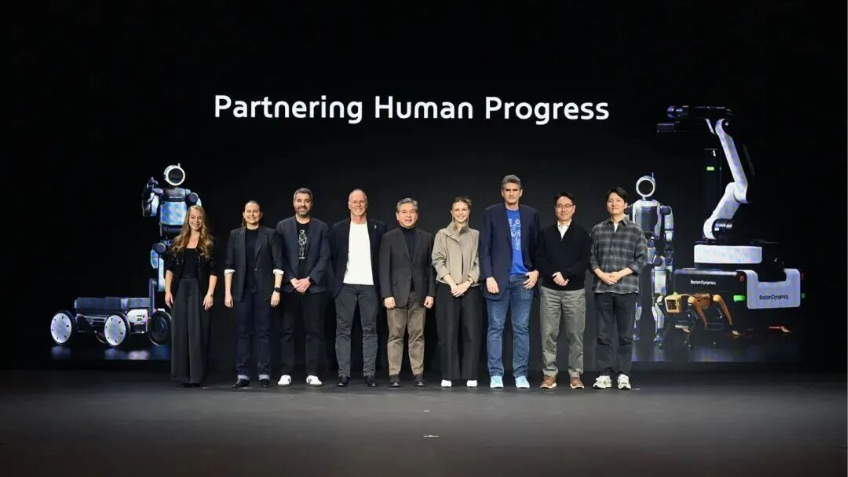
Hyundai Motor Group unveiled a groundbreaking AI robotics strategy at the 2026 Consumer Electronics Show (CES 2026), centered around the theme “Cooperation to Advance Humanity.” This initiative aims to transition traditional hardware-driven robotics into adaptive, AI-driven machines that enhance human capabilities. By leveraging its extensive value chain and product portfolio, Hyundai seeks to establish itself as a leader in physical AI, which encompasses technologies that utilize hardware for real-time data collection and autonomous decision-making across sectors like manufacturing, logistics, and autonomous driving.
To actualize this vision, Hyundai plans to gather critical data throughout its production processes—from manufacturing to sales—and develop a continuous improvement loop that fosters the growth of robotics beyond mobility. The company is also set to enhance the Hyundai Motor Group Physical AI Application Center and construct a manufacturing and foundry facility focused on bespoke robot technologies inspired by physical AI.
Hyundai’s strategy rests on three primary partnerships. The first involves integrating collaborative robots designed to assist human workers in hazardous or repetitive tasks, particularly in manufacturing settings. Notably, Boston Dynamics’ four-legged robot Spot is already operational in over 40 countries for data collection and safety monitoring. Similarly, its warehouse robot Stretch has unloaded more than 20 million boxes globally since its launch in 2023, revolutionizing warehouse automation.
At CES, Boston Dynamics showcased its humanoid robot Atlas, which boasts 56 degrees of freedom and tactile-sensing hands, allowing it to autonomously perform tasks such as sorting materials, assembly, and machine maintenance. Designed for ease of training and robust performance, Atlas is slated for integration into Hyundai’s global manufacturing network, starting with part sorting in 2028, moving to component assembly by 2030, and eventually tackling more complex operations.
The second element of Hyundai’s strategy involves establishing a Group Value Network in partnership with Boston Dynamics. This initiative will merge Boston Dynamics’ AI robotics expertise with Hyundai’s manufacturing capabilities to create safe training environments and a comprehensive end-to-end AI robotics value chain. Hyundai is building this network to accelerate mass production and broaden service deployment using its world-class production infrastructure and technological resources.
Specific measures include rigorous training for Atlas within Hyundai’s manufacturing facilities to prepare it for real-world applications. The plan also encompasses optimizing robot learning through specialized software-defined factory and robot meta-factory application centers. Coordination with affiliates such as Hyundai Motor, Kia, Hyundai Mobis, and Hyundai Glovis will enhance capabilities in manufacturing, parts production, and logistics. Additionally, Hyundai is launching a Robotics-as-a-Service (RaaS) subscription model that offers software upgrades, remote monitoring, and maintenance, in collaboration with global partners like DHL, Nestle, and Maersk.
Hyundai has set an ambitious target to develop a scalable production system capable of manufacturing 30,000 robots annually by 2028.
The third dimension of Hyundai’s strategy focuses on partnering with global AI leaders to drive innovation in AI robotics. In this context, Boston Dynamics announced a strategic collaboration with Google DeepMind to expedite the development of next-generation humanoids. This partnership aims to combine advanced robotics with cutting-edge AI, potentially transforming the future of robotics research.
Furthermore, Hyundai Motor Group has committed to investing 125.2 trillion won in South Korea over the next five years, starting in 2026. This investment is aimed at fostering growth in AI-powered robotics and establishing an innovative robotics ecosystem within the country. As the landscape of AI and robotics continues to evolve, Hyundai’s comprehensive approach signals a significant shift towards a future where human-robot collaboration becomes integral to industrial processes.
See also Amazon’s ‘Buy For Me’ AI Scrapes Retailers’ Data, Sparking Backlash from Small Businesses
 Voice Gender Conversion AI Market to Surge 25.5% to $1.33B by 2025, Driven by Major Tech Advances
 AI Supercycle Gains Momentum: $2 Trillion Investment Surge Expected by 2026
 Americans Turn to ChatGPT for Healthcare Guidance as ACA Subsidies Expire, Survey Reveals