











































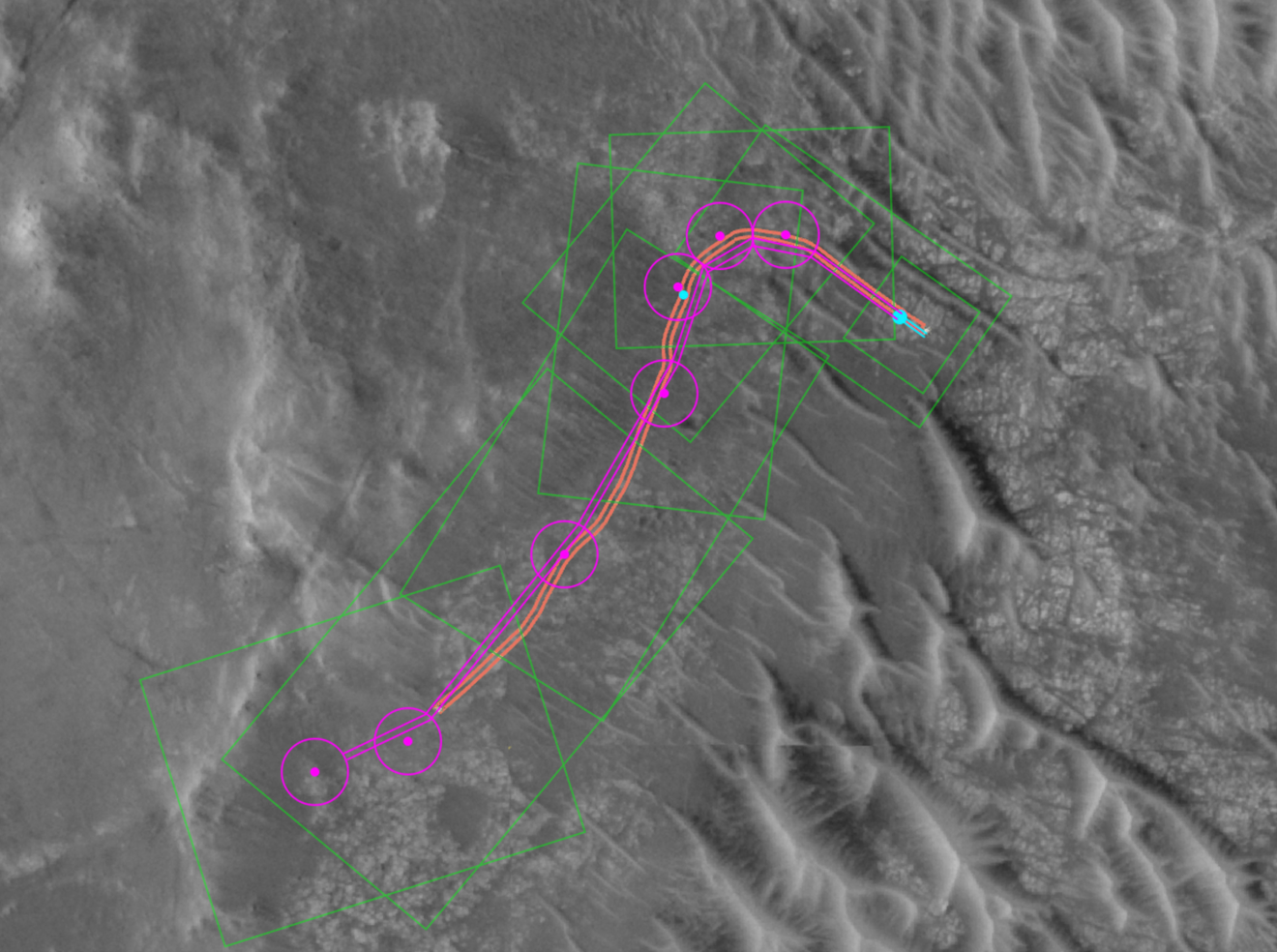
NASA’s Jet Propulsion Laboratory has successfully executed the first rover drives on Mars planned by artificial intelligence, signaling a significant advancement in autonomous navigation for space missions. On December 8 and 10, 2025, the Perseverance rover traversed Jezero Crater by using waypoints generated by Anthropic’s Claude AI models, a departure from the traditional approach that often requires extensive input from human route planners.
This milestone is particularly noteworthy given the challenges posed by the vast distance between Earth and Mars, which complicates real-time communication and control. By leveraging AI to handle complex planning tasks, NASA aims to ease the operational burden on its teams, enhance the speed of mission operations, and extend the capabilities of future missions where human oversight may be limited.
The AI-driven drives were coordinated from JPL’s Rover Operations Center, with Perseverance completing its first drive of 689 feet (210 meters) on December 8, followed by a second drive of 807 feet (246 meters) two days later. Engineers utilized vision-language models to process high-resolution images captured by the HiRISE camera aboard the Mars Reconnaissance Orbiter, along with terrain and slope data from digital elevation models, to establish safe navigation waypoints.
Working alongside Anthropic, the JPL team employed Claude to analyze these datasets and identify potential hazards, such as bedrock and boulder fields, enabling the AI to construct a continuous route made up of manageable segments for the rover. Both drives were subject to thorough review and validation before any commands were sent to Mars.
To verify the safety and compatibility of the AI-generated commands with the rover’s flight software, JPL used a digital twin—an exact virtual replica of Perseverance. Over 500,000 telemetry variables were examined to ensure that the paths planned by AI would not jeopardize the rover’s operation. According to JPL, only minor adjustments were necessary based on ground-level images that the AI had not processed.
Nasa Administrator Jared Isaacman remarked, “This demonstration shows how far our capabilities have advanced and broadens how we will explore other worlds. Autonomous technologies like this can help missions to operate more efficiently, respond to challenging terrain, and increase science return as distance from Earth grows.”
The implications of this test extend beyond Mars. It illustrates how generative AI can transform operational models in space exploration, traditionally limited by time-consuming manual route planning. By automating these processes, NASA is investigating the potential for rovers to undertake longer drives with minimal human input.
Vandi Verma, a space roboticist at JPL and a member of the Perseverance engineering team, explained, “The fundamental elements of generative AI are showing a lot of promise in streamlining the pillars of autonomous navigation for off-planet driving: perception, localization, and planning and control. We are moving towards a day where generative AI and other smart tools will help our surface rovers handle kilometer-scale drives while minimizing operator workload, and flag interesting surface features for our science team by scouring huge volumes of rover images.”
Matt Wallace, manager of JPL’s Exploration Systems Office, emphasized the transformative potential of these technologies. “That is the game-changing technology we need to establish the infrastructure and systems required for a permanent human presence on the Moon and take the U.S. to Mars and beyond.”
While the recent tests were limited in scope, they bring broader implications for fields such as education technology and AI skills development. This real-world application of vision-language models in high-stakes decision-making and systems verification demonstrates a growing intersection between advanced technical education and practical workforce training.
As NASA continues to explore the possibilities of AI in its missions, the successful implementation of autonomous navigation paves the way for more ambitious explorations of our solar system and beyond.
See also Wild Tech Unveils 2026 Growth Strategy with AI-Driven Solutions for Construction and Manufacturing
 IFSA Global EXPO 2026 Launches in Dallas with New Experiences and Networking Opportunities
 SpaceX Proposes One Million Solar-Powered Satellites for AI Data Processing in Orbit
 AI-Washed Layoffs Surge in 2025: Companies Misuse Tech to Mask Cost-Cutting Strategies
 Grokipedia Cited in 263,000 ChatGPT Responses, Raising Misinformation Concerns