















































Microsoft and Broadcom Position Themselves for AI Boom
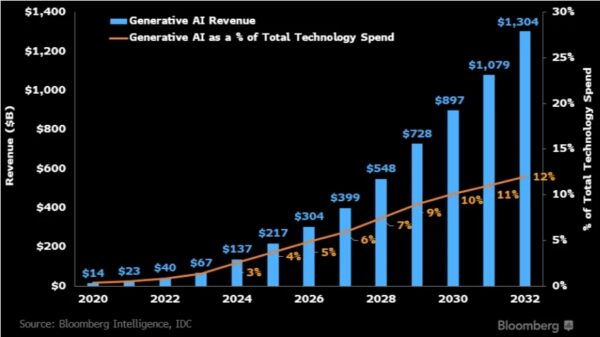
Corporate spending on artificial intelligence (AI) is poised to surge to an astonishing $10 trillion, according to research from Morgan Stanley. This dramatic increase underscores the escalating investment in AI technologies across various sectors, presenting significant opportunities for companies positioned to capitalize on this trend. Among these companies, Microsoft and Broadcom are emerging as key players, leveraging their technological leadership and infrastructure to drive growth in the burgeoning AI landscape.
Microsoft, a familiar name in software and cloud computing, is strategically integrating AI features into its product offerings. The company recently reported a 26% year-over-year increase in its cloud revenue, which is driven by the increasing demand for AI services. This momentum is evident as Microsoft continues to invest in data center capacity and sophisticated AI chips, such as the Maia 200 custom AI accelerator, which powers AI-driven tools like Copilot.
The growing adoption of these AI services is not merely a trend; it is a vital component of Microsoft’s growth strategy. Revenue from its Azure enterprise platform saw a remarkable 39% year-over-year growth, demonstrating the robust demand for cloud-based AI solutions. Additionally, Microsoft is embedding Copilot functionalities into its high-value products such as Microsoft 365 and GitHub, further enhancing their appeal and allowing for premium pricing. As a result, revenue from productivity software and business processes increased by 16% year over year last quarter, with Copilot demand playing a significant role in this growth.
With a forward price-to-earnings (P/E) ratio of 25, Microsoft’s valuation appears attractive, particularly given its track record of consistent double-digit revenue and earnings growth. As the company effectively monetizes its AI investments, it solidifies its position as a promising investment opportunity in an evolving market.
On the other hand, Broadcom is benefiting directly from the escalating investments in data center infrastructure that companies like Microsoft are making. As a leading supplier of high-performance networking components essential for connecting large clusters of chips, Broadcom stands to gain significantly from the growing demand for AI accelerators. The company’s latest financial results reflect this trend, reporting a 39% year-over-year increase in adjusted net income, reaching $9.7 billion, supported by a revenue growth of 28% to $18 billion in the same period.
Broadcom’s strong profitability is also complemented by a shareholder-friendly approach, highlighted by its consistent dividend payments, which amount to $2.8 billion in the last quarter. The company has a robust history of increasing dividends, offering a current yield of 0.73%, while returning half of its trailing earnings to shareholders. While its trailing P/E may seem high, analysts project a 31% annualized earnings growth over the next few years, making its forward P/E of 32 reasonable and likely to yield solid returns for investors.
Investors considering whether to purchase stock in Microsoft should weigh several factors. Notably, Microsoft was not included in a recent list of the top stocks recommended by The Motley Fool Stock Advisor, which identified ten other companies poised for significant returns. This raises questions about whether Microsoft’s current valuation aligns with future growth expectations.
The implications of these developments extend beyond immediate stock performance. As AI adoption accelerates, the landscape of corporate investments is likely to shift, favoring companies that provide essential technologies and infrastructure. With both Microsoft and Broadcom positioned at the forefront of this transformation, their fortunes will likely be closely tied to the broader trends in AI spending and infrastructure development.
In conclusion, the projected $10 trillion in corporate spending on AI could signal a transformative period for technology companies, particularly those like Microsoft and Broadcom. Their investments not only position them for immediate gains but also set the stage for sustained growth in an increasingly AI-driven economy. As these companies continue to innovate and expand their capabilities, they may well emerge as leaders in the next chapter of technological advancement.
See also Anthropic Launches Ad-Free Claude Chatbot, Takes Aim at OpenAI During Super Bowl
 Astera Labs Jumps 19% Amid AI Chip Surge; Analysts Project $202 Target by 2026
 1 in 5 Americans Turn to AI for Tax Filing Assistance Amid Procrastination and Stress
 Crushon AI Launches Unfiltered Roleplay Platform with Advanced Models and Privacy Risks
 AI and Robotics Revolutionize Heart Surgery: Enhanced Precision, Faster Recovery, Fewer Risks