










































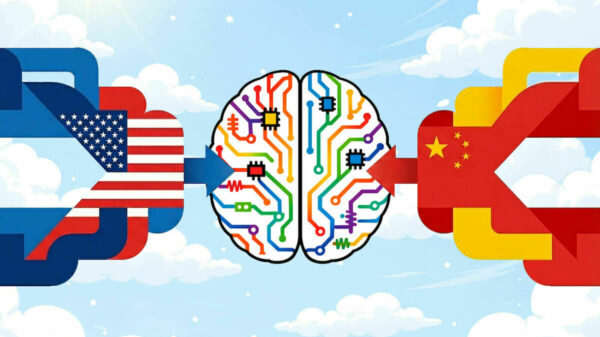







China’s ambitions to compete with the United States in artificial intelligence (AI) technology are being hindered by restrictions on access to advanced chips, according to a report by The Wall Street Journal. The U.S. export controls have created a bottleneck that discourages many Chinese companies from pursuing cutting-edge AI developments, which require substantial computing power.
“The truth may be that the gap is actually widening,” said Tang Jie, founder of the Chinese AI startup Zhipu, during a conference in Beijing. He acknowledged that while Chinese firms are making strides in certain areas, significant challenges and disparities remain.
As the U.S. continues to shape the landscape of AI technology through policy, industry and government stakeholders are closely monitoring the implications. A key event in this ongoing dialogue will be the 2026 Artificial Intelligence Summit, hosted by the Potomac Officers Club on March 18, where leaders from government and industry will discuss AI developments.
In early January, NVIDIA launched its next-generation Rubin hardware, which is designed to support high-performance AI computing. However, Chinese firms are barred from direct purchases of these advanced chips due to U.S. regulations. Instead, they must navigate indirect and often cumbersome arrangements to access the technology, complicating their efforts to develop competitive AI solutions.
The Rubin platform comprises six new chips and is engineered to deliver an AI supercomputer. It features advanced technologies such as the Transformer Engine, NVIDIA Vera CPU, and the latest generations of NVIDIA NVLink interconnect technology, all aimed at accelerating the development of sophisticated AI models.
Despite progress in improving training efficiency and releasing open-source models, leading Chinese firms like DeepSeek and Alibaba still face significant challenges. Industry insiders have noted that domestic chips in China lag behind the most advanced American hardware, making it difficult to close the performance gap.
Even with the recent approval allowing NVIDIA to sell its H200 chips to China, experts believe that this will not dramatically shift the competitive balance. The speed of innovation in the U.S. continues to outpace China, as American companies develop newer and more powerful AI systems.
The U.S. government is actively working to maintain its leadership in AI through a combination of legislative measures, executive policies, and strategic export controls. In December, a bipartisan House bill was introduced to enhance the enforcement of existing export controls, aimed at preventing sensitive technologies from falling into the hands of foreign adversaries. Additionally, a group of bipartisan senators proposed the GAIN AI Act, which would prioritize U.S. companies, startups, and universities for access to advanced AI chips before allowing exports to China or other nations viewed as potential threats.
In July 2025, the White House laid out its AI Action Plan, detailing over 90 federal policy actions focused on accelerating AI innovation, enhancing American AI infrastructure, and leading international diplomacy and security in AI. Moreover, President Trump signed an executive order in December directing the attorney general to create an AI litigation task force. This initiative aims to challenge state-level AI regulations that may stifle innovation.
As global competition in AI technology intensifies, the interplay between U.S. policies and China’s strategic responses will be critical in determining the future landscape of artificial intelligence. The ongoing developments in legislation, technology, and international relations will shape this dynamic field, highlighting the importance of collaboration and innovation in maintaining competitive advantages.
See also Apple Reveals iOS 27: Focus on Stability, AI Upgrades, and Foldable Support for 2026
 Logistics Reply Unveils GaliLEA Dynamic Intelligence to Transform Warehouse Automation
 AI Revolutionizes Advertising: Brands Must Adapt or Fall Behind in 2026 Landscape
 Meta Launches Meta Compute Initiative to Build Massive AI Infrastructure and Reduce Vendor Dependence
 Notre Dame Secures $50.8M Grant to Advance Ethical AI Framework Amidst Tech Revolution