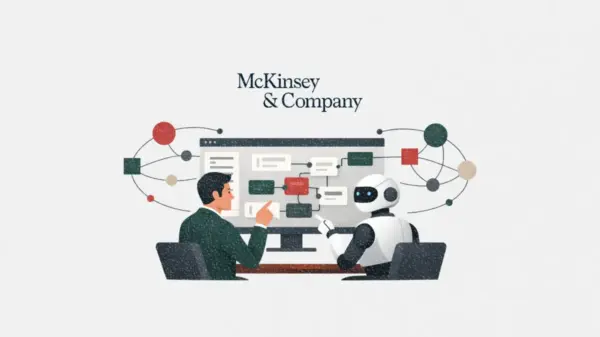
Artificial intelligence is increasingly reshaping the landscape of product launches, as highlighted by McKinsey’s recent analysis on growth and scaling. A significant reason why many product introductions falter is that market assumptions fail under real-world conditions, rather than the products being inherently weak. This challenge underscores the need for a more dynamic approach to market research, moving beyond traditional methods that often validate assumptions too early and lack ongoing adaptability.
Most enterprises accumulate go-to-market risks through a series of small, rational decisions that, when compounded, lead to significant launch exposure. According to McKinsey, organizations often misinterpret market signals, grow internal confidence without external proof, and validate assumptions prematurely. These blind spots can quietly undermine a product’s momentum long before performance metrics reveal any issues.
AI-driven market research is positioned to transform this landscape. Rather than serving as a one-time validation checkpoint, AI enables continuous testing of market assumptions as conditions evolve. This approach allows teams to surface potential risks earlier, ensuring that decisions are aligned across various stakeholders, which is crucial for effective go-to-market planning. Enterprises leveraging AI-led insights gain greater confidence in their launch strategies by identifying risks before they translate into costly post-launch corrections.
Despite the promise of AI, many organizations struggle to implement these technologies effectively, often stalling at the pilot stage due to a lack of structured decision frameworks. The key to mitigating go-to-market risks lies in adopting a comprehensive strategy that integrates AI insights with consulting judgment. This combination helps to align teams and guide real decisions, effectively turning market signals into actionable insights.
AI’s capabilities extend to creating simulated societies powered by generative agents. These systems allow organizations to explore consumer behavior at scale, enabling teams to test various scenarios without relying solely on traditional slow and biased sampling methods. With AI-moderated research, enterprises can analyze consumer sentiment and adoption patterns more accurately and in real-time, providing valuable insights that can shape product positioning and pricing strategies.
However, the implementation of AI is not without its challenges. Teams must not treat AI outputs as definitive answers; doing so can lead to overconfidence in decisions that may not be sound. Misinterpretations can arise when organizations fail to frame their questions properly, leading to biased outcomes. This highlights the importance of AI consulting in providing the necessary context and expertise to interpret AI findings accurately. By establishing a structured approach to market research, consulting helps bridge the gap between data and decision-making.
Looking Ahead
As organizations recognize the limitations of traditional market research, the role of AI is expected to expand further. Competitive advantage will increasingly depend on the ability to integrate insights into real-time decision-making rather than relying on historical data alone. This shift may lead to a notable change in how product development and marketing teams operate, as they will likely begin testing concepts and refining strategies earlier in the product lifecycle.
In the next few years, we can expect that enterprises will enhance their capabilities to manage go-to-market risks through AI-driven insights, allowing for more agile responses to market demands. By adopting a continuous research model that incorporates AI, companies will be better equipped to navigate the complexities of product launches, ultimately leading to improved outcomes and a stronger alignment with consumer needs.
See also Study Reveals AI Models Converge on Ideas, Threatening Human Creativity and Diversity
 SciSciGPT Launches as AI Research Assistant, Boosting Efficiency and Quality by 10x
 Morocco Launches JAZARI ROOT Institute to Centralize National AI Research Efforts
 Soumith Chintala Joins Thinking Machine Labs as CTO to Drive AI Innovation
 Emotionally Intelligent Workers Show No Increased AI Adoption, Study Reveals Insights