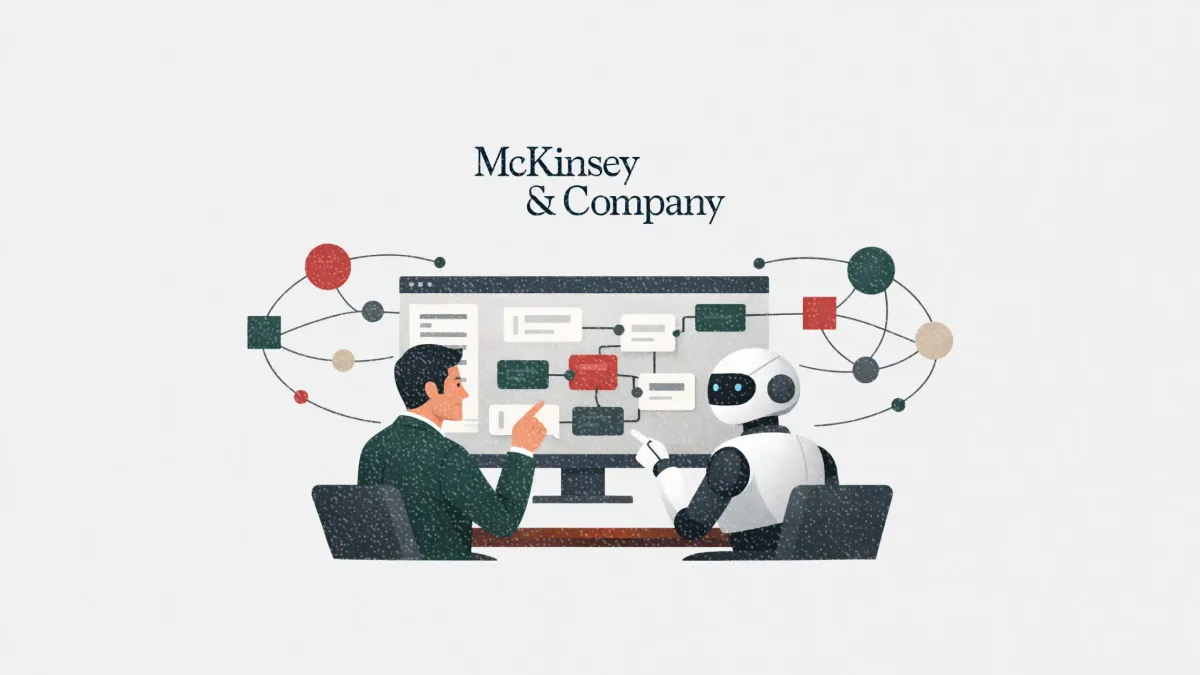
McKinsey & Company’s latest research indicates that the next phase of artificial intelligence (AI) adoption is poised to transform organizational operations significantly. With AI increasingly embedded in modern workplaces, companies are leveraging generative AI, automation tools, and predictive analytics to enhance productivity and decision-making. However, despite the widespread experimentation with AI technologies, many organizations have yet to translate these investments into tangible business results.
According to McKinsey’s “The State of Organizations 2026” report, the primary challenge lies not in the accessibility of technology but in organizational readiness. Many companies have focused on isolated AI projects rather than reengineering workflows to integrate these technologies meaningfully. This disconnect between experimentation and operational transformation may define the forthcoming phase of AI adoption.
The report highlights a growing trend toward AI-first operating models, where human-AI collaboration is reshaping enterprise workflows. As organizations recalibrate their operations around AI, significant implications arise for various teams, particularly marketing, which must adapt to a more automated environment.
Currently, while 88% of organizations are experimenting with AI, a substantial number of leaders report a lack of meaningful financial impact from these initiatives. This discrepancy often stems from an incremental approach to AI adoption, where companies deploy AI as merely an enhancement to existing workflows rather than reconsidering how work is structured across teams. McKinsey suggests that to fully leverage AI’s potential, organizations may need to fundamentally rethink their operational frameworks.
One of the most notable shifts observed is the emergence of hybrid human-AI collaboration. New AI systems are evolving to support decision-making and complex task management, rather than merely serving as automation tools. McKinsey estimates that approximately 75% of roles will necessitate new combinations of technical and human skills as companies integrate AI more deeply into their operations. This evolution requires employees to learn how to collaborate with intelligent systems, transforming their workflow dynamics.
Moreover, the report outlines the transformation of shared-services centers in response to AI advancements. Historically, these centers focused on centralizing administrative tasks like finance and HR. However, with AI’s introduction, they are becoming technology-driven hubs that can orchestrate workflows across organizations. AI-powered platforms are expected to automate routine processes, analyze operational data, and streamline tasks between human teams and digital systems. McKinsey reports that 84% of organizations plan to broaden the scope of their shared-services centers within the next one to two years, marking a significant shift in operational strategies.
As companies transition toward AI-first models, marketing teams are likely to encounter profound changes in their operational processes. AI systems are increasingly capable of analyzing customer data, generating campaign concepts, and optimizing marketing performance in real-time. This shift means that marketing workflows will become more automated, allowing for enhanced efficiency.
Additionally, human-AI collaboration is expected to reshape creative processes within marketing teams. Rather than replacing marketers, AI will act as a collaborator, helping with tasks such as ideation, analysis, and testing. The speed of campaign cycles will also increase, as AI-driven analytics enable marketing teams to test multiple variations of campaigns and adjust strategies rapidly.
To thrive in this evolving landscape, AI literacy will emerge as a core competency for marketing professionals. Those who can effectively manage data-driven campaigns alongside AI systems will find themselves at a competitive advantage. As AI transitions from being a mere productivity tool to an integral part of organizational operations, the synergy between human creativity and machine intelligence will define success in the market.
In conclusion, as organizations move from isolated AI experiments to integrated AI-first workflows, understanding the dynamics of these hybrid systems will become critical for all teams, particularly in marketing. The capacity to effectively coordinate human and AI efforts may soon be as vital as understanding the needs and behaviors of customers themselves.
See also AI’s Dual Impact on Open-Source: Anthropic Boosts Firefox While AI Floods cURL with Junk Reports
 Denver Allocates $4.6M to ComplyAI for AI-Powered Development Review System
 Nvidia Launches Open-Source AI Platform ‘NemoClaw’ Amid $2B Partnership with Thinking Machines Lab
 Microsoft Unveils Microsoft 365 E7 Plan with Copilot Cowork and Anthropic Models
 Horizon Networks Collaborates with Rhizome to Enhance Grid Planning with AI Tool