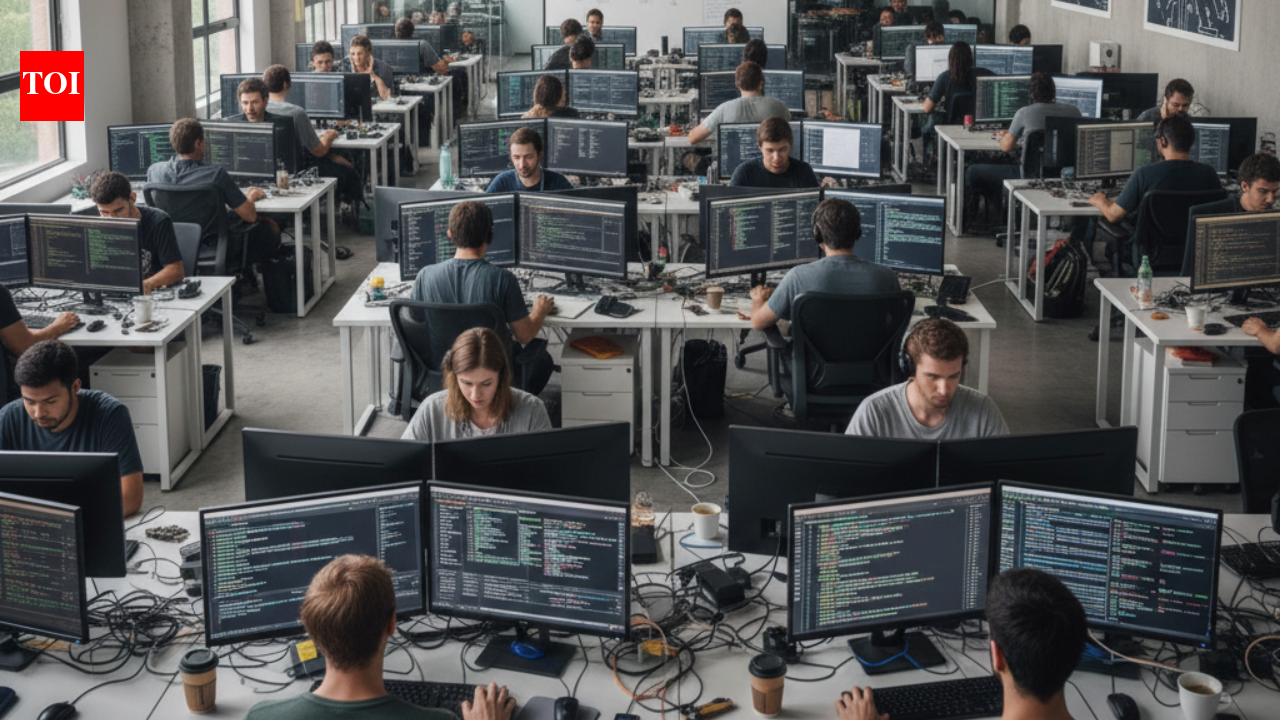
Tech leaders are increasingly divided over the role of artificial intelligence in software engineering, a rift exemplified by differing views from Nvidia CEO Jensen Huang and AI expert Andrej Karpathy. While Huang envisions a future where engineers spend “zero percent of their time doing syntax,” Karpathy, who formerly led the AI development for Tesla’s Autopilot, advocates for hands-on coding, particularly in complex projects. This debate has intensified following Karpathy’s candid reflections on his recent work with Nanochat, where he ultimately resorted to manual coding due to the inadequacies of AI-generated solutions.
In a recent post on the social media platform X, Karpathy expressed his struggles, stating he has “never felt this much behind as a programmer.” This statement stands in sharp contrast to Huang’s radical perspective that positions coding as a mere task, detracting from the broader purpose of problem-solving inherent in engineering. At Nvidia, engineers are encouraged to leverage the AI tool Cursor extensively, with Huang articulating a desire for a workforce that doesn’t engage in coding at all.
This philosophical divide highlights a persistent tension in Silicon Valley regarding AI’s integration into the software development process. Karpathy warns against an oversimplified reliance on AI tools, arguing that engineers need to actively engage with coding to build effective mental models and navigate the complexities of modern software. He described the challenges of working with “fundamentally stochastic, fallible, unintelligible and changing entities” when interfacing with AI systems, urging engineers to “roll up your sleeves to not fall behind.”
Michael Truell, CEO of Cursor, the AI assistant praised by Huang, echoed concerns about blind faith in AI-generated code. In a conversation with Fortune, he compared trusting AI for coding to constructing a house without comprehending its plumbing. He warned that as developers add complexity to their projects, they risk foundational instability if they lack a solid understanding of the underlying code.
Despite the enthusiasm surrounding AI’s capabilities, studies reveal that productivity gains in coding remain elusive. A recent METR study found that, contrary to expectations, AI assistants actually decreased the productivity of experienced developers by 19%. Research conducted by Bain & Company further described the productivity improvements in programming as “unremarkable,” despite the sector being one of the early adopters of generative AI technologies.
Even within the AI development community, the reality of coding with AI is being scrutinized. Boris Cherny, creator of Anthropic’s Claude Code, acknowledged that while “vibe coding” may be effective for prototypes and temporary solutions, it falls short when developers need to produce maintainable code. Cherny emphasized the necessity for careful consideration of every line of code, particularly when the goal is long-term viability.
While leaders like Google CEO Sundar Pichai and Anthropic CEO Dario Amodei tout significant percentages of AI-generated code—30% and 90% respectively—Karpathy’s hands-on experience raises questions about the disparity between AI’s potential and its actual efficacy in delivering production-ready solutions. As the dialogue continues, the tech industry grapples with how best to incorporate AI in a manner that enhances productivity without compromising the quality and reliability of code.
This ongoing debate underscores the broader implications of AI’s role in technology development. As companies strive to harness AI’s capabilities, the need for a balanced approach that values both human skill and machine efficiency becomes increasingly apparent. With contrasting viewpoints from influential figures in the field, the future of coding and software engineering remains a complex landscape, marked by both challenges and opportunities.
See also Anthropic Reveals AI’s Dependency on Human Input Quality in New Economic Index Report
 Nvidia Allows H200 Chip Exports to China, Unlocking $54 Billion AI Market Potential
 Tesla Revives Dojo AI Chip Project, Targets $16.5B Chip Market with AI5 Development
 Automation Revolutionizes AI Processor Interconnects, Enhancing Efficiency and Design Speed
 Microsoft’s AI Strategy Drives $281.7B Revenue, Apple Focuses on Hardware Ecosystem