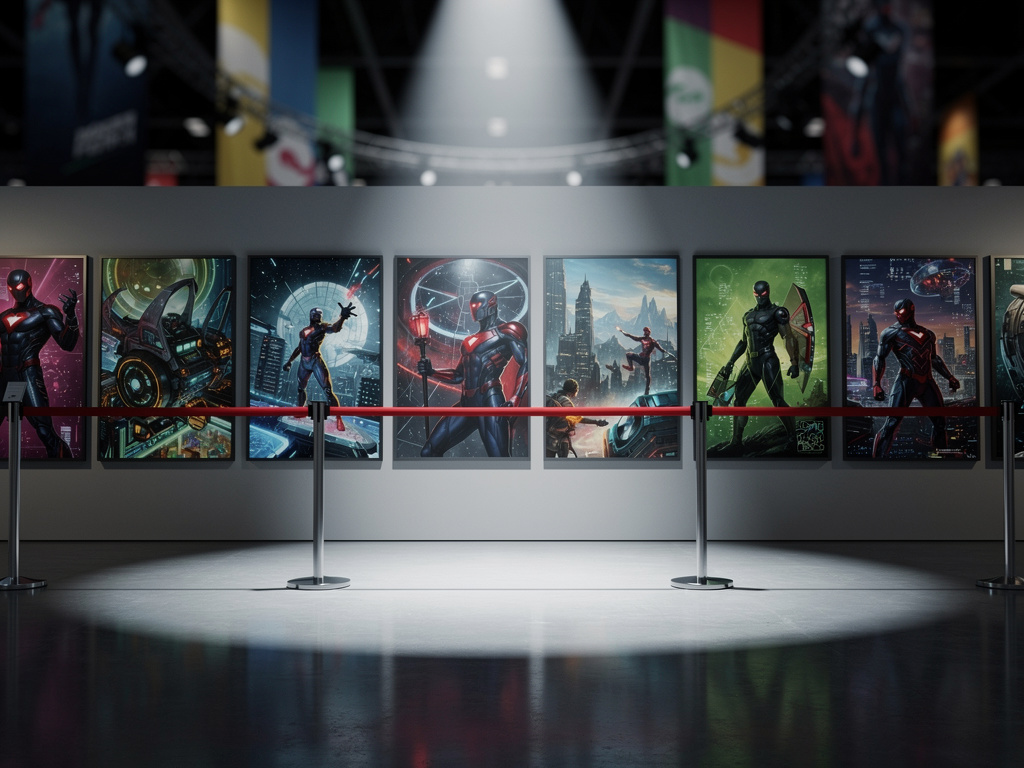
The San Diego Comic-Con, a cornerstone of pop culture where Hollywood showcases major releases and fans seek autographs, has implemented a sudden ban on artificial intelligence (AI) creations from its prominent art show. This policy, effective for the 2026 event, follows a rapid backlash from artists who voiced their concerns over generative tools like Midjourney and Stable Diffusion encroaching on creative industries. The updated guidelines, now stated on the convention’s website, clarify that “material created by Artificial Intelligence (AI) either partially or wholly, is not allowed in the art show,” marking a significant departure from previous regulations.
For years, the art show—a gallery-style exhibition held at the Manchester Grand Hyatt—allowed AI-generated works under stringent conditions: they could not be sold, had to be clearly labeled, and required credits for styles used, a policy in effect since at least 2024. However, as AI technology advanced, artists identified a loophole in early January 2026, igniting a vehement outcry on platforms like Bluesky. Within a day, organizers revised the rules, with Art Show Coordinator Glen Wooten confirming the prohibition in communications to worried creators.
Artist Outrage Ignites Policy Fire
Leading the charge against the prior allowances was concept artist Karla Ortiz, whose clientele includes major studios participating in Comic-Con. “Comic-Con deciding to allow GenAi imagery in the art show—giving valuable space to GenAi users to show slop right NEXT to actual artists who worked their asses off to be there—is a disgrace!” Ortiz expressed on Bluesky. She emphasized that Comic-Con represents a pivotal venue for comic artists, illustrators, and writers, noting that the inclusion of AI felt like a violation amid diminishing opportunities in the industry.
Comic artist Tiana Oreglia also rallied fellow artists, drafting a letter to organizers that highlighted the potential dangers of AI’s involvement. “I think we should be standing firm especially with institutions like Comic-Con which are quite literally built off the backs of artists,” she told 404 Media. Other creators shared similar sentiments: Ron Marz described the initial decision as “gross,” while Tyler Crook declared he would refrain from submitting work. Ethan Sacks speculated that if boycotts emerged, a reversal might follow, as reported by The Comics Beat.
Jim Zub, a writer for Conan the Barbarian comics and a confirmed attendee for 2026, praised the new direction in comments to CNET. “Hundreds of thousands of people attend San Diego Comic-Con each year, and the excitement that generates isn’t because they’re eager to meet a computer spitting out homogenized slop,” he said, underscoring the importance of human creativity in the event.
Inside the Organizer’s Pivot
Wooten, the art show director, provided insight into the decision, sharing emails with The Comics Beat. He explained that the previous regulations were intentionally designed to deter artists from submitting AI-generated works by prohibiting sales. “Those two sentences have been in the rules for a few years to make people not want to put AI art in… It has worked—no one has put AI artwork in. But the issue is becoming more of a problem, so more strident language is necessary: NO! Plain and simple,” Wooten wrote, noting his personal connection to the issue as his wife is an artist.
In 2025, 116 artists reportedly sold over 800 items through quick sales or silent auctions, underscoring the show’s significance in celebrating human creativity despite its evolution into a media giant. Although the organizers did not issue a formal press release, the update followed considerable social media pressure, as outlined by Cartoon Brew. While Comic-Con International did not respond to inquiries from multiple outlets, Wooten’s candid discussions illustrated a growing consensus against AI, influenced by changing public perceptions.
Broader Industry AI Encroachment
Ortiz emphasized the tangible impacts of AI in the industry, referencing Marvel’s AI title sequence for Secret Invasion and Coca-Cola’s AI-driven Christmas advertisements. Netflix utilized AI imagery for El Eternauta, with CEO Ted Sarandos claiming it enhances content quality rather than merely reducing costs, according to CNET. The gaming sector also faced criticism, exemplified by the Indie Game Awards rescinding nominations for Clair Obscur: Expedition 33 due to AI placeholders.
Such cases contribute to fears of job losses. “Suddenly the duration of projects are cut,” Ortiz remarked, “They got generative AI to generate a bunch of references… ‘We already did the initial ideation, so just paint this.’” Oreglia lamented that AI diminishes the essence of art, arguing that “everything interesting… gets stripped away and turned into vapid facsimiles.” The 2023 actors’ strike further highlighted similar concerns across Hollywood.
DC Comics has also established its stance at New York Comic Con, with President Jim Lee asserting that no AI will be used in storytelling or art—”not now, not ever,” emphasizing the importance of authenticity over aggregation.
As Comic-Con joins a growing list of conventions enforcing similar bans, GalaxyCon has enacted a zero-tolerance policy for AI at its 2026 shows following a controversial incident at Dragon Con. “GalaxyCon has a long, proud history of supporting artists… as the fight against unethical AI continues,” they stated. Emerald City Comic Con has also implemented a no-AI policy, while ReedPop events, including New York Comic Con, prohibit AI sales on exhibition floors and artist applications. However, inconsistencies persist, as evidenced by the presence of AI in dealer areas at other conventions, raising the stakes for Comic-Con’s reputation.
The enforcement of the ban will fall to the Art Show Coordinator, with no clear methods outlined for detecting AI amidst increasingly realistic generative technologies. Wooten expressed a desire for his biggest issue to involve mislabeled prints rather than AI monitoring. The prohibition pertains to the art show specifically and may not extend to Artists’ Alley or dealers, where previous rules mirrored submission restrictions.
As anticipation builds towards Comic-Con 2026, scheduled for July 23-26, attention will focus on compliance with this new policy and the broader implications for the industry. For insiders, this episode underscores the potential influence artists can wield when united, but it also reveals vulnerabilities in analog verification methods. Conventions must navigate the delicate balance between attracting fans and honoring creator loyalty in an age where machines increasingly mimic human creativity.
See also OneTrust Reveals 5 Key Governance Shifts for AI Accountability by 2026
 India Proposes Inclusivity Stack for AI Governance to Enhance Digital Accessibility
 Ireland Ranks First in AI Investment with $202.5M Workday Innovation Boost
 Anthropic Embeds Consciousness Clause in Claude’s New AI Constitution for Ethical Governance