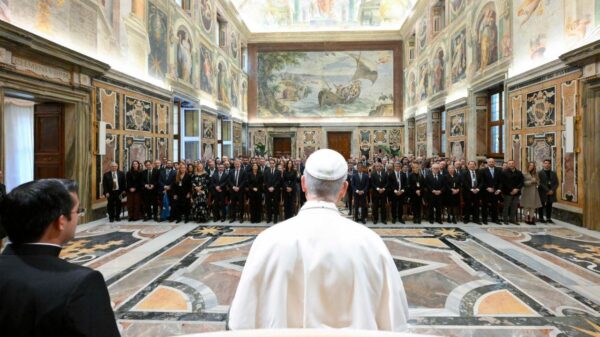
Church leaders in northern Thailand are emphasizing the need for stronger formation in conscience, values, and ethical responsibility as digital technologies and artificial intelligence (AI) continue to evolve. This call to action was underscored during the Catholic Church’s 2026 Annual Regional Seminar held in Nakhon Phanom Province at the beginning of this year, which attracted nearly 200 priests, five bishops, and delegates from neighboring Laos.
With a focus on the theme derived from the recent Vatican document Antiqua et Nova: Note on the Relationship Between Artificial Intelligence and Human Intelligence, the seminar sought to update clergy on the implications of emerging technologies. The main speaker, Fr. Joseph Anucha Chaiyadej, Secretary General of the Office of Social Communication of the Bishops’ Conference, addressed the Church’s perspective on these developments during his keynote address.
Fr. Joseph highlighted the fundamental characteristics and limitations of artificial intelligence, clarifying that “artificial intelligence does not possess true intelligence, consciousness, or comprehension.” He stressed that AI should be viewed not as the “subject” but rather the “object,” devoid of conscience or life. He presented the Vatican document as a “moral compass” for clergy and pastoral ministers operating within digital environments, urging them: “Don’t let algorithms write your story; use technology to serve humanity.”
The seminar also tackled significant challenges posed by AI, such as the phenomenon of “truth decay.” Fr. Joseph warned about the damaging impact of deepfakes and filter bubbles, which can distort public discourse and manipulate perceptions. He referenced the Vatican document’s caution regarding deepfakes, noting, “While the images or videos themselves may be artificial, the damage they cause is real, leaving ‘deep scars in the hearts of those who suffer it’ and ‘real wounds in their human dignity.’”
Moreover, he pointed out that filter bubbles contribute to an echo chamber effect, isolating individuals by reinforcing their pre-existing beliefs. The Vatican’s Towards Full Presence: A Pastoral Reflection on Engagement with Social Media describes this personalization of information as a barrier to genuine dialogue.
In light of these challenges, Fr. Joseph urged clergy and Church institutions to adhere to principles of transparency, inclusion, and accountability—concepts echoed in global discussions about AI ethics. He reminded attendees that Antiqua et Nova emphasizes the necessity for growth in human responsibility, values, and conscience in tandem with technological advancements.
As the seminar drew to a close, Fr. Joseph underlined the importance of transparency in AI systems, particularly in high-stakes areas like education, governance, and social services. He advocated for efforts to “open the black box” of AI processes, which are often obscured, to ensure ethical oversight and informed decision-making. “Only through clarity, ethical oversight, and human discernment can technology truly serve the dignity of the person and the mission of the Church,” he stated.
This regional seminar reflects the Catholic Church in northern Thailand’s commitment to fostering a critical, faith-based dialogue surrounding artificial intelligence, rooted in responsibility, wisdom, and fidelity to the Gospel in the digital age. As AI continues to penetrate various facets of society, the Church aims to guide its community in navigating these complexities with informed ethical perspectives.
See also OpenAI Launches Codex-Spark on Cerebras Chips, Achieving 1,000 Tokens per Second
 Seize the Moment: Buy Nvidia and Micron Now as AI Demand Soars Amid Supply Constraints
 Leonardo.ai, Midjourney, and Stable Diffusion: 2026’s Top AI Image Generators Ranked
 Students Confront AI Ethics at Oglethorpe’s ‘On Mutual Ground’ Event with Leading Experts
 Apple Faces 5% Stock Plunge Amid Siri Delays, FTC Censorship Claims, and Investor Pullbacks