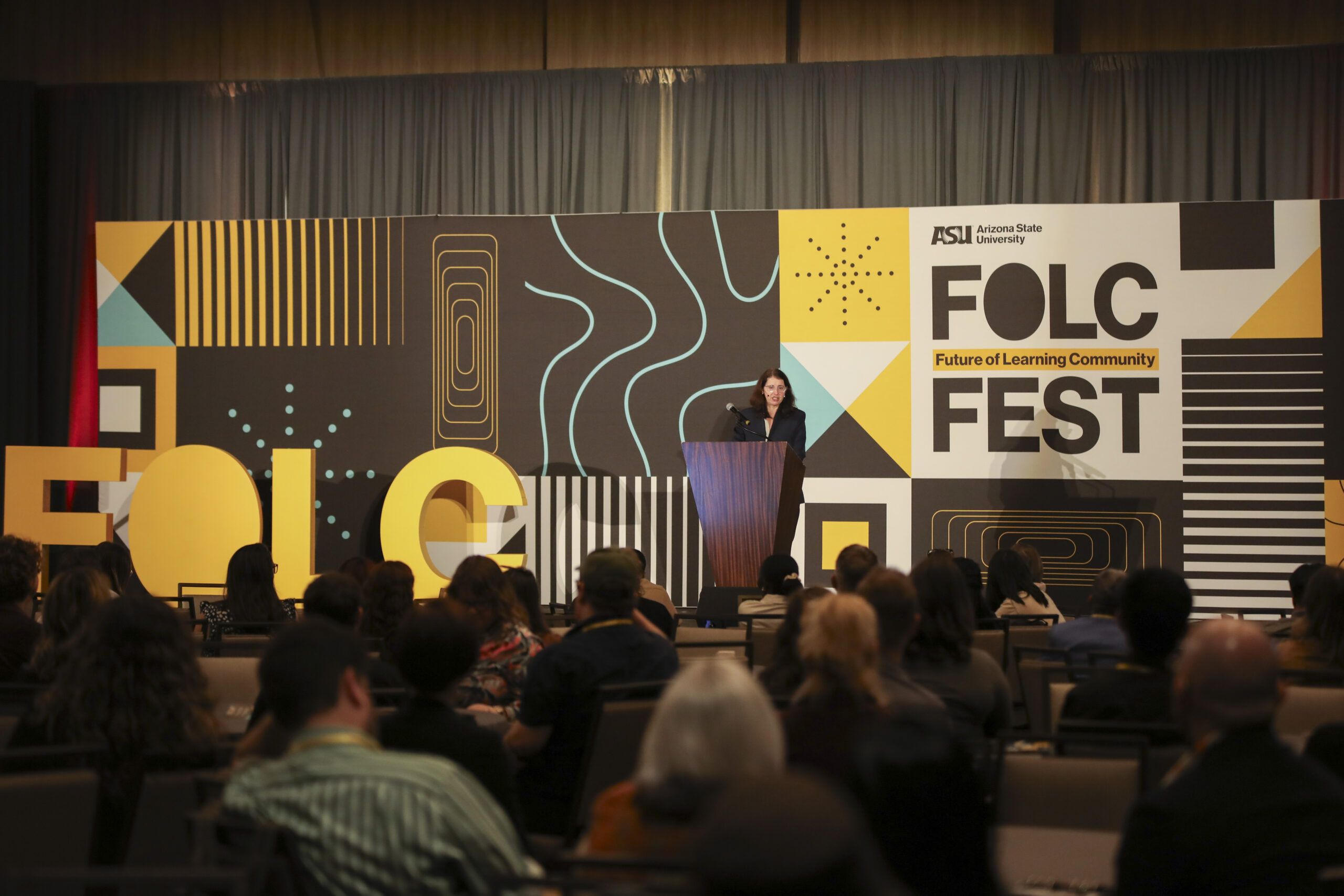
Arizona State University (ASU) hosted its annual Future of Learning Community (FOLC) Fest, gathering over 800 faculty, staff, and learning professionals to discuss the evolving landscape of education. The event, organized by ASU Academic Enterprise’s Office of the University Provost, focused on enhancing educational accessibility and effectiveness, aligning with the university’s Changing Futures campaign, which emphasizes responsible scaling of impact and improved outcomes for diverse learner populations.
“Changing Futures comes to life when we design learning around how people actually live and learn,” said Gemma Garcia, executive director of learning technology in the Academic Enterprise and co-chair of FOLC Fest. The two-day conference explored how innovative learning design and emerging technologies, particularly artificial intelligence (AI), can facilitate lifelong learning and career transitions.
This year’s keynote speakers emphasized the dual nature of learning as both a technological and human endeavor. Isabelle Hau, executive director of the Stanford Accelerator for Learning, opened the event by discussing “The Next Intelligence,” where she argued that relational intelligence—the human ability to connect and collaborate—will be pivotal in an AI-driven world. Hau highlighted the need for systems and technologies that enhance human relationships rather than undermine them.
On the second day, ASU University Professor of Technology and Innovation Sethuraman “Panch” Panchanathan participated in a fireside chat with ASU Executive Vice President and University Provost Nancy Gonzales. Their discussion centered on the transformative role AI plays in education and the responsibility of universities to create scalable opportunities. “My conversation with Panch reinforced what makes universities so critical to the future of innovation,” Gonzales noted, emphasizing the importance of collaboration in driving social and economic progress.
Throughout the event, various sessions showcased ASU’s ongoing academic innovations, aided by support teams leveraging faculty expertise to create learning opportunities beyond traditional degree pathways. Noteworthy presentations included research on instructor modeling videos, presented by Bobbi Doherty, which could enhance teaching presence and boost learner persistence in online courses. Additionally, Marissa Huth shared her experiences integrating the generative AI tool Claude into Canvas workflows, providing valuable insights for instructional designers navigating AI-supported course production.
Collaborative projects also emerged, such as a poster presentation by online course manager Nicholas Rogers and senior instructional designer Alejandra Dashe, which examined the redesign of a health and wellness course. Their work, developed with faculty member Teri Taylor, utilized evidence-based frameworks like Backward Design and Universal Design for Learning, showcasing how AI and aligned learning objectives can enhance accessibility and learner success.
Interactive demonstrations throughout FOLC Fest further illustrated how data-driven decision-making and AI applications can improve educational outcomes. Pallavi Sharma, manager of analytics, showcased “ABCD: AnyBody Can Dashboard,” a live demonstration using Google Looker Studio to integrate various data sources for enhanced program visualization. Rachel Reed and Vanshaj Gupta explored how learner data flows from classroom experiences to inform leadership decisions, underlining the proactive strategies necessary for addressing early vulnerabilities in new programs.
Accessibility remained a key theme, with demonstrations on AI’s potential to create inclusive learning environments. Rogers and instructional designer Jaclyn Campbell presented Access Granted, which employs Claude AI to ensure compliance with WCAG standards. Dashe and her team also introduced the “PDF Remediator,” an AI tool designed to simplify the production of accessible course materials.
The overarching takeaway from FOLC Fest was the imperative for educational systems to adapt to learners’ lives rather than the reverse. Sessions demonstrated how ASU faculty are employing data, accessibility-first design, and targeted AI applications to lower barriers and support learners flexibly and effectively. “That’s what Changing Futures looks like in practice,” remarked Danielle McNamara, director of the Learning Engineering Institute and co-chair of FOLC Fest. “When learning systems adapt to people’s lives, we expand access, reduce barriers, and create pathways that support learners wherever they are and wherever they’re headed.”
See also AI Transforms Learning Space Design: Join Experts on March 11 for Insights and Innovations
 Milwaukee’s Five Universities Partner with Northwestern Mutual to Advance AI Initiatives
 MagicSchool Shelves AI Chatbot Raina Amid Parental Protests Over Student Safety Concerns
 Bharat Bodhan AI Conclave 2026 Unites 3,100 to Advance AI in Education Ecosystem
 Ex-Google AI Leader Warns Law, Medical Degrees May Lose Value Amid Rapid AI Advances