In a shifting landscape marked by intense competition, major tech firms are adopting a ‘frenemy’ strategy, transforming former rivals into partners to navigate the burgeoning demand for artificial intelligence (AI) solutions. This strategic pivot underscores the necessity of investment and collaboration in the face of surging market needs.
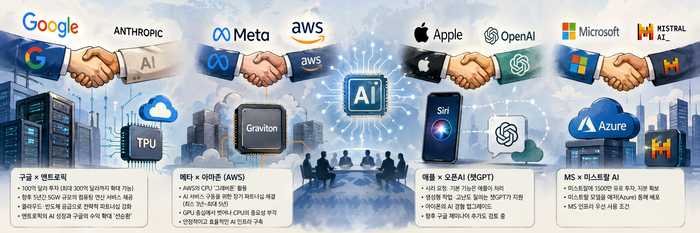
Recent developments highlight this trend, notably the $10 billion investment deal between Google LLC and Anthropic, which carries a valuation of $350 billion. This partnership could potentially escalate to $30 billion based on performance metrics. Google aims to extend its role beyond mere investment, focusing on strengthening its partnership by providing cloud services and semiconductors, particularly offering Anthropic 5 gigawatts (GW) of computing power over the next five years—enough to power approximately 3.8 million households.
As Anthropic’s AI agent, Claude, garners attention in the tech sector, the partnership allows Google to enhance its competitive edge. Analysts suggest that by preemptively supplying infrastructure, Google is reinforcing a positive feedback loop that secures premium customers while expanding revenue streams.
Another significant alliance is forming between Meta Platforms, Inc. and Amazon Web Services (AWS). Meta plans to utilize AWS Graviton, a CPU designed by AWS, to power various AI services. Although the financial specifics of the contract remain undisclosed, reports indicate that the term spans at least three years, potentially extending to five.
Previously, the spotlight was firmly on graphic processing units (GPUs), pivotal for training and inference in large language models (LLMs). However, the emergence of AI agents has shifted focus to the importance of central processing units (CPUs), which are essential for the stable coordination of overall systems. This change emphasizes the evolving requirements for AI infrastructure.
In a strategic move to enhance on-device AI capabilities, Apple Inc. has implemented a multi-layered structure within its Apple Intelligence framework. When a user interacts with Siri, the voice assistant, basic functions are handled by Apple Intelligence, while more complex queries are redirected to ChatGPT. This integration has not only upgraded the AI experience on iPhones but has also provided OpenAI with substantial distribution power. Reports suggest Apple is considering the addition of Google Gemini as another AI option alongside its existing collaboration with OpenAI.
Meanwhile, Microsoft has entered an AI partnership with Mistral AI, investing €15 million, approximately 2.59 billion won, to secure an equity stake. This collaboration stipulates that Mistral AI prioritize Microsoft infrastructure, particularly by distributing its AI models via Microsoft Azure, the company’s cloud platform.
An industry insider commented on the changing dynamics, stating, “Ultimately, it is practical because the investment is recovered through performance.” This reflects a broader shift: companies that once vied for market share are now recognizing the need for efficient infrastructure borrowing as the industry landscape evolves.
As these alliances take shape, they signal a new era in the tech industry where collaboration may be as vital as competition. With AI demand escalating, the strategic partnerships formed today could well dictate the future landscape of artificial intelligence, shaping innovations and market dynamics for years to come.
See also Schwarz Group Invests EUR 500M in AI Start-Up Cohere, Acquires Aleph Alpha
 China Halts Meta’s $2B Acquisition of AI Startup Manus Over Investment Prohibitions
 Elon Musk Files Lawsuit Against OpenAI Over Non-Profit Mission Shift Ahead of Trial
 Cohere Acquires Aleph Alpha in $20 Billion Sovereign AI Merger with Dual HQs
 OpenAI Revises Pact with Microsoft, Opens Access to Other Cloud Providers