



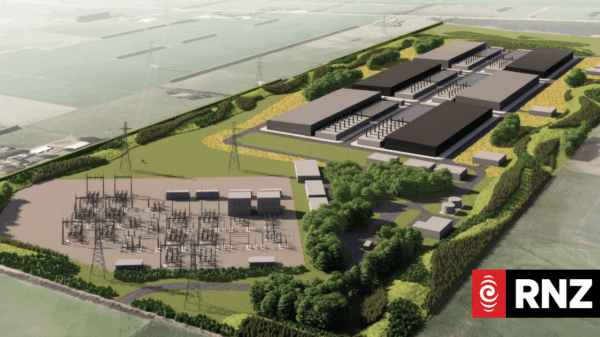












































A new $3.5 billion data centre poised to become New Zealand’s first “artificial intelligence factory” is set to be constructed near Invercargill. Datagrid New Zealand has received resource consent for the expansive 78,000 square-metre facility in Makarewa, north of Invercargill. Founded in 2021 by Rémi Galasso and Malcolm Dick, the company aims to leverage New Zealand’s renewable energy resources to support burgeoning AI technologies.
“This approval is the result of years of dedication and collaboration, and we are excited about the transformative impact this project will have on Southland and New Zealand as a whole,” Galasso stated. The facility will feature a dedicated substation, consuming 280 megawatts of power, making it the second-largest electricity user in the country, following the Tiwai Point aluminium smelter. In total, the centre will account for approximately 6 percent of New Zealand’s annual electricity demand.
The demand for data centres is growing in New Zealand, driven by international companies looking to utilize the country’s abundant renewable electricity while reducing their climate impact. Technology expert Mark Laurence noted that the term “AI factory” was popularized by NVIDIA CEO Jensen Huang to describe data centres constructed specifically for AI applications, including training and inference. AI training refers to the process of teaching a model patterns through data sets, while inference applies this knowledge.
Laurence illustrated this with the example of ChatGPT, explaining that when OpenAI prepares to train a new version of the model, it processes extensive data over months using powerful data centres. Each interaction with ChatGPT or similar tools represents an inference, where users input queries and receive responses.
As the head of Ten Past Tomorrow, a strategic advisory and AI training firm, Laurence emphasized the increasing demand for both training and inference capabilities as AI tools become more widely adopted. He highlighted New Zealand’s geographical and climatic advantages for hosting data centres, stating that the average annual temperature in Invercargill is about 10°C, allowing for efficient cooling of the facilities using outside air.
The Invercargill site is not the first major data centre in the country; Microsoft opened a data centre in Auckland in 2024, and Amazon Web Services invested $7.5 billion to establish a cluster of data centres in the same city. Once fully operational, the Datagrid facility is expected to handle approximately 960 million ChatGPT conversations per day, translating to 5 to 10 percent of global daily interactions with the AI chatbot.
While Microsoft and AWS are providing data outputs to local organizations, Datagrid plans to export its data offshore via a subsea cable to serve international markets. However, the company has yet to disclose its client roster or the specific applications for the data generated at its centre.
Laurence expressed concerns over New Zealand’s “AI illiteracy,” urging for government measures to ensure the nation reaps the benefits of the technology being developed in facilities like Datagrid’s. He noted that New Zealanders are not receiving training at a pace comparable to other developed nations, hindering the country’s ability to remain competitive in the evolving AI landscape.
“We’re still a nation that’s using AI to change the tone of an email and summarise long documents, while the rest of the world is pulling ahead,” he said. He argued that while the infrastructure being built is promising for the economy, it must be accompanied by national training initiatives that enable New Zealanders to effectively leverage the outputs of such facilities.
Sheree Casey, CEO of the Southland Business Chamber, described the new data centre as a pivotal opportunity for the region’s economic diversification. Upon reaching operational status, Datagrid anticipates generating hundreds of millions annually in data service exports and contributing approximately $60 million to the GDP each year. The construction phase alone is projected to create over 1,200 skilled jobs and inject around $4 billion into the local economy.
Transpower, New Zealand’s national grid operator, has expressed confidence that the grid can accommodate the energy demands of the new data centre. Executive General Manager of Grid Development, Matt Webb, indicated that numerous renewable energy projects, including significant wind and solar operations in Southland, are underway to meet future energy needs. He noted that the confirmed electricity load projected for Datagrid would bolster investor confidence in renewable energy initiatives across the region.
As New Zealand positions itself to embrace the AI revolution, the successful establishment of the Datagrid facility could serve as a catalyst for broader economic growth, provided that adequate training and educational frameworks are implemented to equip the workforce with the necessary skills for this rapidly evolving sector.
See also Bank of America Warns of Wage Concerns Amid AI Spending Surge
 OpenAI Restructures Amid Record Losses, Eyes 2030 Vision
 Global Spending on AI Data Centers Surpasses Oil Investments in 2025
 Rigetti CEO Signals Caution with $11 Million Stock Sale Amid Quantum Surge
 Investors Must Adapt to New Multipolar World Dynamics