











































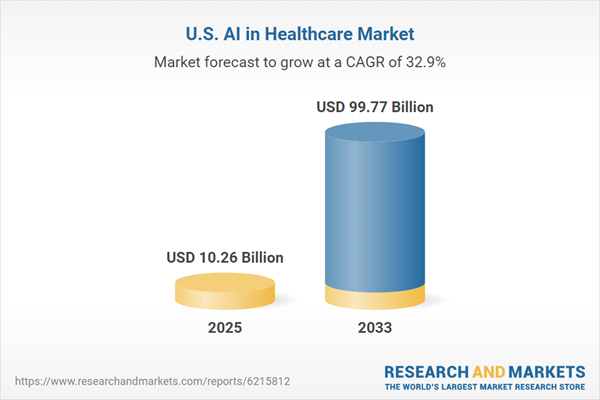
The United States AI in healthcare market is poised for remarkable growth, projected to surge from $10.26 billion in 2025 to $99.77 billion by 2033, representing a compound annual growth rate (CAGR) of 32.88%. This expansion is largely driven by digital transformation, increasing demand for precision medicine, supportive government initiatives, and the pressing need for cost-effective healthcare solutions. AI applications, including predictive analytics and medical imaging, are enhancing care efficiency and accuracy, while AI-driven clinical decision-making and advancements in natural language processing (NLP) are pushing the industry forward. However, challenges such as data privacy concerns, regulatory compliance, and high implementation costs persist as significant hurdles.
The rise of AI in healthcare is underpinned by its ability to process vast amounts of data, providing healthcare professionals with insights that enable early disease detection and personalized treatment plans. Hospitals and research facilities increasingly harness AI for various applications, including drug development, virtual health assistants, and clinical diagnostics. As American healthcare systems embrace digital transformation, AI is emerging as a vital tool for improving productivity, enhancing patient outcomes, and fostering innovation in medical and administrative processes.
Many factors are driving the growth of the AI in healthcare sector in the U.S. The demand for improved diagnostic accuracy, the proliferation of digital health technologies, and advancements in machine learning and data integration are contributing to this upward trajectory. The FDA’s backing of AI-based medical devices, coupled with government initiatives that promote healthcare digitization, further accelerates market growth. As healthcare costs rise and the availability of big data expands, the United States is cementing its position as a global leader in healthcare innovation, fueled by the accelerated integration of AI.
Market Dynamics and Innovations
One of the key growth drivers is the expanding integration of AI into clinical decision-making. Advanced algorithms are revolutionizing how healthcare is delivered, assisting physicians in diagnosing conditions, predicting treatment outcomes, and identifying high-risk patients with enhanced accuracy. In April 2025, Tempus partnered with Illumina to enhance precision medicine by merging AI-driven clinical data with genomic sequencing, representing a significant advancement in personalized treatment decisions. This partnership exemplifies the increasing reliance on AI for decision support, which ensures better efficiency and reduced diagnostic errors.
The rapid advancement of personalized and precision medicine is another important catalyst for AI adoption in the U.S. healthcare market. AI’s capability to analyze genetic, environmental, and lifestyle data allows for the creation of individualized treatment plans tailored to each patient’s specific profile. By combining genomic sequencing with machine learning, clinicians can more accurately predict disease risk and select appropriate therapies. AI-powered precision medicine platforms are being effectively utilized across various medical specialties, such as oncology and cardiology, to optimize care delivery. The ongoing digitization of health records provides a robust basis for predictive modeling, facilitating a shift from reactive to preventive and personalized care.
Furthermore, advancements in NLP are transforming the use of unstructured clinical data within the healthcare sector. NLP algorithms can analyze physician notes, medical transcripts, and patient communication to extract vital insights for diagnosis and treatment. These developments streamline documentation and enhance care coordination, ultimately improving decision-making accuracy. California recently enacted Assembly Bill 3030, which mandates healthcare providers to disclose the use of generative AI in patient communication, highlighting the growing integration of AI-driven language tools in healthcare.
Despite these positive trends, the U.S. AI in healthcare market faces notable challenges. Data privacy and regulatory compliance are paramount concerns, as AI systems require extensive access to sensitive patient information. Compliance with regulations such as HIPAA, alongside emerging state-specific laws, complicates the landscape. Ensuring transparency in AI practices while safeguarding patient data remains critical. The lack of standardized data-sharing protocols also limits interoperability, hindering the full potential of AI.
High implementation costs and a shortage of skilled professionals further impede growth. Many healthcare organizations, particularly small and mid-sized hospitals, struggle to afford the necessary investments in AI technologies, leading to uneven adoption. Additionally, the workforce must navigate a steep learning curve to effectively use AI tools, resulting in a gap between technological innovations and their clinical application. Collaborative efforts between technology providers and medical practitioners are crucial to address these barriers and promote equitable access to AI resources.
As the landscape evolves, major players in the market, including Amazon Web Services Inc., Google Inc., and Nvidia Corporation, are poised to drive further innovation in AI applications for healthcare. The robust growth of the U.S. AI healthcare market signals a transformative shift in how healthcare is delivered, promising improved patient outcomes and operational efficiency. As the sector continues to embrace AI technologies, the implications for better healthcare delivery and system performance are significant.
See also SPLICE Software Elevates AI Customer Engagement with Unified Voice and Strategic Partnerships
 Salesforce Shares Drop 0.8% Amid AI Concerns as Traders Await Key U.S. Data
 ConnectOne Bancorp Completes $14B Deal, Focuses on AI Efficiency and Shareholder Returns
 Wipro Launches AI-Powered Operating Model for Enterprise Transformation Across Four Key Functions
 Oracle Launches AI Platform for Life Sciences, Tackles Data Fragmentation with $523B Backlog