






















































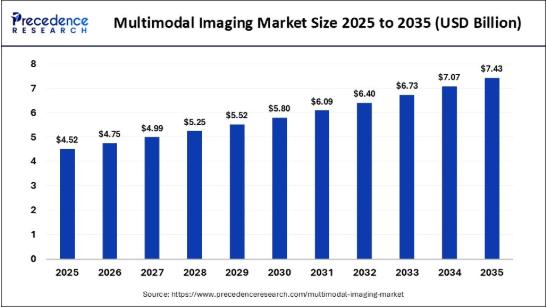
The global multimodal imaging market is projected to witness significant growth, increasing from an estimated value of USD 4.52 billion in 2025 to USD 7.43 billion by 2035. This growth represents a compound annual growth rate (CAGR) of 5.10% from 2026 to 2035, according to a report by Precedence Research. The surge is driven by rising healthcare demands, the adoption of advanced hybrid imaging systems, and a shift towards non-invasive diagnostic techniques across hospitals, clinics, and research centers worldwide.
As healthcare needs become more complex, the demand for precise and non-invasive diagnostic methods is calling for an increased reliance on multimodal imaging techniques. These methods are essential for improving diagnostic accuracy and enhancing patient outcomes, especially in the context of rising chronic diseases including cancer, neurological disorders, and cardiovascular issues.
Technological advancements, particularly the integration of artificial intelligence (AI) with imaging systems, are significantly contributing to this market expansion. AI enhances diagnostic precision and treatment planning, providing a clearer understanding of patient conditions. Moreover, the increasing emphasis on non-invasive diagnostic methods that offer high spatial resolution and functional imaging is propelling market demand.
Emerging markets, particularly in the Asia-Pacific region, are poised to provide substantial growth opportunities. This growth is largely attributed to increasing healthcare investments and greater access to advanced medical technologies. As the Asian middle class expands, there is a growing emphasis on AI-driven personalized medicine, which presents new applications for multimodal imaging in targeted treatments.
North America currently holds the largest share of the multimodal imaging market, accounting for approximately 40% of the global market share in 2025. Factors fueling this dominance include high rates of chronic diseases, a large aging population, and significant investments in healthcare infrastructure. The U.S. market, valued at USD 1.36 billion in 2025, is expected to reach USD 2.27 billion by 2035, with a CAGR of 5.26%.
In contrast, the Asia-Pacific region is expected to exhibit the fastest growth, with a projected CAGR of 5.5% from 2026 to 2035. Key drivers include rapid adoption of AI technologies in healthcare, growing government funding, and an expanding population with better access to healthcare services. Countries like India are at the forefront, thanks to affordable scanning technologies, governmental initiatives such as ‘Make in India,’ and improved healthcare access driving market expansion.
The market segmentation reveals that the PET/CT segment dominated in 2025, holding a 42% share due to its powerful combination of functional and anatomical data that enhances diagnostic accuracy. Meanwhile, the PET/MRI segment is expected to grow at the fastest rate, with a CAGR of 4.3%, thanks to its ability to align MRI’s structural insights with PET’s quantitative pathology.
Oncology remains the largest application area, accounting for 38% of the revenue in 2025, driven by the methods’ effectiveness in early detection and image-guided therapies. In cardiology, multimodal imaging is gaining traction, growing at a CAGR of 4.5%, as it helps in the early assessment and management of heart conditions.
Hospitals represent the largest end-user of multimodal imaging technology, holding 55% of the market in 2025, owing to high patient volumes and access to advanced equipment. The growth of diagnostic imaging centers is also notable, with an expected CAGR of 4.7%, as they increasingly adopt PET-CT and PET-MRI technologies to meet rising patient demand.
Leading companies in the multimodal imaging space include Siemens Healthineers, GE Healthcare, and Philips Healthcare, each contributing innovative solutions that enhance diagnostic capabilities. For example, Siemens offers Nexaris Therapy Suites that integrate different imaging modalities to optimize surgical workflows, while GE develops AI foundation models to facilitate advanced imaging analysis.
As the multimodal imaging market continues to evolve, the integration of advanced technologies, along with a focus on personalized medicine, sets the stage for improved healthcare outcomes. This dynamic landscape presents both challenges and opportunities, as stakeholders navigate the complexities of modern healthcare demands and technological capabilities.
See also OpenAI’s Generative AI Users Face Potential Copyright Liability Amid Legal Uncertainties
 Suno and Udio Settle $500M Lawsuits with Major Labels as AI Music Industry Evolves
 Stanford’s Iro Armeni Reveals Innovative Techniques in 3D Vision Models and Generative AI
 OpenAI Launches GPT-5.4 Mini and Nano for Free Users with 2x Speed Boost
 OpenAI Unveils GPT-5.4 Mini and Nano for Faster, Cost-Effective AI Workflows















