





















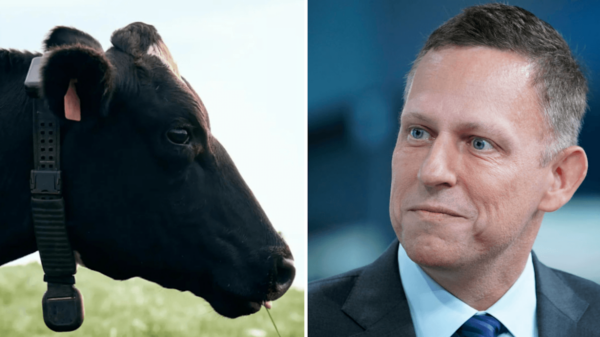





















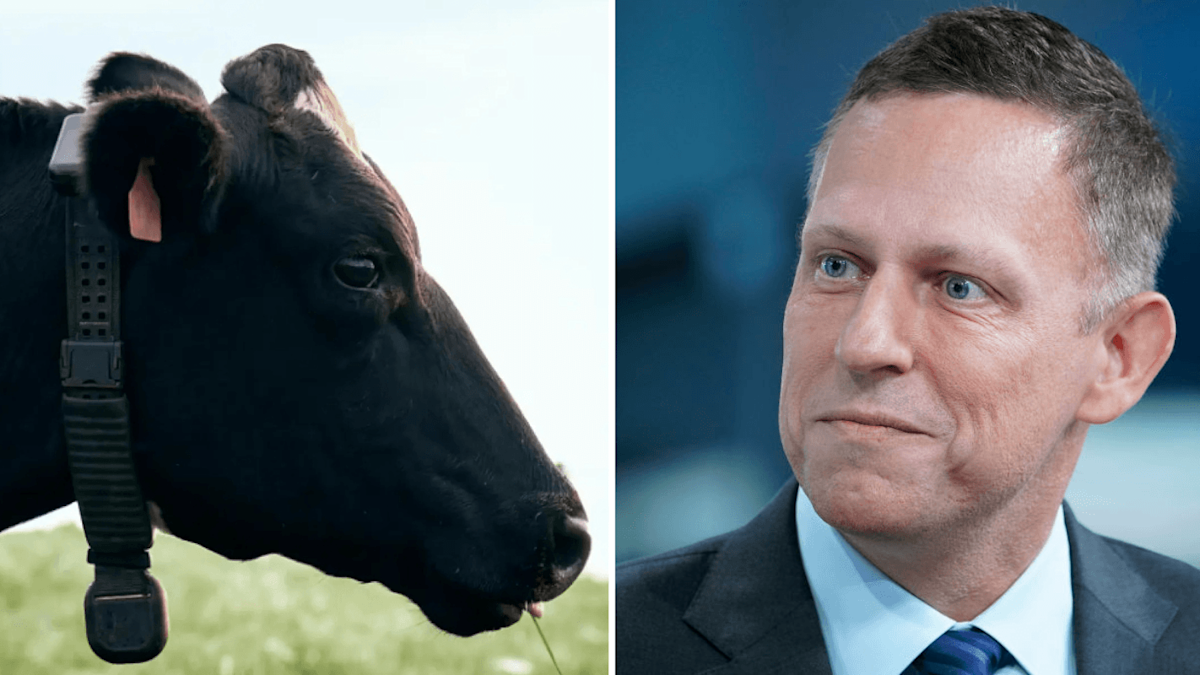
An artificial intelligence startup specializing in smart collars for cattle is poised to achieve a valuation of over $2 billion, attracting significant interest from top venture capital firms. Halter, a New Zealand-based company, is reportedly in discussions for a new funding round, led by billionaire Peter Thiel’s Founders Fund, that would effectively double its valuation from its previous $1 billion mark set just months ago.
The latest funding round is said to be oversubscribed, implying that demand from investors is so high that the ultimate size of the financing is still undetermined. Halter’s innovative collars are solar-powered and utilize AI to create virtual fences for cattle, eliminating the need for traditional physical barriers. Farmers can connect the collars to their smartphones, enabling them to monitor herd locations and health metrics via an application. The technology even allows ranchers to manage cattle movement remotely through vibrations and audio cues emitted from the devices.
This advanced approach to livestock management extends beyond conventional collars, which typically focus on tracking digestion and breeding cycles. Halter’s model positions itself as a comprehensive herd management solution, with costs estimated between $5 to $8 per animal per month. “The goal was to make pasture farming more sustainable and productive using technology,” said founder Craig Piggott in a recent interview.
In June, Halter successfully raised $100 million in its previous funding round, led by BOND, at a valuation of around $1 billion. The company has since expanded its operations by opening a new office in Colorado and is emphasizing a growth strategy aimed at the U.S. market. This momentum is particularly striking in the context of a broader downturn in agricultural technology, where many startups have faced challenges, including bankruptcy and decreased venture capital investment.
Despite these hurdles, the precision agriculture sector—focused on using technology to optimize farming operations—continues to show rapid growth potential. Industry analysts project the global precision agriculture market will reach approximately $9.5 billion by 2025, with estimates suggesting it could exceed $17 billion by 2031. Efficient farming methods could lead to more stable food prices, although the relationship remains complex and evolving.
Although Halter operates as a private entity, its soaring valuation highlights a renewed investor interest in precision agriculture. Several publicly traded companies are already entrenched in this sector and stand to benefit from the technological advancements driving the market. Deere & Co. (NYSE: DE), for instance, has established a dedicated segment for Production and Precision Agriculture. Its See & Spray technology, which utilizes cameras and machine learning to pinpoint and target weeds, has effectively halved the use of non-residual herbicides across millions of acres.
Merck & Co. (NYSE: MRK), while primarily known for its pharmaceutical operations, has also made significant strides in agricultural technology. The company’s Allflex and SenseHub divisions monitor over 2 million dairy cows globally, having sold more than 500 million animal identification tags annually. Merck’s acquisition of the Antelliq Group for $2.4 billion in 2019 underscores its commitment to this market, though Halter’s unique virtual fencing capability differentiates it from traditional offerings.
In addition, companies like AGCO Corp. (NYSE: AGCO) and CNH Industrial (NYSE: CNH) are enhancing their portfolios with digital farming tools, while Corteva (NYSE: CTVA) invests in precision application technologies and partnerships with satellite imagery providers. These developments illustrate the varied landscape of agtech, where even amidst setbacks, select companies like Halter are drawing serious investment and attention.
Thiel’s backing of Halter signals a shift in perception that precision agriculture may hold significant promise beyond being a niche market. With captivating advancements like AI-driven cattle collars and substantial investments in established public companies, the agtech sector is increasingly viewed as a field worthy of close scrutiny as it evolves.
See also Finance Ministry Alerts Public to Fake AI Video Featuring Adviser Salehuddin Ahmed
 Bajaj Finance Launches 200K AI-Generated Ads with Bollywood Celebrities’ Digital Rights
 Traders Seek Credit Protection as Oracle’s Bond Derivatives Costs Double Since September
 BiyaPay Reveals Strategic Upgrade to Enhance Digital Finance Platform for Global Users
 MVGX Tech Launches AI-Powered Green Supply Chain Finance System at SFF 2025