







































In a strategic announcement at the World Economic Forum in Davos on January 21, 2026, Lenovo Group Ltd.’s Chief Financial Officer, Winston Cheng, unveiled an ambitious plan to position the company at the forefront of the artificial intelligence landscape. Rather than developing its own foundational large language model (LLM), Lenovo aims to collaborate with various global LLM providers, positioning itself as a neutral player amid the complex web of international regulations governing AI technology.
Cheng emphasized this “orchestrator approach” during his discussions with Reuters, highlighting the importance of partnerships over proprietary development. Unlike competitors such as Apple Inc., which primarily utilizes OpenAI and Google Gemini for AI applications, Lenovo, the world’s largest personal computer vendor by shipments, plans to integrate AI across its extensive product range, including laptops, smartphones, and wearables. “We are the only company besides Apple with significant market share across both PCs and mobiles, and in the open Android and Windows ecosystems,” Cheng stated.
Potential partners identified by Cheng include firms like Humain in Saudi Arabia, Mistral AI in Europe, and Chinese companies Alibaba Group Holding Ltd. and DeepSeek, signaling Lenovo’s intent to diversify its geographic and regulatory engagement in the AI space.
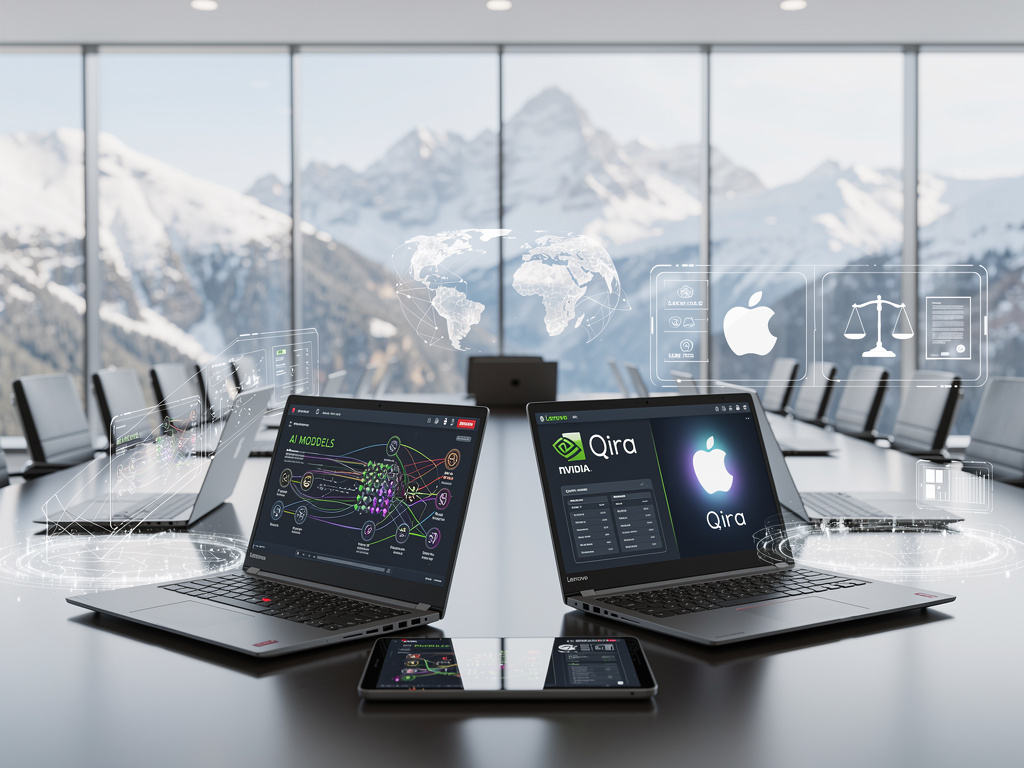
Cheng’s remarks reflect Lenovo’s transformation from a hardware-focused enterprise to an AI enabler. Earlier this month, the company introduced Qira, a cross-device intelligence platform that aims to facilitate seamless integration with external LLMs. This innovation, according to Cheng, is crucial for appealing to both consumers and enterprises, offering continuity across devices.
Lenovo’s strategy also addresses growing geopolitical tensions and data sovereignty concerns, allowing for localized model deployment without the complications of developing proprietary systems. Analysts note that this strategy mirrors broader trends in the tech industry, as hardware manufacturers increasingly seek to act as integration layers rather than creators of foundational models. Cheng, who took on the CFO role in April 2025 after working in tech investment banking, stressed the importance of maintaining cost discipline amid the current AI hype.
During the briefing, he also pointed out the rising costs of memory chips and indicated that these increases would likely be passed on to consumers. Additionally, Cheng warned of a potential “AI bubble” impacting equity markets, advising the industry to scrutinize operating costs alongside capital expenditures.
The foundation for Lenovo’s strategy was laid at CES 2026, where the company showcased its Hybrid AI Advantage portfolio, featuring advanced inferencing servers like the ThinkSystem SR675i, equipped with AMD Epyc CPUs and Nvidia Corp.’s Blackwell GPUs. These servers are designed specifically for LLM workloads in both data center and edge environments. Executive Vice President Ashley Gorakhpurwalla noted, “Enterprises today need AI that can turn massive amounts of data into insight the moment it’s created.”
At the Las Vegas event, Lenovo highlighted Qira as a “personal AI super agent,” capable of extending functionality across Motorola smartphones and PCs to create a unified intelligence platform. Lenovo Chairman Yuanqing Yang articulated the vision of AI enhancing creativity by drawing from “individual habits, language, and experiences.” This hybrid model, which combines on-device processing with cloud capabilities, prioritizes privacy and low latency, essential for both enterprise analytics and consumer applications.
Lenovo’s partnership with Nvidia aims to enhance its infrastructure capabilities, focusing on liquid-cooled hybrid systems for rapid data center deployment. Cheng mentioned plans to extend these capabilities into Asia and the Middle East, aligning local manufacturing with regional sovereignty requirements.
This multi-partner approach not only safeguards Lenovo against U.S.-China tensions but also ensures tailored AI solutions for diverse markets. Cheng reiterated the focus on optimizing “silicon, operating systems, and diverse AI models,” allowing Lenovo to scale its Qira platform globally without navigating complex regulatory challenges. In contrast to Apple’s more closed ecosystem, Lenovo’s open approach invites wider developer engagement and innovation.
Financially, Lenovo reported strong traction, with Q2 fiscal 2025/26 revenue reaching a record $4.1 billion in infrastructure, bolstered by increased sales to AI cloud providers. The company reported a staggering 154% year-over-year growth in liquid cooling solutions, underscoring the demand for efficient AI hardware in the enterprise sector.
As Lenovo positions itself at the intersection of hardware and AI, its xIQ platforms and AI Factory services focus on integrating agentic AI into sectors like sports, exemplified by the Football AI Pro initiative for the FIFA World Cup 2026, which analyzes 2,000 metrics in real time.
Lenovo’s server offerings, including the ThinkEdge series for edge inferencing, are also strategically designed to address the shift from LLM development to deployment—a phase that can significantly inflate operational costs. Industry experts have highlighted the SR675i’s capabilities for running full LLMs in sectors such as healthcare and finance, while advanced cooling solutions and as-a-service pricing models mitigate energy and capital expenditure challenges.
As companies in the Asia Pacific gear up for increased AI investments, Lenovo’s partnerships and innovations position it to capture emerging opportunities in a rapidly evolving landscape. Cheng’s caution about potential market bubbles serves as a reminder for stakeholders to maintain a balanced perspective on AI-related investments. As Lenovo pursues its orchestrator role, it has the potential to redefine how hardware interacts with AI, creating cohesive experiences across devices while competitors grapple with more singular approaches.
See also NVIDIA Optimizes Visual Generative AI on RTX PCs with New ComfyUI and Model Enhancements
 OpenAI Reveals Key Techniques to Identify AI-Generated Images Online
 ChatGPT’s GPT-5.2 Cited AI-Generated Grokipedia, Raising Research Accuracy Concerns
 AI Models Surpass Average Human Creativity Among 100,000 Participants in New Study