

































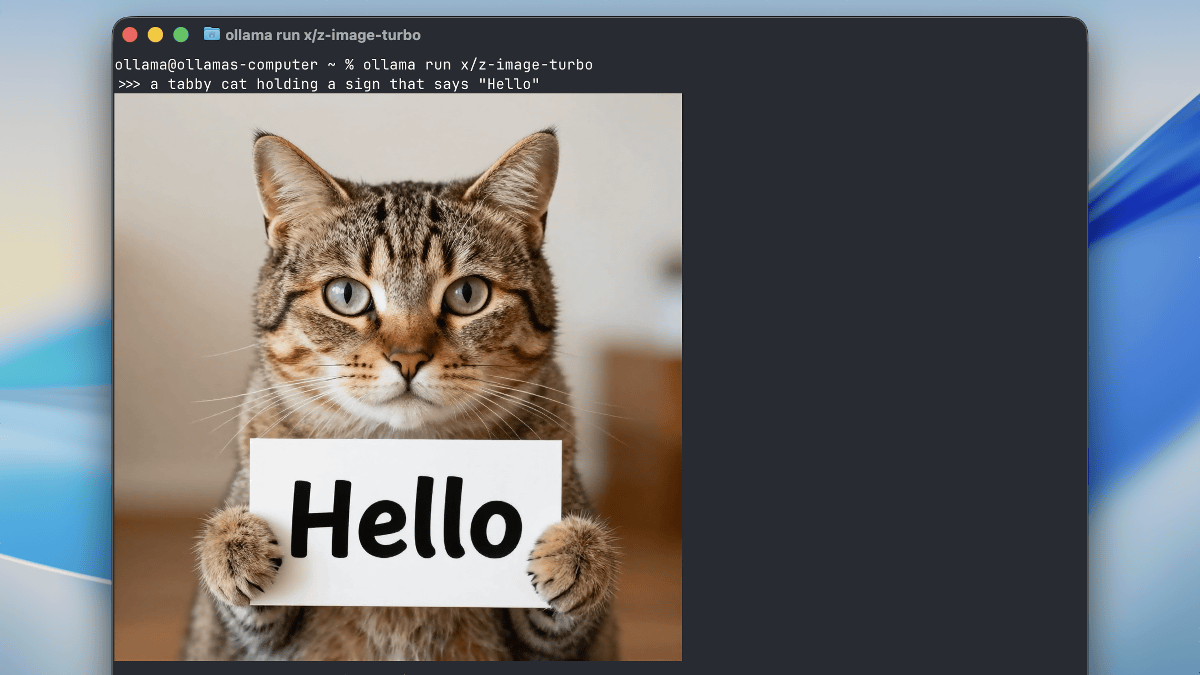
On January 20, 2026, Ollama announced the addition of image generation capabilities as an experimental feature in its application, which allows users to run various artificial intelligence models locally. Currently, the macOS version of Ollama supports image generation through two models: FLUX.2 [klein] and Z-Image-Turbo.
Ollama, designed to facilitate the use of large-scale language models in local environments, released a graphical user interface (GUI) app in July 2025. This GUI allows users to easily download and operate various open models, including Llama, Gemma, and gpt-oss. At that time, the app also enabled users to load images into the multimodal AI system and request detailed analyses of those images.
The latest update enhances the Ollama platform by introducing image generation features, providing users with new creative possibilities. As of the announcement date, the image generation capabilities are still in the experimental phase. Users can leverage FLUX.2 [klein], which offers both 4 billion and 9 billion parameter models, and supports various quantized model formats including fp8 and bf16. Z-Image-Turbo, on the other hand, is optimized for running fp8 and bf16 models.
This move by Ollama signifies its commitment to expanding the functionalities of its AI tools. For users, the ability to generate images directly within the app opens up new avenues for creative expression and practical applications. Users can display generated images inline by employing terminal emulators such as Ghostty or iTerm2.
Ollama’s developments come at a time when the demand for localized artificial intelligence solutions is rapidly increasing. Many users prefer running AI models on their own machines to maintain privacy, reduce latency, and avoid dependency on cloud services. The integration of image generation capabilities aligns with this trend, offering users a powerful tool to harness AI’s creative potential without relying on external servers.
Looking ahead, Ollama has indicated that it plans to support image generation on Windows and Linux platforms in the future. Additionally, there are intentions to introduce image editing functions, further broadening the application’s utility. As the company continues to innovate, it remains well-positioned to attract a growing user base among developers, artists, and general consumers interested in leveraging artificial intelligence in their projects.
In summary, the recent enhancements to Ollama’s platform underscore a significant shift in the accessibility of AI technologies. With the experimental introduction of image generation, Ollama not only enriches its user experience but also reinforces the ongoing evolution in the AI landscape, emphasizing local deployment as a key focus for future advancements.
See also Lenovo Reveals AI Strategy at Davos, Partners with Global Language Models Amid Regulations
 NVIDIA Optimizes Visual Generative AI on RTX PCs with New ComfyUI and Model Enhancements
 OpenAI Reveals Key Techniques to Identify AI-Generated Images Online
 ChatGPT’s GPT-5.2 Cited AI-Generated Grokipedia, Raising Research Accuracy Concerns
 AI Models Surpass Average Human Creativity Among 100,000 Participants in New Study