















































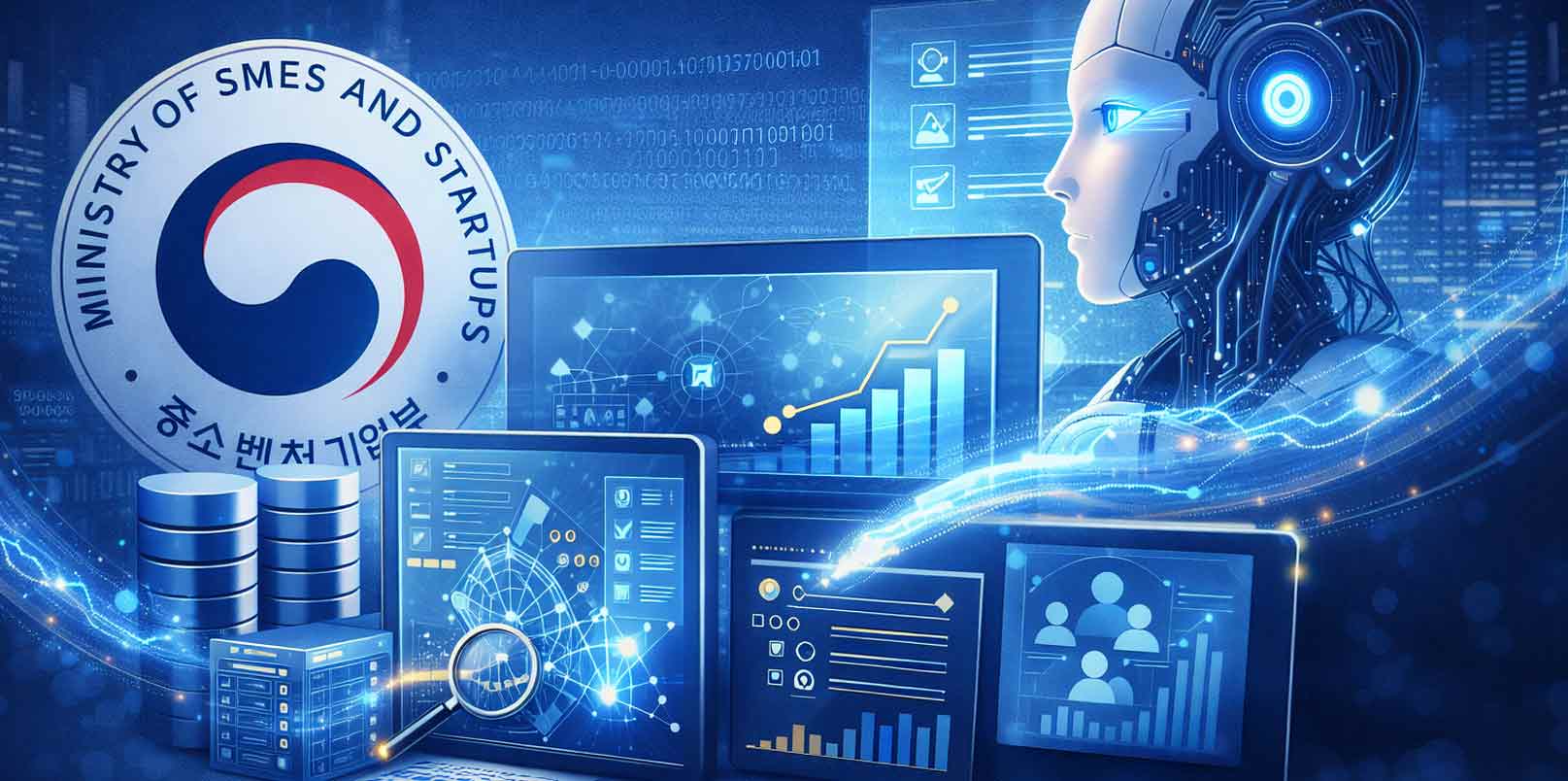
South Korea is exploring the potential of artificial intelligence (AI) to enhance government support for small and medium-sized enterprises (SMEs). The Ministry of SMEs and Startups (MSS) is transforming its approach from merely digital administration to a more sophisticated, algorithm-assisted policy delivery system. This shift focuses not just on the amount of support available but on how effectively and efficiently it can be tailored to meet the needs of those who require it.
On February 12, the MSS hosted a communication roundtable at the Global Startup Center in Gangnam, Seoul, showcasing six startups selected through the “OpenData X AI Challenge.” This initiative aims to combine public datasets with private AI technology to create practical solutions for SMEs and small business owners.
A total of 124 AI startups submitted applications after recruitment began in November of the previous year. Following a rigorous selection process that included document screening, expert evaluations, and user testing, two companies were chosen in each of three categories: customized government support program recommendations, customized consulting for small business owners, and SME growth and risk prediction. The selected startups include PersonaAI and Lumos in the support recommendation category, Heum and MyMeta for consulting, and Ambigen and Clotho for growth and risk prediction.
Each selected team received full datasets from institutions such as the Korea Technology and Information Promotion Agency for SMEs and the Small Enterprise and Market Service, along with funding of KRW 10 million to develop their AI models. The MSS stated that these companies would also receive ongoing support for commercialization, research and development (R&D), workforce development, and access to policy financing, including loans and guarantees.
This initiative reflects a broader strategy to utilize public data not just for transparency but for operational improvement. Public institutions have made datasets accessible to AI startups with the explicit aim of solving real-world challenges faced by SMEs and small business owners. In the support recommendation category, startups have developed platforms allowing business owners to submit company profiles or histories and receive tailored government program recommendations. In the consulting category, the developed solutions focus on issues such as commercial area analysis, tax-related assistance, and financial monitoring. Meanwhile, in the growth and risk prediction category, AI models have been tailored to forecast SME performance and identify potential risks.
However, the initiative also highlighted some structural challenges. Minister Han Seong-sook acknowledged that certain government datasets could not be fully disclosed, which posed limitations for the startups. “The needs of SMEs and small business owners could have been defined more specifically and clearly,” she noted. Following the same sentiment, Seo Beom-seok, a team leader at SK Broadband and evaluator for the challenge, remarked, “While government data was provided, there was insufficient data reflecting the management conditions of small business owners. For a more complete service, a government-level framework for collecting such data is necessary.”
Startup representatives emphasized the importance of user-friendly solutions. Kim Kyung-jin, CEO of Lumos, mentioned that his company integrated regional SME office programs to include provincial firms, while PersonaAI’s leadership stressed the need for tools that could be used “easily and quickly” without requiring extensive training. Infrastructure-related issues, such as latency with government servers, were also raised as points of concern.
The OpenData X AI Challenge not only positions AI startups as private-sector innovators but also as partners in government policy infrastructure. Selected companies gain access to institutional datasets and follow-up commercialization support, which creates reference cases tied directly to public-sector implementation. This initiative signifies a shift in SME policy delivery, as Minister Han compared the current first-come, first-served method of allocating support programs to competing for concert tickets. The implication is that AI could enable more structured allocation or matching mechanisms for available support.
The scale of SME involvement in the South Korean economy makes this experiment significant. With 124 AI startups participating, the depth of domestic AI capacity engaging with public-sector use cases is evident. Globally, governments are exploring frameworks for AI governance and regulatory protocols. Korea’s pragmatic approach involves starting with controlled, proof-of-concept initiatives in SME policy areas before assessing operational feasibility. The mention of the AI Basic Act during the roundtable suggests that governance compliance will increasingly intersect with the deployment of these services.
As the initiative progresses, it illustrates an emerging market for GovTech and policy-linked AI services, providing a potential model for policymakers around the world. While the experiment remains in its early stages, its success hinges on data completeness, infrastructure scalability, and the ability of these solutions to move beyond pilot phases. The ministry has indicated that it will refine related policies based on field-level feedback to enable AI startups to gather practical references and grow.
In conclusion, the OpenData X AI Challenge represents a controlled test rather than a structural overhaul of SME policy. However, if this approach is sustained, it could mark a gradual transition from reactive administration to a more predictive, data-driven allocation of support. For now, South Korea has made a tangible step by actively integrating AI startups into the framework of SME policy and inviting them to contribute to its evolution.
See also Maharashtra Government Invests Rs 22 Lakh in AI Systems for Higher Education Reforms
 Albanian Actress Anila Bisha Sues Government Over AI Virtual Minister Image Use
 National AI Computing Center Set to Launch on Reclaimed Land in Haenam by 2029
 Massachusetts Launches OpenAI-Powered ChatGPT Assistant for 40,000 State Employees
 Government Mandates AI-Generated Content Labelling, Reduces Takedown Times to 2-3 Hours