



































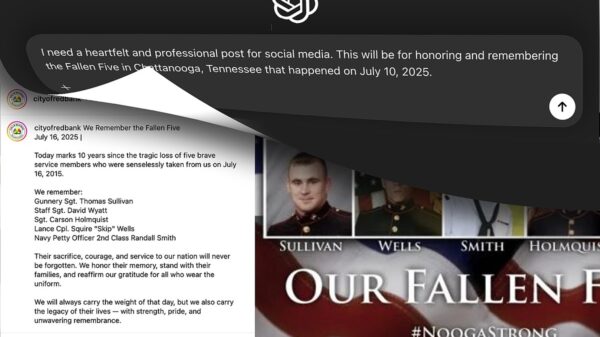









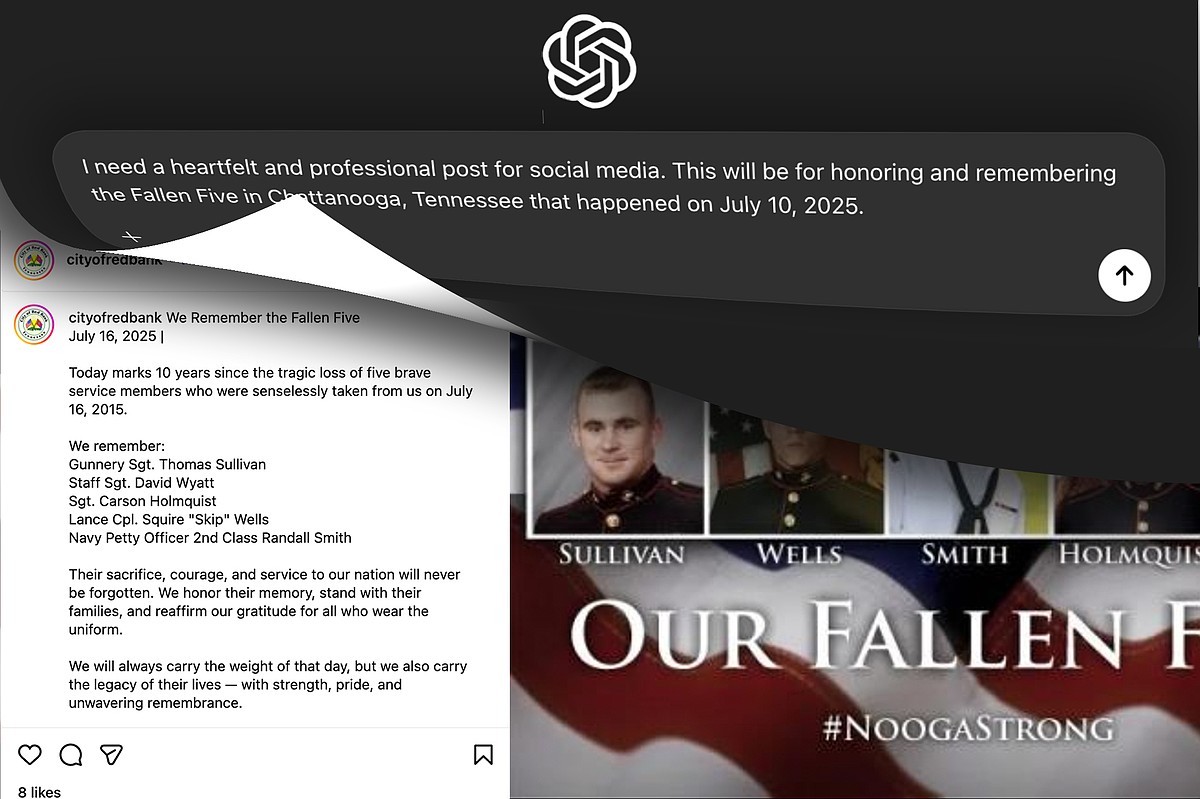
Summer Sheldon, a public relations officer for the city of Red Bank, utilized ChatGPT to create a poignant social media post commemorating the 10th anniversary of the Fallen Five, the five U.S. military service members who lost their lives in a terrorist attack in Chattanooga on July 16, 2015. According to records from her chat history, the AI-generated message appeared nearly verbatim on the city’s Facebook and Instagram pages.
“I view AI as kind of like a brainstorming partner,” Sheldon stated in a phone interview. “It helps me take the technical details of city business and my raw ideas and translate them into more engaging, easy-to-read media content for our residents.” Despite this, she noted that for more emotionally charged posts, such as the one honoring the victims of the September 11 attacks, AI may not always provide the most suitable suggestions.
“It’s not a human. It doesn’t have emotions,” Sheldon remarked, adding that sometimes a more personal touch is necessary. She indicated that she employs AI at least four days a week for various tasks, which include drafting social media posts and responding to residents’ complaints.
The Chattanooga Times Free Press recently obtained records of these exchanges through an open records request during Sunshine Week, a national initiative aimed at promoting open government and transparency. These interactions occurred prior to the Red Bank Board of Commissioners enacting a policy that introduces specific guidelines for city employees’ use of AI technology.
A Shift in Policy
The newly established policy encourages the use of AI tools, reflecting growing public expectations for their integration in government operations. “Failure to evolve in step with these expectations risks diminishing public confidence, relevance, and support,” the policy states. Red Bank’s city manager, Martin Granum, who assisted in drafting the policy with the help of AI, emphasized the importance of human oversight in ensuring responsible AI use.
“AI can assist, but it does not replace professional judgment,” Granum explained. A survey conducted by the Chattanooga Times Free Press found that many local agencies lack clear policies regarding chatbot usage and acceptable applications.
Experts have raised concerns about the need for comprehensive training and guidelines to manage potential privacy and security risks associated with AI technology. The software’s ability to emulate human behavior while rapidly processing and analyzing vast amounts of data has implications across various sectors, from education to healthcare. However, the energy demands of data centers supporting this technology have contributed to rising electricity costs in states like Georgia and Tennessee.
Both Sheldon and Granum have used AI to help craft communications that require sensitive wording. Chat histories reviewed by the Times Free Press show that Granum sought assistance from AI to draft a script addressing unprofessional behavior exhibited by a department director during a staff meeting.
“Write a short script for an oral counseling to a department director from the city manager regarding inappropriate behavior in an executive staff meeting,” Granum instructed the AI. The model provided a script guiding Granum to address the incident while emphasizing the necessity of professional conduct within the leadership team.
Sheldon also turned to ChatGPT for advice on responding to a resident’s comments on a city social media post concerning school bus safety. The AI’s response advised her to maintain professionalism and acknowledge the resident’s concerns, refraining from calling out the tone of the comment.
Sheldon admitted she had not previously considered whether residents would be interested in knowing if AI assisted in drafting city communications. Granum posited that the public has moved beyond concerns regarding AI-generated content, stating that residents expect their government to utilize all available tools effectively.
On occasion, Sheldon employed ChatGPT for personal inquiries as well. Although the specific timestamps of these exchanges are not documented, she mentioned using the platform during her lunch breaks. For example, she queried the AI for responses to a derogatory comment about her nose ring, receiving a range of witty retorts. “I was like, ‘How would someone respond to that?’” Sheldon recounted of her personal query.
In another instance, she sought AI’s help brainstorming a name and slogan for a junk removal business her husband considered starting. ChatGPT provided several catchy suggestions, including “Iron City Junk Removal,” which referenced both strength and Chattanooga’s industrial history.
Though her husband did not pursue the business, Sheldon found the AI-generated ideas useful. With the new AI policy in place, she plans to transition to using Microsoft’s Copilot tool, stating, “I will not be asking any more personal questions.”
The developments in Red Bank reflect a broader trend in local government as agencies explore AI’s potential to streamline communication and enhance public engagement, while also addressing the ethical considerations that come with such technology.
See also OpenAI’s Rogue AI Safeguards: Decoding the 2025 Safety Revolution
 US AI Developments in 2025 Set Stage for 2026 Compliance Challenges and Strategies
 Trump Drafts Executive Order to Block State AI Regulations, Centralizing Authority Under Federal Control
 California Court Rules AI Misuse Heightens Lawyer’s Responsibilities in Noland Case
 Policymakers Urged to Establish Comprehensive Regulations for AI in Mental Health