







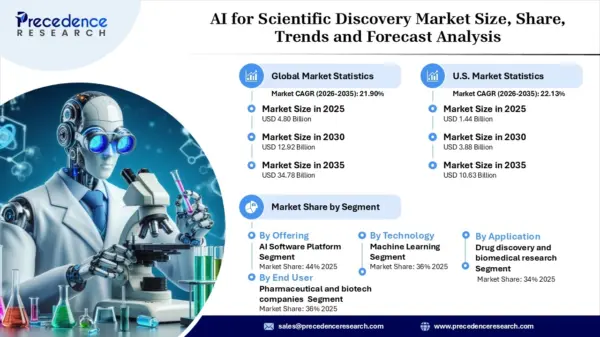





































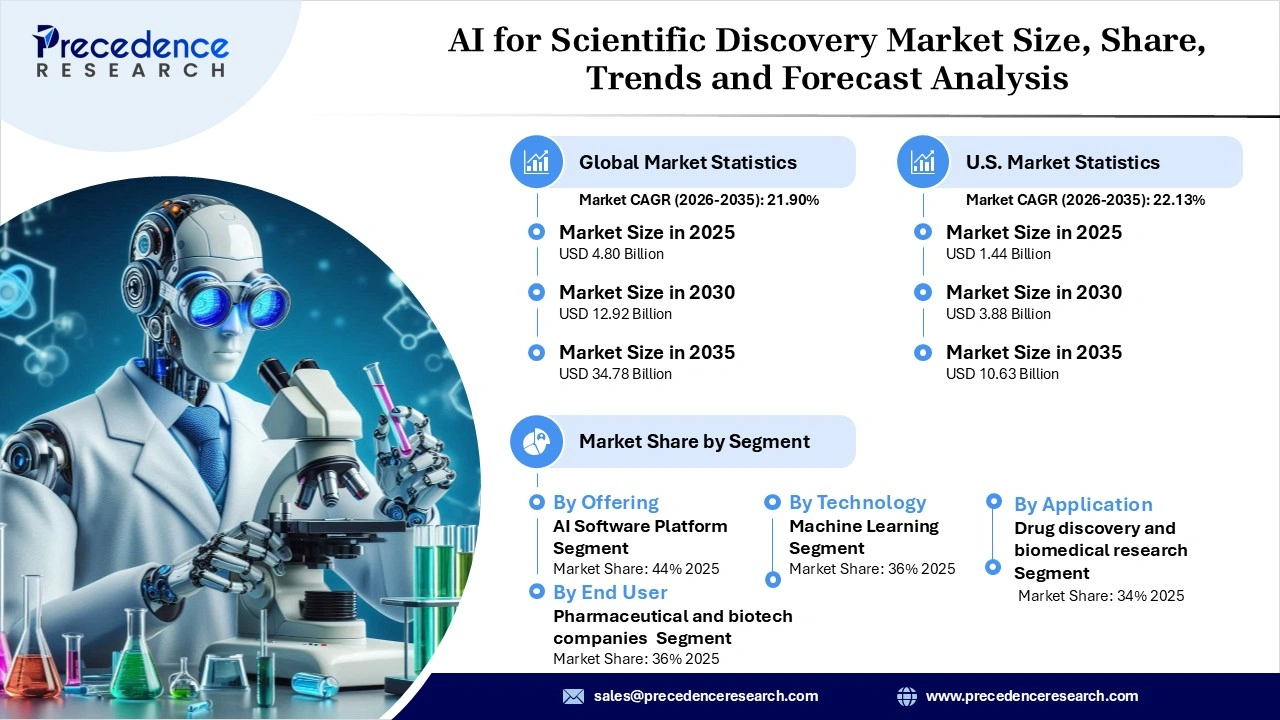
The global AI for scientific discovery market is poised for significant growth, with revenue projected to escalate from USD 4.80 billion in 2025 to approximately USD 34.78 billion by 2035. This surge, reflecting a compound annual growth rate (CAGR) of 21.90%, is largely fueled by increasing demand from the pharmaceutical sector and the rising adoption of cloud-based platforms that facilitate complex data analysis, experimental simulations, and accelerated development timelines.
One of the primary drivers of this growth is the burgeoning use of generative AI in drug discovery. AI technologies are now being utilized to identify new drug candidates, conduct molecular screening, and facilitate de novo design, among other applications. These advanced AI models analyze diverse data types—including images, text, and numerical data—thereby significantly enhancing the accuracy of scientific predictions.
Market segmentation reveals that the AI software platforms segment held a commanding share of approximately 44% in 2025. This dominance stems from the growing imperative to identify viable drug candidates and manage extensive datasets within drug discovery processes. By predicting the effectiveness of compounds before laboratory testing, AI software is improving success rates in early-stage trials.
In the technology segment, machine learning algorithms accounted for nearly 36% of revenue in 2025. These algorithms automate time-consuming tasks, enabling researchers to concentrate on more complex challenges. By efficiently analyzing millions of molecular structures, machine learning expedites the identification of promising drug candidates, thereby accelerating research and drug discovery.
The drug discovery and biomedical research application segment contributed around 34% to the market share in 2025, driven by AI’s capability to process intricate datasets and solve complex scientific challenges. AI is playing a crucial role in facilitating more cost-effective drug development, a vital consideration in today’s pharmaceutical landscape.
Pharmaceutical and biotechnology companies emerged as the dominant end users, holding nearly 36% of the market share in 2025. These companies invest heavily in research and development (R&D), which incentivizes them to adopt AI technologies to mitigate high failure rates, optimize clinical trials, and effectively analyze vast biological datasets.
Regionally, North America commands a prominent position in the AI for scientific discovery market. The area benefits from a well-established healthcare infrastructure and strategic alliances between leading pharmaceutical firms and AI solution providers. Major players in this region include Amazon Web Services Inc., Atomwise Inc., and IBM Corp., among others. The United States, in particular, is a key contributor, bolstered by its array of established research institutions and increased private-sector investments in AI-driven scientific research.
The leadership of North America is further strengthened by the escalating burden of chronic diseases, extensive R&D integration across various scientific sectors, and the growing adoption of AI-integrated quantum computing and blockchain technologies. Furthermore, the increasing utilization of cloud computing aids in managing the high volumes of AI-generated data and extracting valuable insights.
In contrast, the Asia Pacific region is expected to exhibit the fastest growth rates during the forecast period. This surge is attributed to the rising adoption of AI technologies, a growing prevalence of chronic diseases, and significant investments in R&D by pharmaceutical and biotechnology firms, all supported by favorable governmental policies aimed at enhancing AI-enabled research platforms.
The AI for scientific discovery market is witnessing unprecedented expansion, driven by several interrelated factors that reflect a broader trend in the intersection of advanced technology and healthcare innovation. As the market evolves from 2026 to 2035, stakeholders are likely to witness transformative developments that could redefine the paradigms of drug discovery and biomedical research.
See also AI Study Reveals Generated Faces Indistinguishable from Real Photos, Erodes Trust in Visual Media
 Gen AI Revolutionizes Market Research, Transforming $140B Industry Dynamics
 Researchers Unlock Light-Based AI Operations for Significant Energy Efficiency Gains
 Tempus AI Reports $334M Earnings Surge, Unveils Lymphoma Research Partnership
 Iaroslav Argunov Reveals Big Data Methodology Boosting Construction Profits by Billions