

















































Researchers from The Hong Kong Polytechnic University have developed a pioneering real-time wildfire forecasting framework known as Fast Cross-Scale Deep Learning, aimed at improving emergency response capabilities in wildfire-prone areas. The study, published online on March 10, 2026, in the journal ENGINEERING Environment, highlights the increasing need for high-resolution and operationally fast forecasting systems in densely populated regions like Hong Kong, where urban development often borders vegetated hillsides.
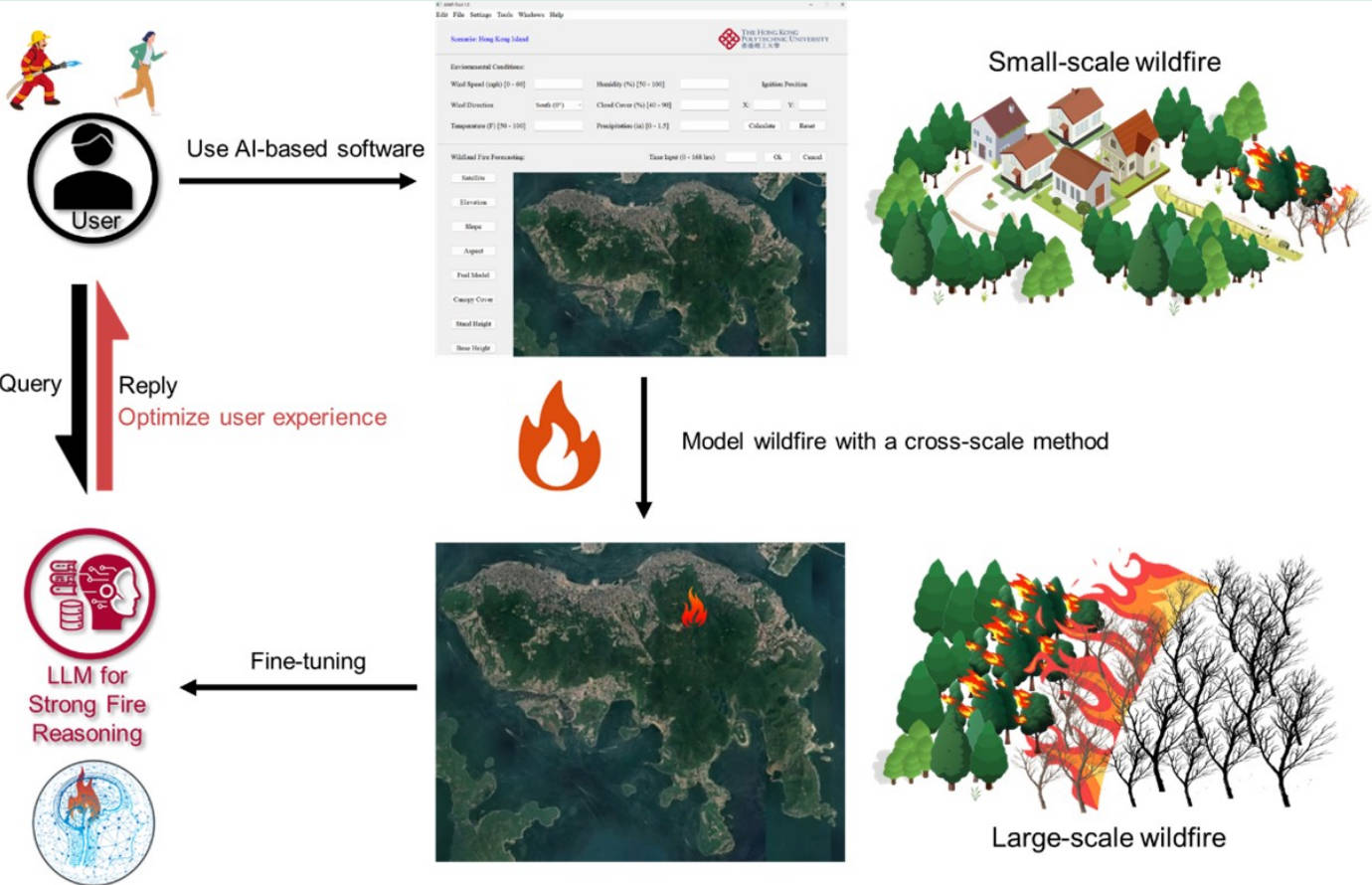
Traditional models for forecasting wildfire spread typically rely on extensive computational resources and specialized knowledge, making them less effective in urgent situations where timely information can be crucial for decision-making. The researchers recognized that early-stage fires, which are often small and sparse, are particularly challenging for artificial intelligence (AI) systems to detect, while larger fires require costly image processing due to their size. To address these issues, the team implemented a two-stage strategy that optimizes the AI’s ability to forecast fires at different scales.
For early-stage fires, which last less than 12 hours or burn less than 1,000 square meters, the researchers maintained a high resolution of 5 meters, dividing images into thousands of overlapping blocks. This technique allowed the model to better identify sparse burnt pixels. Conversely, for larger fires, the imagery was resized and split into nine overlapping blocks, effectively reducing computational demands while still retaining critical patterns of fire spread. The dataset utilized for this framework consisted of 240 cases simulated using the FARSITE wildfire model, covering various wind speeds, directions, and ignition points specific to Hong Kong Island.
The Fast Cross-Scale Deep Learning framework demonstrated significant accuracy in its predictions, achieving an F1-score of 0.65 for early-stage fires and 0.75 for larger fires. Moreover, the accuracy of large-fire predictions reached approximately 85%, with errors remaining below 15%. In terms of speed, the AI system delivered forecasts in seconds to tens of seconds, a considerable improvement over traditional modeling that could take tens of minutes.
The researchers emphasized that the true value of their framework lies in its integration with field decision-making processes. The system is designed not merely as a theoretical model but as a component of a comprehensive emergency support workflow that can rapidly generate forecasts while reducing the computational burden often associated with wildfire modeling. Despite these advancements, the study acknowledges that early-stage fire predictions still present challenges, underscoring the complexity of capturing the initial moments after ignition accurately.
As wildfire threats persist, particularly in high-risk wildland-urban interface areas, the implications of this research are significant. The team also introduced the Intelligent Wildfire Forecast Tool (IWFTool), which operationalizes the model for practical use, enabling predictions and response support for up to 72 hours. This tool could be instrumental in shaping real-time decisions related to evacuation, suppression, and resource deployment, where time is of the essence.
While the forecasting framework was demonstrated using Hong Kong as a case study, its cross-scale design holds promise for adaptation in other fire-prone regions. As the demand for more accessible and efficient wildfire forecasting tools continues to rise, researchers hope that their innovative approach will bridge the gap between advanced modeling techniques and front-line emergency response efforts.
See also DARPA Launches MATHBAC Program to Enhance AI Agent Communication with $2M Funding
 Google DeepMind Announces AI Research Roles for PhD Students Focused on Cancer Discovery
 DeepSeek Set to Launch V4 AI Model, Potentially Using Huawei Chips to Counter US Restrictions
 Nvidia’s Bryan Catanzaro Reveals GPU Shortages Impacting AI Research Teams
 New Framework Achieves 95% Accuracy in Acoustic Neighbor Embeddings for Word Classification