













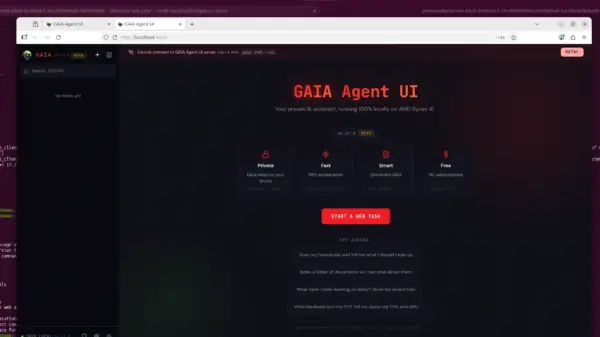



































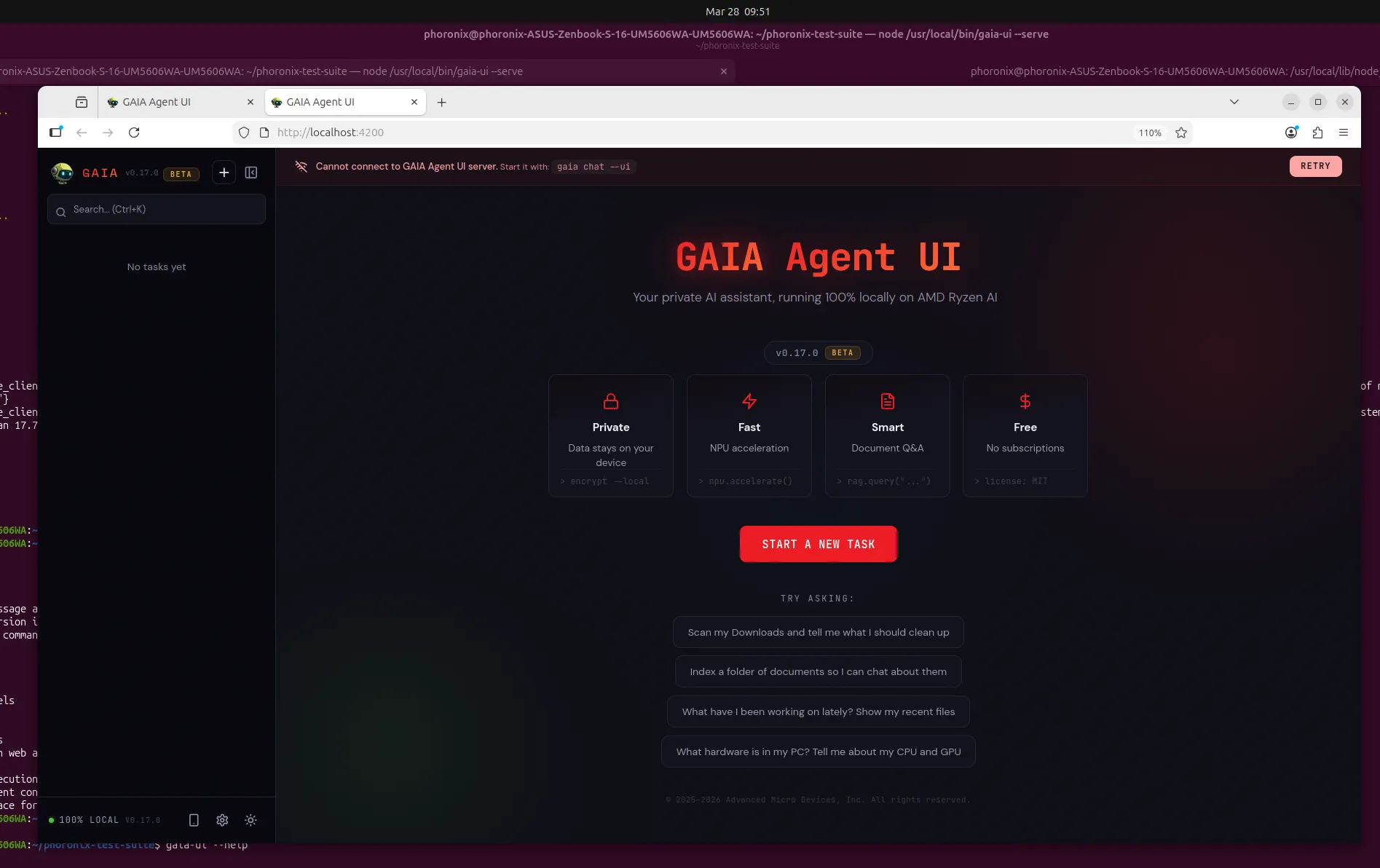
AMD has launched a new version of its GAIA AI agent framework, now dubbed GAIA 0.17, which introduces a privacy-first web application called the Agent UI. This release focuses on leveraging the capabilities of Ryzen AI hardware for local AI tasks, including document analysis, code generation, and command execution, all conducted without reliance on cloud services.
The GAIA Agent UI enhances user privacy by enabling operations strictly on local machines. Users can drag and drop over 53 different file formats—such as PDFs and Word documents—to receive answers complete with page-level citations, driven by local retrieval-augmented generation (RAG) technology. The platform allows for executing shell commands and writing files, but each action must be approved by the user, adding a layer of security.
In addition to document handling, the GAIA Agent UI features robust file search capabilities, enabling users to locate content across projects effectively. A built-in ngrok tunnel allows users to access their local GAIA instance from mobile devices, improving flexibility and usability. This version also introduces real-time streaming, enabling users to observe the agent’s reasoning process as it works, along with the ability to create and switch between sessions while preserving full history.
Performance monitoring has been enhanced as well; users can now view token counts, latency, and throughput metrics for each response via hover tooltips. The inclusion of tool execution guardrails provides another layer of control, allowing users to approve or deny shell commands before they are executed. This emphasis on local processing and user control underscores AMD’s commitment to privacy in AI applications.
GAIA 0.17 also includes improvements in hardware detection for both Ryzen AI and Radeon graphics cards, along with enhancements to messaging and system prompt optimization. These updates aim to streamline the user experience and ensure that the framework operates efficiently across various environments.
This release coincides with the introduction of the Lemonade SDK 10.0 and FastFlowLM 0.9.35, which together enhance the functionality of Ryzen AI neural processing units (NPUs) under Linux for running large language models (LLMs). Such synergies indicate a push from AMD to make its hardware more versatile in the rapidly evolving AI landscape.
AMD’s developments reflect a broader trend in the tech industry towards more privacy-conscious applications, particularly in AI. As users become increasingly aware of data security concerns, local processing solutions are gaining traction. With GAIA 0.17, AMD positions itself as a key player in this space, offering features that prioritize user privacy without sacrificing functionality.
For further details and downloads, users can access the GAIA 0.17 release on AMD’s GitHub page. As the AI landscape continues to evolve, AMD’s latest offering could set the stage for how other companies approach AI privacy and processing in the future.
See also Tesseract Launches Site Manager and PRISM Vision Badge for Job Site Clarity
 Affordable Android Smartwatches That Offer Great Value and Features
 Russia”s AIDOL Robot Stumbles During Debut in Moscow
 AI Technology Revolutionizes Meat Processing at Cargill Slaughterhouse
 Seagate Unveils Exos 4U100: 3.2PB AI-Ready Storage with Advanced HAMR Tech