















































On February 11 in New York City, Glossy will host a one-day event titled AI Marketing Strategies, where industry leaders will explore best practices for integrating AI tools into marketing processes. This comes at a time when companies are increasingly turning to generative AI to enhance customer engagement and personalization.
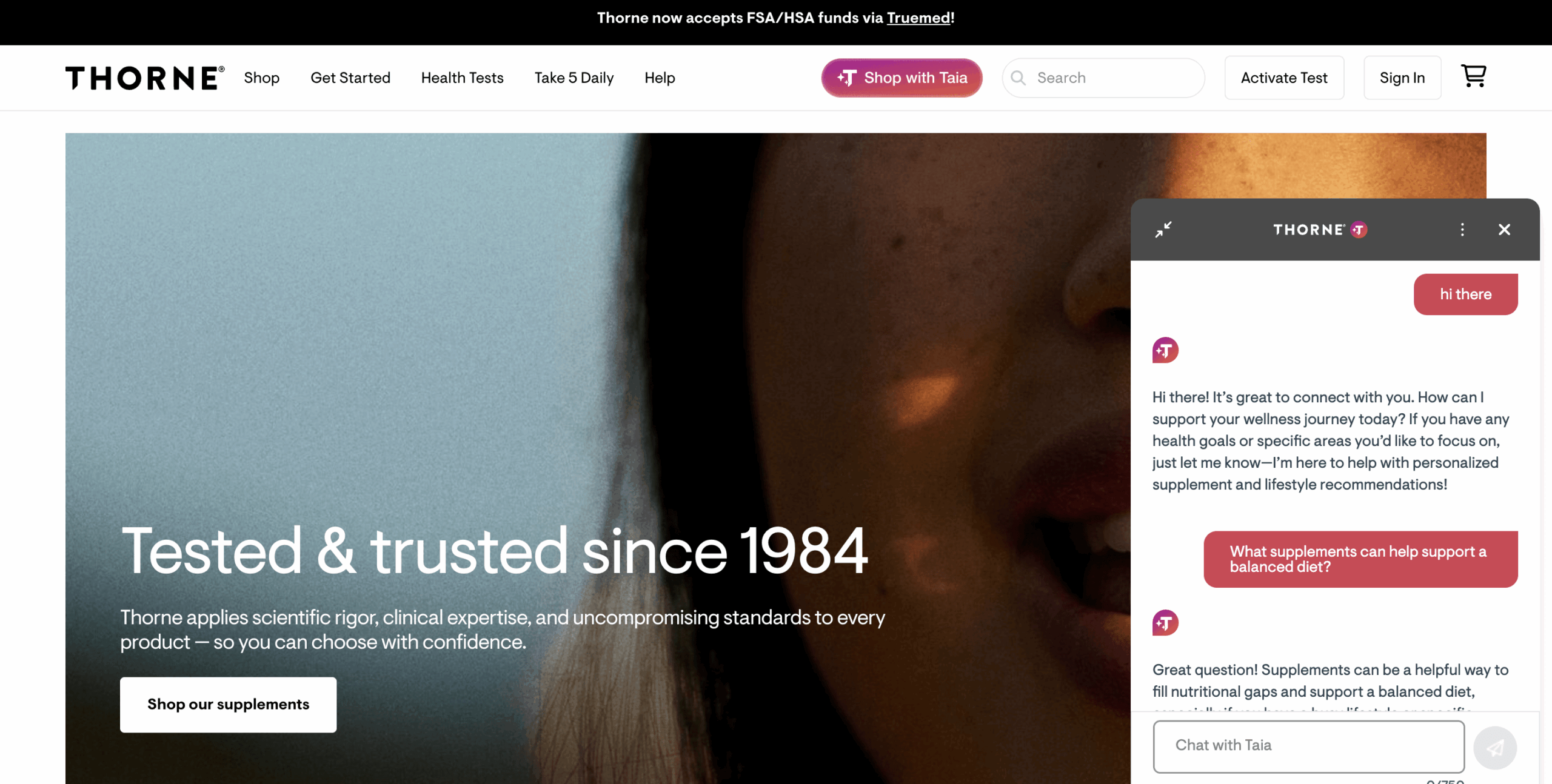
Earlier this month, Thorne, a leader in the supplement category, introduced a generative AI-powered wellness advisor chatbot named Taia. Available on Thorne’s homepage, this innovative tool allows shoppers to ask questions related to health and wellness, providing insights on products, as well as advice on sleep, stress, energy, digestion, and immunity.
“Trying to maintain wellness can be really complicated,” said Nathan Price, PhD., Thorne’s chief science officer. He emphasized the need for clarity in health guidance, stating that many people struggle to find solutions for their wellness concerns. Taia aims to streamline this process by offering personalized recommendations for supplements, lifestyle, and nutrition tips, while also providing an overview of Thorne’s product offerings.
Taia is built on Thorne’s internal knowledge database, which is supported by a team of researchers and doctors, combined with foundational AI knowledge of health and wellness. The chatbot also draws from Thorne’s extensive library of blog posts and studies to offer additional reading and general advice, addressing common concerns such as gut issues, itchy skin, and fatigue.
Founded in 1984, Thorne has grown to offer over 300 products sold directly to consumers and through major retailers. The company was recently acquired by L Catterton equity group for approximately $680 million. In 2022, its sales reached $228 million, marking a 24% increase from the previous year. Dr. Price noted that unlike many companies, Thorne’s business is evenly distributed across its product categories, underscoring the importance of personalization in driving conversions. “We really want people to be able to find what’s going to make a difference for them,” he added.
Taia has been under development for four years, created by Thorne’s in-house team using large language AI models. For users logged into their Thorne accounts, the chatbot retains conversation history, allowing it to provide increasingly useful recommendations over time. Early feedback suggests positive reception, although Dr. Price acknowledged some confusion among users who mistakenly perceive Taia as a customer service representative rather than a health and wellness advisor.
Importantly, Taia, similar to OpenAI’s recent beta launch of ChatGPT Health, is not designed to diagnose or treat illnesses, distinguishing it from telehealth services like Forward Health or Next Health. This limitation also means Taia is not subject to regulation as a medical device by the FDA. Addressing regulatory challenges, Dr. Price stated, “It’s a huge challenge, and one of the major things we had to do while building Taia is ensuring it doesn’t give medical advice.”
Taia faces competition from other wellness advisory tools, including Oura Ring’s Oura Advisor and Headspace’s Ebb, as well as ChatGPT Health. The launch of Taia coincides with a Thorne study that surveyed 3,000 consumers, revealing that 57% are uncertain about which health products to choose, while 67% expressed interest in using a trusted tool to simplify supplement decisions. The study also indicated that many consumers feel overwhelmed by conflicting online information about supplements.
Dr. Price, who co-authored the 2023 book “The Age of Scientific Wellness,” envisions a future where generative AI can enhance health predictability. He describes the ongoing technological movement as ushering in “a new era of freedom in health.” His aspirations include a system where various chatbots can share information seamlessly, offering comprehensive health insights to both users and their physicians.
While Dr. Price is optimistic about the future of AI in healthcare, he acknowledged the diversity of consumer preferences. Some individuals prioritize privacy over data sharing, which may influence their adoption of AI-driven health solutions. “There are people that want everything in isolation,” he noted, recognizing the validity of both viewpoints.
As the landscape for wellness advisor chatbots evolves, questions remain about whether one platform will dominate the market or if multiple offerings will coexist. Dr. Price suggests that consumer preferences will ultimately dictate the trajectory of these technologies, emphasizing the importance of trust and perceived utility. “The race is on to build systems that provide early health warning signs and actionable insights,” he concluded, underscoring the rapid pace of innovation in this space.
See also AI-Driven EDA Tools Slash Chip Design Costs by 60% at CES 2026, Ushering Silicon Renaissance
 AI Automation Tools Drive Instant Digital Payouts, Reshaping User Expectations Across Industries
 AI Redefines Careers: How Workers Adapt and New Roles Emerge in 2023
 Fundrise Launches RealAI, Analyzing 3.5 Trillion Data Points for $69/Month
 Adobe Enhances Photoshop with Firefly AI Tools for High-Resolution Image Editing