




















































Revolutionizing Enzyme Design
Researchers from the Institute of Biochemistry at Graz University of Technology (TU Graz) and the University of Graz have unveiled a groundbreaking technique for designing customized enzymes, a development with significant implications for industry, medicine, and environmental protection. Their study, published in the journal Nature, introduces a method known as Riff-Diff (Rotamer Inverted Fragment Finder–Diffusion), allowing for the precise construction of protein structures around active centers, rather than relying on existing database structures.
“Instead of putting the cart before the horse and searching databases to see which structure matches an active centre, we can now design enzymes for chemical reactions efficiently and precisely from scratch using a one-shot process,” said Gustav Oberdorfer, whose project HELIXMOLD played a pivotal role in this advancement. Lead author Markus Braun emphasized that the new enzymes produced are highly efficient biocatalysts, stable enough for industrial applications, dramatically reducing the time and resources previously needed for screening and optimization.
This innovation leverages recent advancements in machine learning, enabling the design of more complex protein structures than earlier methods permitted. The Riff-Diff technique combines generative machine learning models with atomistic modeling. Initially, structural motifs of proteins are arranged around active centers, followed by the use of a generative AI model called RFdiffusion, which generates the complete protein molecule structure. The scaffold is then refined step-by-step to ensure that chemically active elements are positioned with remarkable precision, achieving accuracy at the angstrom level, as verified by high-resolution protein structures.
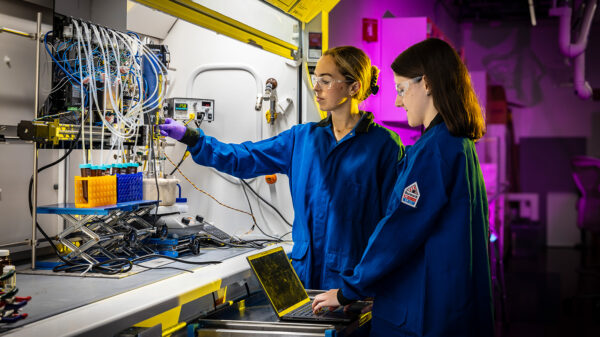
The research team successfully demonstrated the method’s effectiveness in the laboratory, generating active enzymes for various reaction types from 35 tested sequences. The newly created catalysts exhibited significantly faster reaction rates compared to previous computer-aided designs and maintained high thermal stability, with most retaining their functional shape at temperatures up to 90 degrees Celsius or more, a crucial factor for industrial applications. Lead author Adrian Tripp remarked, “Although nature itself produces a large number of enzymes through evolution, this takes time. With our approach, we can massively accelerate this process and thus contribute to making industrial processes more sustainable, developing targeted enzyme therapies, and keeping the environment cleaner.”
This breakthrough also underscores the importance of interdisciplinary collaboration between TU Graz and the University of Graz. Mélanie Hall from the Institute of Chemistry at the University of Graz highlighted the value of integrating diverse areas of expertise, stating, “The integration of different areas of expertise at the interface of protein science, biotechnology, and organic chemistry shows how crucial interdisciplinary approaches are for the advancement of modern biocatalysis.”
The implications of this research extend beyond enzyme design, potentially transforming various industrial processes and therapeutic applications. As the biotechnology sector increasingly seeks sustainable solutions and precise biochemical tools, the Riff-Diff method could represent a significant leap forward in the development of effective enzymes, paving the way for a cleaner and more efficient future.
Publication: Computational enzyme design by catalytic motif scaffolding
Authors: Markus Braun, Adrian Tripp, Morakot Chakatok, Sigrid Kaltenbrunner, Celina Fischer, David Stoll, Aleksandar Bijelic, Wael Elaily, Massimo G. Totaro, Melanie Moser, Shlomo Y. Hoch, Horst Lechner, Federico Rossi, Matteo Aleotti, Mélanie Hall, Gustav Oberdorfer
In: Nature
DOI: https://doi.org/10.1038/s41586-025-09747-9
See also Hollywood Titans Unite Against AI Theft: Johansson, Blanchett Lead 800-Strong Campaign
 UN AI Chief and Billion-Dollar Investors Unite at WAM Morocco to Drive Industrial Revolution
 TU/e Secures €1.5M to Revolutionize Materials Science with AI-Driven SimuLingua Project
 U.S. Faces Dilemma as Nvidia Seeks Approval to Sell AI Chips to China Amid Security Risks