
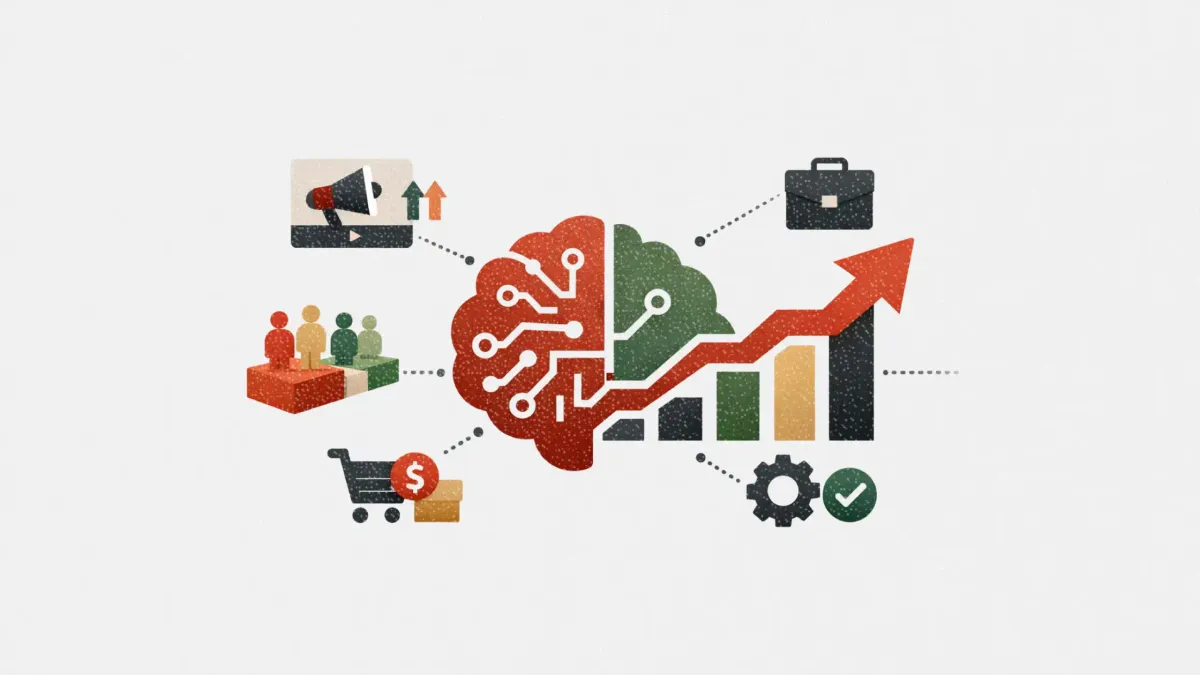
Artificial intelligence (AI) has evolved from a supplemental tool to a core element of marketing operations, significantly reshaping strategies in 2026. Recent industry data indicates that businesses implementing structured AI marketing frameworks are experiencing notable gains in conversion rates, productivity, and revenue growth. With nearly universal adoption of AI among marketers, the critical factor for achieving return on investment (ROI) now hinges on effective implementation rather than mere usage.
According to a SurveyMonkey report, 88% of marketers utilize AI tools on a daily basis, with 93% leveraging AI for faster content generation, 81% for quicker insights, and 90% for expedited decision-making. However, the mere presence of AI does not guarantee financial returns. Benchmark data reveals an average ROI of 3.7 times on AI investments, meaning that each dollar spent yields nearly four dollars in value. In organizations with mature AI implementations, 74% report that their AI initiatives meet or exceed ROI expectations, with 20% demonstrating ROI above 30%. The most impactful results are observed when AI is integrated into critical business functions such as IT, operations, and customer service.
The importance of embedding AI into operational frameworks rather than treating it as a mere productivity hack is evident. Companies that implement AI frameworks with structured integration, shared data, and continuous feedback mechanisms are distinguishing themselves in the market. The data highlights several areas where AI-driven marketing frameworks are delivering measurable improvements. AI-enhanced segmentation and targeting, for example, have improved ad targeting accuracy by 26% and increased conversion rates by 32%, especially when combined with predictive modeling and behavioral data within campaign workflows.
Creative optimization has also seen significant benefits, with AI-generated advertisements boosting click-through rates by 47% and reducing cost per acquisition by 29%. This shift allows for continuous optimization rather than relying on traditional, manual creative testing processes. Additionally, marketing teams utilizing AI report 44% higher productivity, with an average of 11 hours saved per week, which can be redirected toward strategic planning and experimentation.
Moreover, organizations that implement AI across both marketing and sales domains experience stronger revenue performance. In environments driven by data, 83% of sales teams employing AI report revenue growth compared to 66% of those without. This indicates that successful AI frameworks thrive when applied across the entire organization rather than remaining confined to specific departments.
For B2B marketers striving to build effective AI marketing frameworks in 2026, the key lies in disciplined execution. Marketers should prioritize use cases linked directly to ROI, focusing on initiatives that enhance conversion rates, cost efficiency, or pipeline velocity. Early cross-functional alignment is essential; when Marketing Directors, Sales Leaders, and Operations Managers collaborate and share data, the compounded impact of AI initiatives becomes more pronounced.
In addition to focusing on activity metrics, marketers should track critical performance indicators such as cost per acquisition, conversion lift, and revenue contribution to gauge the true impact of their efforts. Investment in feedback loops is crucial; AI systems must be continuously trained on campaign performance and customer behavior data to improve efficacy over time. Furthermore, the time savings garnered from AI should not merely reduce workload but should fund experimentation and growth initiatives.
The landscape in 2026 is not about whether to use AI, but about how effectively organizations can structure their AI frameworks to produce tangible business outcomes. Marketing teams that view AI as an integral component of their infrastructure rather than just a collection of tools are witnessing enhanced conversion performance, increased productivity, and sustained revenue growth. As the competitive gap continues to widen, those who can harness the full potential of AI in their marketing strategies will likely lead the market.
See also Doceree Appoints Matthew Baggett as SVP, AI Solutions to Drive reptwin.ai Commercialization
 Foxtel Expands Kayo Sports with New F1 Deal and AI-Driven Personalization Strategy
 Baird & Warner Launches AI Social Media Assistant to Streamline Agent Marketing Efforts
 Robin Emiliani Reveals 2026 Insights on AI’s Role in Building Brand Trust
 U.S. Supreme Court Declines to Hear AI Copyright Case, Upholding Current Legal Standards