























































Bengaluru: Anthropic’s new model, Mythos, signifies a pivotal advancement in artificial intelligence, particularly in software engineering tasks, challenging the traditional incremental improvements usually associated with frontier AI systems. According to a recent analysis by Kotak Securities, if the enhancements demonstrated by Mythos are effectively applied in real-world enterprise environments, the firm’s previous forecast of a 3–3.5% annual growth headwind for the IT services industry over the next three years may need reevaluation. The analysis cautioned, however, that continued breakthroughs in AI models could exacerbate risks for IT firms, especially those heavily focused on application services.
The report emphasized that Mythos has shown a notable increase in benchmark performance across various software engineering tasks, representing a deviation from recent trends of modest improvements. It suggests that the model significantly enhances agentic software development capabilities, although there remains uncertainty regarding its impact in practical terms, given the lack of a public release. As a result, potential disruption risks may escalate for IT services companies with substantial involvement in application services.
Industry experts indicate that the ramifications of Mythos’s capabilities could extend beyond conventional IT services. Viral Shah, co-founder and CEO of JuliaHub, highlighted that even engineering services firms, primarily involved in hardware design, testing, and verification across sectors like aerospace and automotive, might experience disruption. “Anything that is digital is a fair game. AI represents a shift from labour to capital,” he stated. Shah anticipates that while the immediate effects may manifest as margin pressures, the long-term consequences could be existential for some firms. “I expect a bimodal distribution where a few firms adapt and go from strength to strength while others may vanish,” he noted, further underlining Mythos’s capability to pinpoint security vulnerabilities in highly secure operating systems that had previously gone unnoticed.
Conversely, some industry leaders perceive a shift in demand rather than an outright contraction. Namratha Dharshan, chief business leader at ISG, indicated that revenue deflation has already surfaced in routine, repetitive tasks. However, she suggested that AI-driven changes are simultaneously spurring growth in areas such as data readiness, governance, cybersecurity, and workflow design. “Labour arbitrage is not a sustainable model going forward,” she remarked, noting that ISG is witnessing a 20% year-on-year increase in new project scopes as companies adapt to evolving demands.
Analysts further observe a structural transition in service delivery models. Biswajeet Mahapatra, a principal analyst at Forrester, pointed out that services centered on repetitive defect discovery and low-complexity application maintenance are particularly vulnerable. He underscored that models like Mythos could dramatically reduce the effort needed to identify bugs and security flaws, particularly in code-intensive environments. Despite these challenges, Mahapatra does not anticipate a total revenue collapse within the sector. Instead, he predicts a shift in focus toward areas such as triage, remediation prioritization, coordinated patching, and safe deployment, which will still necessitate deep system understanding and governance.
The evolving landscape suggests that firms clinging to traditional manual testing models may face significant risks. In contrast, organizations that pivot towards secure-by-design engineering, remediation orchestration, and AI-augmented reliability services are likely to experience a transformation in demand rather than an outright decline. As AI technologies like Mythos continue to evolve and penetrate the IT sector, the implications for service delivery and operational frameworks will become increasingly profound, underscoring the need for adaptability amid an accelerating pace of technological change.
See also Cerebras Secures $20B Deal with OpenAI for AI Computing Infrastructure Expansion
 Swiss Minister Files Complaint Against Grok AI for Digital Abuse Amid Free Speech Debate
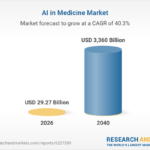 AI in Medicine Market Projected to Reach $3.36 Trillion by 2040 with 40.3% CAGR
 Google DeepMind Hires Philosopher Henry Shevlin to Explore Machine Consciousness
 Runway CEO Proposes $100M Budget Shift to Create 50 AI Films for Higher Success Rates














