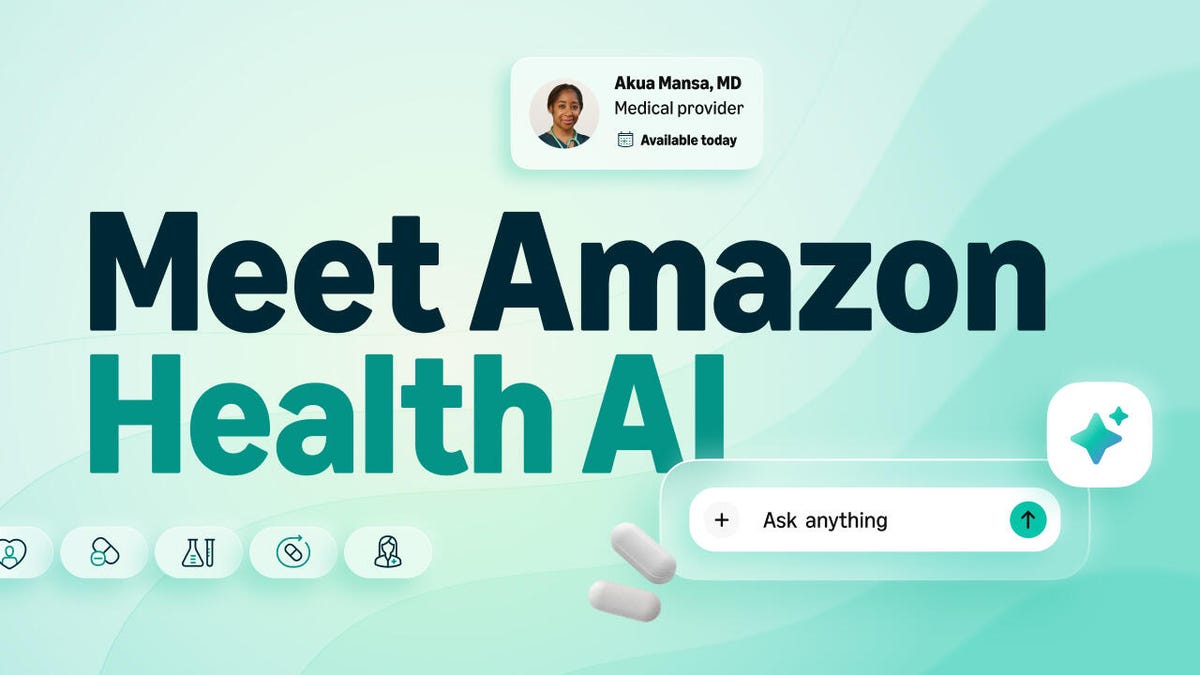
Amazon is expanding access to its health care virtual assistant, Health AI, the company announced on Tuesday. Initially available only to members of One Medical, the service will now be accessible to most users on the Amazon app and website, with a phased rollout expected to reach all U.S. customers over the coming weeks. This move aims to enhance patient engagement and provide crucial health information to a broader audience.
Amazon’s Health AI is designed to answer general health-related questions and offer wellness guidance tailored to individual health histories, medications, and conditions. For a more personalized experience, users can opt to share their medical records with the system. Furthermore, the AI can assist with prescription refills through Amazon Pharmacy and facilitate connections with One Medical doctors for video, in-person, or messaging consultations.
An Amazon spokesperson told CNET, “We run ongoing evaluations and automated testing to monitor the quality and safety of responses, and we continuously improve the system based on clinical review findings.” However, concerns linger regarding the use of chatbots in sensitive areas such as health advice, as misinformation can lead to adverse outcomes. Patients are advised to verify AI-provided health information with their healthcare providers.
Health AI is reportedly compliant with HIPAA regulations and is intended solely for medical support, not as a replacement for professional healthcare providers. The AI can address questions like, “Can you explain my recent cholesterol results and what they mean for me?” or “What allergy medications are safe with my current prescriptions?”
Developed in collaboration with One Medical’s clinical leadership, Health AI underwent extensive security testing, with strict measures in place to protect customer information. Amazon emphasized that rigorous evaluations assessed the AI’s performance across various scenarios, including clinical safety and emergency response. “Before launch, we evaluated Health AI’s performance across thousands of synthetically generated conversations spanning quality dimensions including clinical safety, emergency response, and compliance,” the spokesperson added.
In uncertain situations regarding clinical recommendations, Health AI is designed to direct users to human providers, ensuring that necessary medical expertise is available. Should specialty treatment be required, the AI facilitates connections both with primary care providers and specialists.
For Amazon Prime members, there is an introductory offer that allows them to connect with a One Medical provider for five free direct-message consultations. This feature can be extended to family members through Amazon Family, provided they have either Prime for Young Adults or Prime Access. Beyond the complimentary sessions, each telehealth consultation costs $29, or users may opt for a One Medical membership priced at $99 annually, which allows for the inclusion of up to five family members at $66 per year each.
Amazon’s move into digital health services highlights a growing trend among tech companies to leverage artificial intelligence for practical applications in healthcare. Other players in the field, such as OpenAI, which introduced ChatGPT Health in January, and Anthropic with its Claude for Healthcare, are also exploring similar offerings that provide health guidance and management of health data.
Given the increasing reliance on AI-driven solutions, the importance of maintaining patient safety and accuracy in health-related conversations cannot be overstated. As the digital healthcare landscape evolves, Amazon’s Health AI will undoubtedly play a significant role in shaping how consumers interact with their health information and healthcare providers.
See also Target Boycott Ends After Meeting DEI Demands; $2B Commitment to Black Businesses Promised
 HCA Healthcare’s CIO Chad Wasserman Reveals AI-Driven Strategies for Patient Care Excellence
 Microsoft Targets 3 Million Africans for AI Training Amid Rising Competition from DeepSeek
 Character.AI Faces Outage, Over 2,000 Users Report Login Issues, Status Under Investigation
 ByteDance Deploys 500 Nvidia Blackwell Systems in Malaysia, Tapping 36,000 B200 Chips