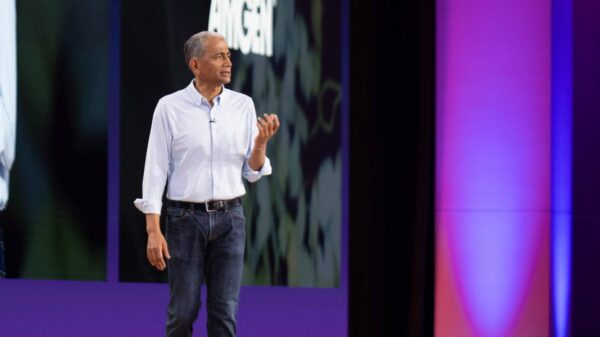














































As artificial intelligence increasingly permeates the workforce, job cuts attributed to AI are becoming more common. This trend was highlighted at HumanX, a recent four-day conference in San Francisco that attracted approximately 6,500 investors, entrepreneurs, and tech executives. A stark advertisement at the entrance read, “Stop hiring humans,” setting an anxious tone for discussions surrounding the future of work.
May Habib, chief executive of AI platform Writer, noted on stage that Fortune 500 leaders are experiencing a “collective panic attack” over job displacement fears related to AI. This anxiety is not unwarranted, as several high-profile companies have cited AI as a reason for layoffs. For instance, Salesforce announced a cut of 4,000 customer support jobs, stating that AI now performs 50 percent of the tasks previously handled by humans. Similarly, Block chief Jack Dorsey revealed plans to reduce the company’s workforce by nearly half, attributing the move to “intelligence tools” that have transformed business operations.
However, not all experts agree with the rationale behind these layoffs. Some economists argue that companies may be using AI as a convenient excuse to justify job cuts driven by prior overhiring or necessary cost reductions. Sam Altman of OpenAI has spoken out against what he calls “AI-washing,” cautioning against using AI as a false pretext for downsizing. Despite these reservations, many industry insiders predict significant disruption as AI technologies advance.
“AI is going to transform every single company, every single job, every single way that we do work,” declared Matt Garman, CEO of Amazon Web Services. The debate surrounding AI’s impact on jobs continues to intensify, as leaders in the tech sector grapple with the implications of this rapidly evolving landscape.
Historically, industry figures have expressed opposing views on the future of programming. Two years ago, Nvidia chief Jensen Huang claimed that the ultimate goal was to eliminate the need for programming entirely. In response, Andrew Ng, founder of DeepLearning.AI, argued that coding remains a crucial skill, now more accessible than ever due to AI advancements. This perspective aligns with a growing belief that interpersonal skills will become increasingly valuable as AI takes on more technical tasks.
“As AI can do more of a job, the things that will distinguish and differentiate a given employee are going to be the human skills — critical thinking, communication, teamwork,” said Greg Hart, CEO of Coursera, which has reported a threefold increase in enrollment for its critical thinking courses over the past year. Florian Douetteau, CEO of Dataiku, echoed this sentiment, emphasizing the importance of human judgment in an AI-driven work environment. He envisioned a collaborative future where AI handles routine tasks while humans provide oversight.
Despite these optimistic projections, Douetteau expressed concern about a potential disconnect between emerging technologies and the skills of future generations. “We are going to have a generation of people who will never have written anything from start to finish in their entire lives,” he remarked, adding that this scenario is “pretty unsettling.”
The conversation around job displacement due to AI is particularly pressing for younger workers, many of whom are already facing challenges in securing employment. A study by investment fund SignalFire revealed a staggering 50 percent decline in hiring candidates with less than one year of experience among major tech companies from 2019 to 2024, as AI automates entry-level tasks that traditionally provided on-the-job training.
Former U.S. Vice President Al Gore raised alarm over the implications of AI on the job market, warning that we must prepare for significant losses in knowledge work categories. As the only dissenting voice at the conference, Gore called for a proactive plan to map out at-risk jobs and prepare workers for career transitions to avoid repeating the mistakes made during previous waves of globalization and deindustrialization. “The mistake was not globalization. The mistake was in not preparing for the consequences of globalization,” he stated, drawing parallels to the job losses experienced in the 2000s.
“Maybe we don’t want to talk about it,” he added, “because it may slow down the enthusiasm for the technology.” As the discourse around AI and employment evolves, the need for a balanced approach to technology adoption and workforce preparation remains critical.
See also Bank of America Warns of Wage Concerns Amid AI Spending Surge
 OpenAI Restructures Amid Record Losses, Eyes 2030 Vision
 Global Spending on AI Data Centers Surpasses Oil Investments in 2025
 Rigetti CEO Signals Caution with $11 Million Stock Sale Amid Quantum Surge
 Investors Must Adapt to New Multipolar World Dynamics