


















































In early 2026, the competitive landscape of AI image generation witnessed a notable entry with the launch of Riverflow 2.0 by Sourceful. Building on the less-publicized Riverflow 1.0, released in October 2025, this family of models has swiftly garnered attention for its emphasis on production-grade results, catering specifically to designers, marketers, and e-commerce teams seeking high-fidelity visuals that require minimal post-processing.
Available exclusively through aggregator platforms such as Replicate, OpenRouter, and Runware, Riverflow 2.0 aims to fill the gap between artistic expression and commercial necessity. With its focus on delivering consistent and reliable outputs, it positions itself as a vital tool for professionals who demand quality without the hassle of extensive revisions.
Riverflow 2.0’s standout features include a pronounced dedication to photorealism, ensuring natural textures and accurate lighting, akin to the quality seen in National Geographic photography. The model guarantees stable characters and consistent object rendering across generations, minimizing variations that can disrupt commercial workflows. These characteristics make it particularly suitable for applications like product mockups, packaging, and branding.
One of Riverflow 2.0’s most innovative capabilities is its reference-based super-resolution. Users can upload low-resolution or damaged images, and the model effectively enhances and reconstructs them in high definition. This feature is especially beneficial for preserving brand-specific details, allowing for up to four reference images per generation.
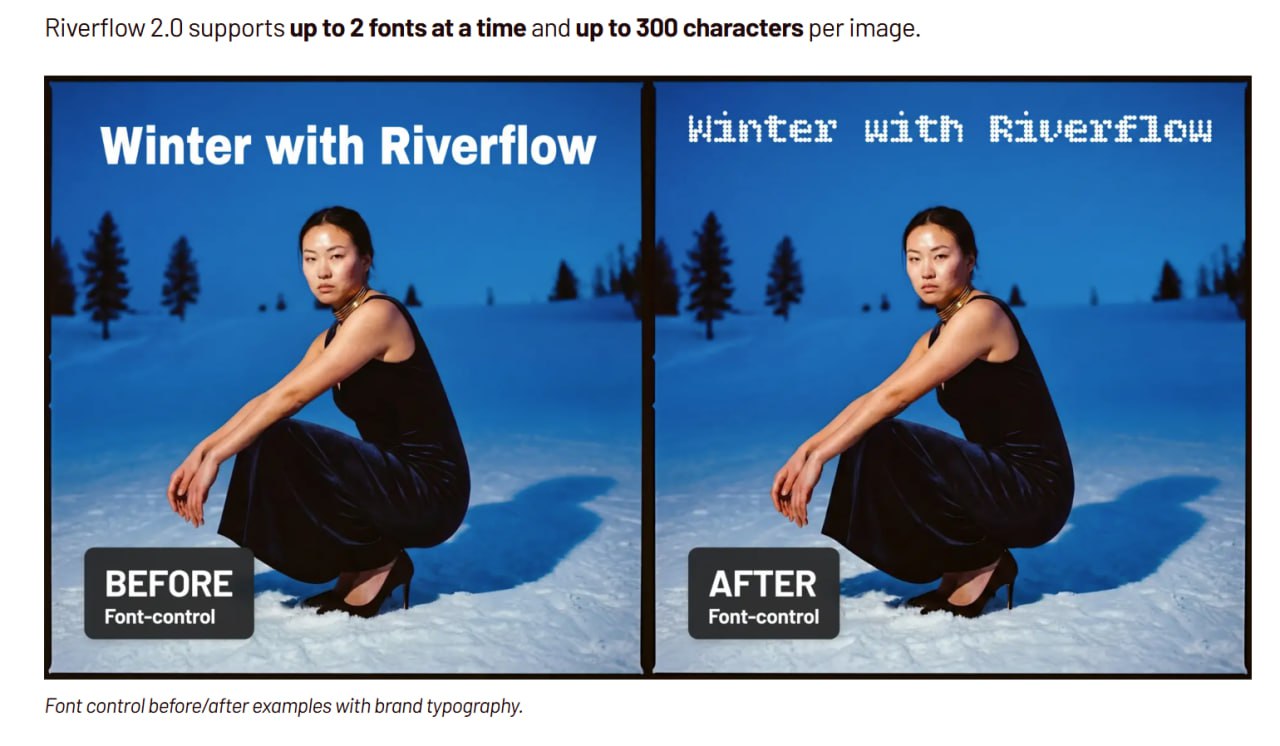
The model also excels in in-image text rendering, enabling users to input custom fonts and specific text strings. This capability addresses a long-standing issue in AI-generated visuals: the frequent occurrence of garbled or inaccurate text. By ensuring legible and accurately styled typography, Riverflow 2.0 significantly enhances the usability of generated images for logos, packaging, and posters.
Technologically, Riverflow 2.0 incorporates an agentic architecture that employs Chain-of-Thought processing and multi-stage self-correction. This iterative approach allows the model to refine its outputs by assessing and correcting errors through internal judgment, thereby reducing the likelihood of hallucinations and ensuring greater reliability. This method leads to fewer wasted credits and more immediately usable assets for users.
The model is offered in two distinct variants: a Fast / Lightweight edition optimized for cost-effective production runs, and a Pro / Max edition that provides enhanced quality and stricter control for complex commercial needs. The latter variant is designed for top-tier applications, delivering the highest levels of detail and text accuracy.
Pricing for Riverflow 2.0 is structured to accommodate various user needs, with the Pro variant costing approximately $0.15 per 1K or 2K resolution image, and $0.33 per 4K image. Additional services, such as custom fonts and super-resolution references, incur extra charges. On the other hand, Fast variants are more economical, typically ranging between $0.025 and $0.035 per image based on resolution.
Importantly, Riverflow 2.0 is exclusively distributed through API aggregators, which facilitates integration into applications and custom workflows without the need for local model management. This approach streamlines the process for users looking to incorporate advanced AI-driven image generation into their existing systems.
As the AI image generation market continues to evolve, Riverflow 2.0 carves out a significant niche by focusing on industrial-grade design work. Its capabilities in producing precise e-commerce product shots, brand-consistent marketing material, and high-quality packaging prototypes set it apart from other rapid artistic generators. Early evaluations, such as those from Artificial Analysis, indicate that Riverflow 2.0 often ranks highly on image editing leaderboards, demonstrating its effectiveness in instruction-following and detail restoration.
For professionals frustrated by AI-related challenges like inconsistent renders and troublesome text issues, Riverflow 2.0 presents a compelling option. By allowing users to generate nearly production-ready images from the outset, Sourceful encourages potential customers to explore its offerings through aggregator platforms, where they can experiment with detailed prompts, references, and fonts to achieve the desired visual outcomes.
See also Flow AI Launches Integrated Video Generation Platform to Streamline Corporate Marketing
 KPMG’s Fabiana Clemente Reveals Key Insights on Synthetic Data’s Role in AI Systems
 RecCloud Announces Day-One Support for Seedance 2.0, Enhancing AI Video Generation
 AI-Generated Data Now Discoverable: Key Court Rulings Impact Companies in 2026
 Researchers Bypass AI Image Editing Filters with 80.9% Success Using In-Image Text