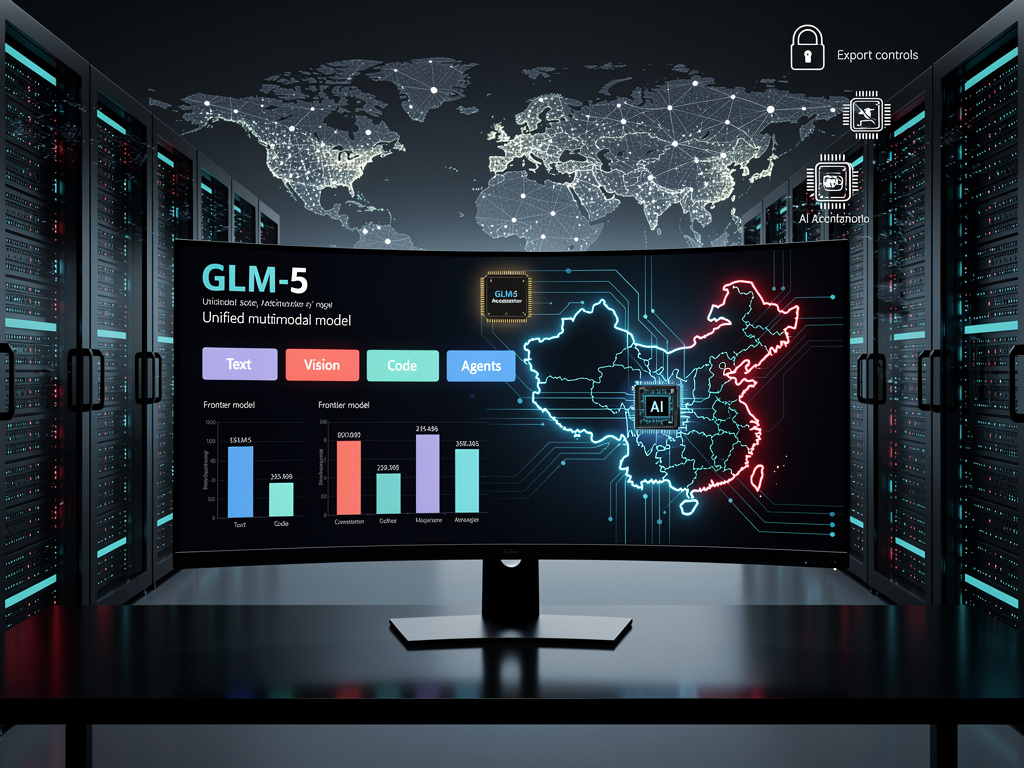
In a significant development in the global artificial intelligence landscape, Beijing-based startup Zhipu AI has launched GLM-5, a unified multimodal model that it claims can rival and, in some benchmarks, outperform leading Western counterparts like OpenAI’s GPT-4o. The initiative highlights China’s ambitions to close the gap—or surpass—American AI capabilities amid ongoing geopolitical tensions and stringent export controls affecting the semiconductor supply chain.
GLM-5 is not simply an incremental update; it represents a generational leap in Zhipu AI’s technology. According to the company, the model is designed from the ground up as a natively multimodal system, capable of simultaneously processing and generating text, images, video, audio, and code. This approach distinguishes GLM-5 from earlier models, including some developed by Zhipu itself, which relied on a text-centric backbone to incorporate other modalities. The company positions GLM-5 as a direct competitor to not only GPT-4o but also to Google’s Gemini 2.5 Pro and Anthropic’s Claude 4 Sonnet.
The technical framework of GLM-5 is ambitious. Zhipu AI describes its model as employing a deeply integrated multimodal architecture, allowing different types of input to be processed through interconnected pathways. This architecture facilitates enriched cross-modal understanding, enabling tasks such as analyzing video content while reasoning about its audio track and generating a comprehensive summary—all within a single inference pass.
Particularly notable are GLM-5’s vision capabilities. Zhipu claims the model achieves state-of-the-art performance on various vision-language benchmarks, including those requiring detailed visual reasoning and document comprehension. In the company’s published results, GLM-5 outperformed GPT-4o on benchmarks such as MMMU (Massive Multi-discipline Multimodal Understanding) and MathVista, which test the ability to interpret visual information in academic contexts. The model also demonstrated competitive scores on coding benchmarks like SWE-bench Verified, assessing its capability to resolve real-world software engineering issues.
Industry experts caution that strong benchmark performance does not always equate to real-world effectiveness. Historical evidence shows AI models can excel in controlled environments yet falter in real-world applications. Nonetheless, the breadth of GLM-5’s benchmark results is compelling. The model scores competitively on metrics like GPQA Diamond (a graduate-level science reasoning benchmark) and AIME 2025 (a mathematics competition benchmark). Zhipu also emphasizes GLM-5’s agentic capabilities, including its ability to use tools, browse the web, and execute multi-step tasks autonomously.
The significance of these claims is heightened by the current geopolitical climate. Chinese AI firms have faced increasing restrictions from U.S. policymakers aimed at curbing their access to advanced semiconductor technology, particularly high-end GPUs from NVIDIA. The development of a model like GLM-5 under these constraints suggests either exceptional engineering capabilities or innovative strategies in procurement. Zhipu AI, which counts Tsinghua University among its founding institutions and has raised billions in funding, appears to have heavily invested in algorithmic optimization to offset any hardware limitations.
The launch of GLM-5 is not an isolated event. It comes at a time when other Chinese AI companies are also gaining traction. For instance, DeepSeek’s R1 reasoning model gained attention earlier in 2025 for its impressive performance at a lower training cost than comparable Western models. Similarly, Alibaba’s Qwen series is making strides in open-source circles, while other tech giants such as ByteDance and Baidu continue to invest in foundational model development. This collective momentum positions the Chinese AI sector as a growing competitor on the global stage.
In its strategic approach, Zhipu AI has leveraged its ChatGLM series, which has built a substantial user base in China, and is expanding API services to both domestic and international developers. GLM-5 is available through the Zhipu Qingyan platform and via API, with a pricing strategy designed to undercut Western competitors. The model offers various configurations optimized for different use cases, including versions that enhance reasoning capabilities for complex mathematical and scientific challenges.
One of the most forward-looking aspects of GLM-5 is its focus on agentic AI capabilities. The model is engineered not just to serve as a conversational assistant but as an autonomous agent capable of planning, executing, and iterating on complex tasks. This includes the ability to interact with external APIs, execute code, perform web searches, and manage workflows with minimal human input. This shift underscores a broader industry trend where leading AI models are being developed to perform meaningful work rather than merely responding to queries.
The emergence of GLM-5 carries significant geopolitical implications. U.S. efforts to slow China’s AI advancements through export controls may need reassessment in light of increasingly capable Chinese models. If companies like Zhipu can develop frontier-class models despite limited access to advanced technology, the effectiveness of these restrictions becomes questionable. Furthermore, the competitive pressure from Chinese AI firms may accelerate innovation in the West, compelling companies like OpenAI and Google to enhance their offerings in response to this rise in competition.
For enterprises and developers exploring AI solutions, GLM-5 offers a compelling alternative to established Western providers. Its competitive performance across multiple domains could reshape the landscape for organizations, especially those focused on or serving Asian markets. Coupled with an aggressive pricing strategy, GLM-5 might drive down API costs industry-wide, benefiting end users. As the competitive dynamics evolve, GLM-5 serves as a poignant reminder that the era of American dominance in frontier AI capabilities is increasingly challenged, signaling a new chapter in the global AI narrative.
See also Sourceful Launches Riverflow 2.0 with Unmatched Photorealism for Commercial AI Imaging
 Flow AI Launches Integrated Video Generation Platform to Streamline Corporate Marketing
 KPMG’s Fabiana Clemente Reveals Key Insights on Synthetic Data’s Role in AI Systems
 RecCloud Announces Day-One Support for Seedance 2.0, Enhancing AI Video Generation
 AI-Generated Data Now Discoverable: Key Court Rulings Impact Companies in 2026