














































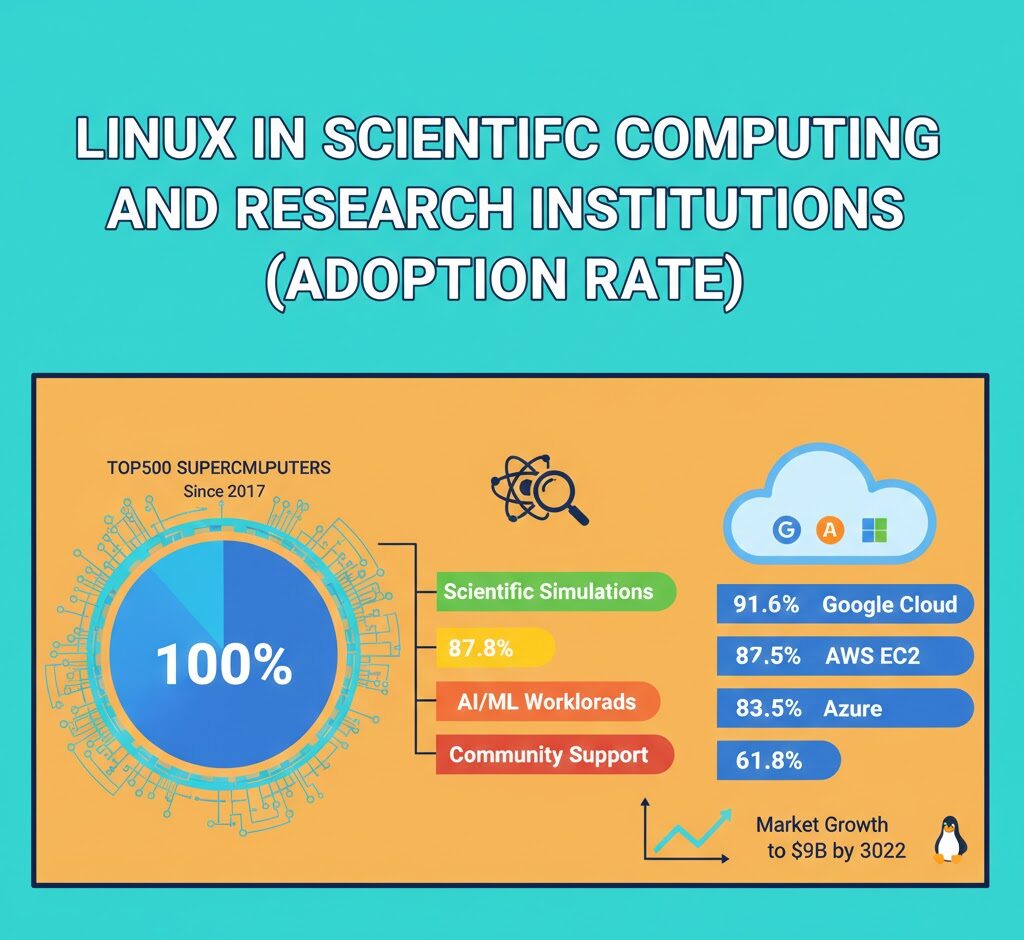
Every system on the TOP500 list of the world’s most powerful supercomputers runs on Linux, a streak that has extended uninterrupted since November 2017. This near-total domination highlights Linux’s critical role in scientific computing across various sectors, from high-performance computing (HPC) clusters to artificial intelligence (AI) research infrastructure and cloud-based platforms. The latest statistics reveal that Linux powers an impressive 100% of the TOP500 supercomputers, as well as 96.7% of scientific simulations and 87.8% of machine learning workloads globally.
The November 2025 TOP500 list ranks 500 systems that collectively achieved 22.16 exaFLOPS, with four surpassing the exascale threshold, all of which operate on Linux. Among the top performers, El Capitan at the Lawrence Livermore National Laboratory leads with a performance of 1.809 exaFLOPS using Red Hat Enterprise Linux (RHEL). Following it are Frontier and Aurora, both of which utilize various Linux-based operating systems. The JUPITER Booster, located at the Jülich Supercomputing Centre in Germany, marked Europe’s first entry into the exascale arena.
The U.S. maintains a significant lead with 175 systems, accounting for 48.4% of the total computing power on the TOP500 list, and Linux runs on every one of them. This overwhelming trend toward Linux is mirrored in research labs worldwide, where institutions like CERN and Fermilab have standardized on RHEL-based distributions. Meanwhile, NASA’s Pleiades supercomputer operates on SUSE Linux Enterprise Server, with plans to transition to Red Hat.
Recent statistics further illustrate Linux’s dominance across scientific workloads. An astonishing 96.7% of climate modeling, genomic analysis, and particle physics simulations are executed on Linux systems. This prevalence not only reflects the versatility and adaptability of Linux but also its growing acceptance among HPC institutions, where 73.2% cite community support for Linux as a primary factor in their operational choices. Additionally, 15.6% of government HPC labs reported an annual increase in Linux kernel customization, optimizing their systems for peak performance.
Market Context
In terms of cloud infrastructure, Linux is equally entrenched. Google Cloud reported a 91.6% adoption rate of Linux, while AWS EC2 follows closely with 83.5%. Microsoft Azure also shows a significant 61.8% of its cloud offerings running on Linux. The expansion of cloud-based research computing has democratized access to high-performance resources, particularly for universities that cannot afford on-premises supercomputers. AWS recently unveiled a dedicated HPC cluster equipped with 40,000 Trainium chips, all running on Linux, reinforcing its role in research.
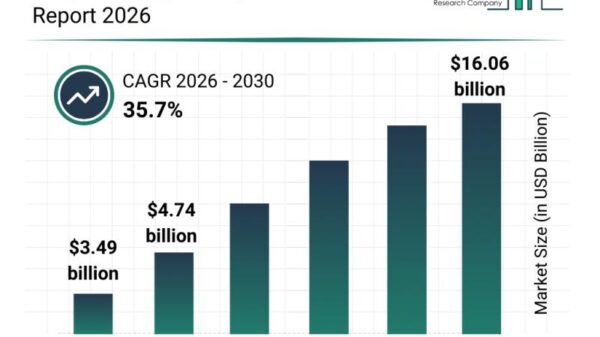
The global Linux operating system market underscores this trend, valued at approximately $21.97 billion in 2024 and projected to reach $99.69 billion by 2032. This growth is driven not only by scientific research but also by an increasing shift toward hybrid and cloud environments, leading to a compound annual growth rate (CAGR) of around 20.9% in the Linux market.
As for AI research, Linux continues to be the backbone, powering 87.8% of machine learning workloads globally. The reliance on Linux among developers is also notable, with about 78.5% using it as their primary or secondary operating system for AI and machine learning tasks. This trend is reflected in the popularity of frameworks like PyTorch, which captured around 85% of deep learning research papers and is integrated into many Linux-based systems.
In summary, Linux’s grip on the supercomputing landscape and broader scientific HPC ecosystem remains unassailable. Research institutions are not just deciding on whether to use Linux but are instead focused on choosing the distribution that aligns with their specific hardware, support needs, and workload profiles. This trend is echoed beyond scientific research, as governments and enterprises increasingly adopt Linux for its cost-effectiveness and flexibility, mirroring the evolution seen in research labs across the globe.
See also Pearson Reveals AI Study Tools Tripled Active Reading Engagement for 400K Students
 Lockheed Martin Enhances F-35 with AI Combat ID for Superior Threat Detection
 University of Cincinnati Secures $1M Grant to Enhance Medical Training with AI Technology
 Academic Album Launch Transforms Research on Metaverse into Catchy Eurotrance Tracks
 AI-Powered Study Aims to Transform Menopause Support with Online Insights