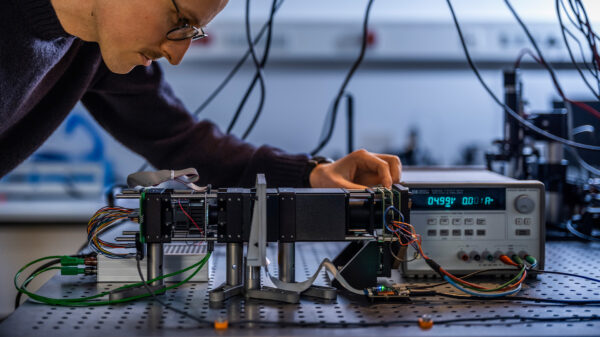
















































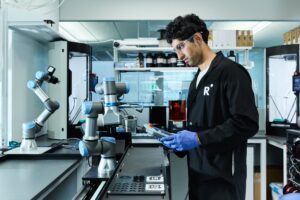
Radical AI, a New York City-based autonomous material-science discovery firm founded in 2024, is reshaping the landscape of materials research and development with its innovative self-driving lab. The lab boasts the capability to create and characterize over 25 alloys in a single day, harnessing the power of artificial intelligence to significantly enhance the materials discovery process. By screening billions of material compositions, Radical AI’s AI system predicts structures and physical properties, identifying candidates for experimental synthesis and characterization, thereby generating critical data that feeds back into the system to refine predictions.
This approach aligns with a growing trend in the industry. Research from Cypris R&D Intelligence indicates that AI-assisted methodologies yield 44% more material discoveries compared to traditional techniques, potentially compressing the typical 10 to 20-year timelines of materials R&D to just 1 to 2 years in some instances. Kristin Persson, director of the materials project at Berkeley Lab, highlighted the transformative nature of machine learning in materials science: “It saves scientists from repeating the same process over and over while testing new chemicals and making new materials in the lab.”
Radical AI’s lab is designed to establish a fully closed-loop system that progresses from discovery to the manufacturing of new materials. Its AI can analyze scientific publications, formulate hypotheses, and send materials for synthesis and testing, all while capturing and analyzing data to inform subsequent experiments. According to CEO Joseph Krause, once the loop is initiated, various processes occur in tandem: “We might be reading publications and coming up with the new experiment as we are characterizing the last thing that we just made and pulling real information out in real time.”
Krause, who brings expertise from his PhD studies at Rice University and a prior role at the Army Research Lab, co-founded Radical AI alongside Jorge Colindres and Gerbrand Ceder, the latter having served as a principal investigator at Lawrence Berkeley National Laboratory’s autonomous lab. The company secured $55 million in a Seed+ funding round in July 2025, led by RTX Ventures, with additional backing from NVIDIA’s NVentures, Eni Next, and AlleyCorp. A reported $60 million Series A followed soon after.
As Radical AI joins competitors like Lila Sciences and Periodic Labs in the development of “self-driving labs,” it also faces significant challenges. Academic institutions, including Argonne National Laboratory and Berkeley Lab, have made strides in automating the materials discovery process, with Argonne’s Polybot screening 90,000 material combinations in a matter of weeks—an endeavor that would traditionally span months.
Despite its ambitious goals, Radical AI’s lab is not fully autonomous; some testing remains semi-automated, requiring human oversight in analysis and labeling. While all samples are synthesized autonomously, certain tests, such as tensile assessments, still involve human intervention. Krause emphasized the importance of human expertise in analyzing data: “If you can’t pull that data in and understand all of that and analyze that, you’re not really building knowledge.”
However, significant bottlenecks in processing and manufacturing persist, a hurdle that Krause identifies as a major factor in the lengthy timelines of materials science. Though Radical AI is currently focused on discovery and testing, the company is cognizant of the need to address manufacturability challenges in the future. “If we can vertically integrate and then bring our AI and autonomy to the manufacturing process as well, then we can connect novel discovery and testing of manufacturability in a couple of weeks versus the 10 to 15 year process that it is today,” Krause stated.
A major issue facing the scientific community is the lack of data sharing regarding failed experiments, often leading to duplicated efforts across institutions. Radical AI aims to bridge this gap by meticulously recording and indexing all experimental outcomes, including failures, which are factored into future predictions. Krause noted, “We don’t do that in typical human science operations today.” This data-driven approach is vital for training AI models, as it enables continuous learning and improvement, steering clear of reliance solely on simulated data.
In a move to further integrate cutting-edge technology into materials science, Radical AI has joined the Genesis Mission, an initiative announced by the Trump administration in November. This mission seeks to foster a new era of AI-accelerated innovation within the scientific realm. It aims to create an “integrated discovery platform” that connects leading supercomputers, experimental facilities, AI systems, and datasets across scientific domains to enhance the productivity of American research.
Krause remarked on the importance of this initiative, stating, “This is an opportunity to show the American public how strong science is in the United States and show the capability to actually build the most advanced scientific tool ever built.” As Radical AI continues to navigate the challenges of the materials R&D landscape, its vision of a fully integrated, AI-driven materials discovery and manufacturing pipeline highlights the potential for groundbreaking advancements across multiple industries, including automotive, aerospace, and energy.
See also Next-Gen AI Swarms Threaten Social Media Integrity as 50% of Online Text is Generated by Bots
 Lam Research Achieves Record $5.34B Revenue, Drives AI Tool Investments Amid Supply Constraints
 Researcher Accused of Obscuring Baby’s Poisoning; AI Retractions Surge to 63,000
 Integrated MC-DL Framework Achieves 94% Gamma Passing Rate in Radiotherapy QA
 Researchers Achieve Exponential Gains in Machine Learning Using Minimal Quantum Features