









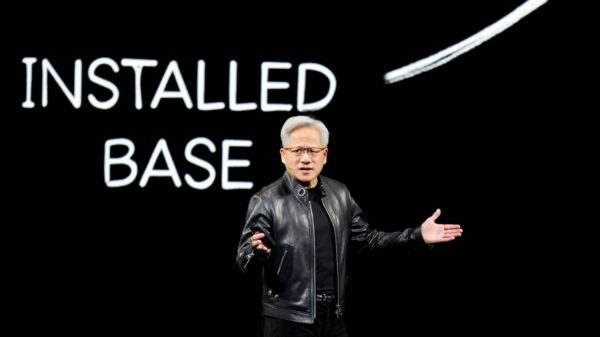













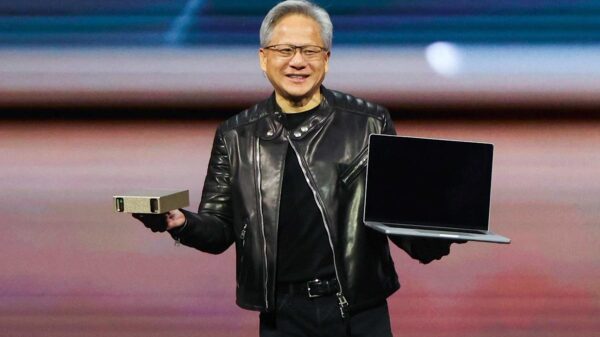

















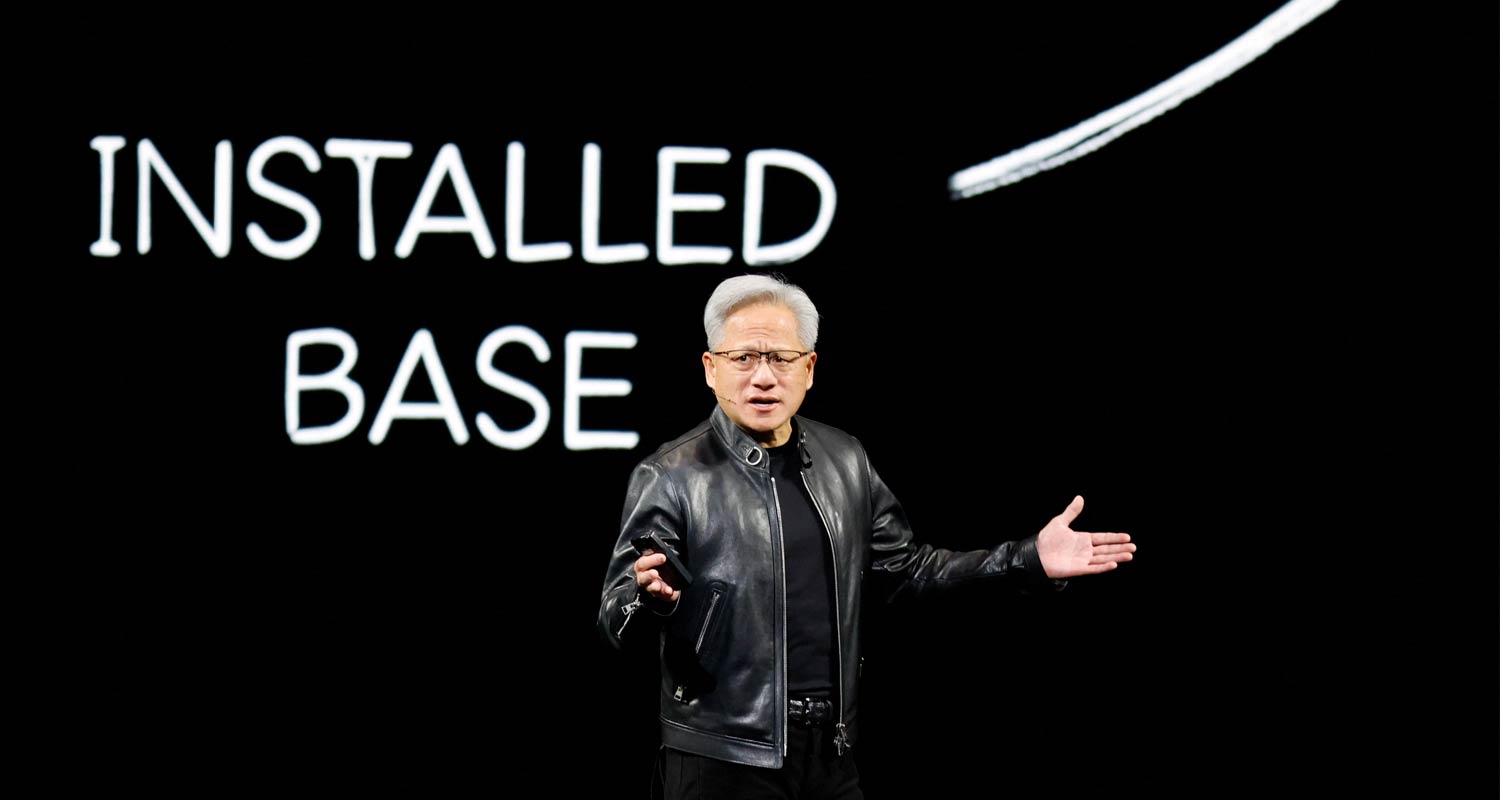
Nvidia is targeting a revenue opportunity of at least $1 trillion from its AI chips through to 2027, as the company aims to bolster its presence in the rapidly growing market for real-time AI systems. CEO Jensen Huang unveiled a new CPU and an AI system leveraging technology from Groq, a chip start-up from which Nvidia licensed technology for $17 billion in December, during its annual GTC developer conference in San Jose, California.
This strategy marks a shift for Nvidia, which has historically focused on AI model training, as it faces increasing competition in inference computing—the process of responding to queries—from CPUs and custom processors developed by companies like Google. Nvidia has dominated AI model training, but Huang emphasized the rising importance of inference. “The inference inflection has arrived,” he stated. “And demand just keeps on going up.”
Speaking at a venue with a capacity of over 18,000, Huang urged attendees to remember that “this is a tech conference,” as he showcased Nvidia’s latest innovations. Following a remarkable surge that propelled Nvidia to a $5 trillion valuation last October, questions have emerged regarding the sustainability of its growth trajectory. Investors are particularly scrutinizing whether Nvidia’s reinvestment strategy within the AI ecosystem will prove beneficial. Huang’s remarks appeared to mitigate some of these concerns.
The forecast of a $1 trillion opportunity marks a significant increase from the $500 billion revenue potential Nvidia projected earlier for its Blackwell and Rubin AI chips during its last earnings call in February. Following the announcement, Nvidia’s stock experienced a brief uptick before settling with a close of 1.2% up.
“Huang mapping out a $1 trillion opportunity through 2027 underscores the durable demand for Nvidia’s AI infrastructure despite investor concerns,” noted Emarketer analyst Jacob Bourne. “It signals Nvidia is sustaining its leadership in the AI chip market while the overall AI industry expands beyond early experimentation into large-scale deployment.”
Huang explained that the inference process will be divided into two steps: the Vera Rubin chips will manage the initial phase called “prefill,” which converts user requests from natural language into the “tokens” utilized by AI systems. The subsequent “decode” stage will be handled by Groq’s new chips, where the AI system provides the desired responses.
With organizations such as OpenAI, Anthropic, and Meta shifting their focus toward accommodating hundreds of millions of users engaging with their AI systems, the demand for CPUs is increasing. This segment, traditionally dominated by Intel, is gaining traction as a viable alternative to Nvidia’s graphics processors for deploying AI models.
“We are selling a lot of CPU standalone,” Huang remarked as he introduced the new Vera CPU, expressing confidence that this segment would undoubtedly become a multibillion-dollar business for Nvidia. He also shared elements of the company’s Feynman roadmap, albeit with limited specifics beyond a list of various chips, including AI processors and networking components, expected to culminate in the Feynman architecture by 2028, following the launch of the Rubin Ultra chips.
In addition, Nvidia is setting its sights on the market for autonomous AI agents with NemoClaw, which integrates with the widely discussed OpenClaw platform to enhance privacy and safety controls for tasks that can be executed with minimal human intervention.
“It’s kind of uplevelled the entire discussion. It’s uplevelled the entire thought of how they do infrastructure,” remarked Bob O’Donnell, president of Technalysis Research, commenting on the announcements. “He (Huang) used to come out with a new GPU chip and say, look, here’s my new chip. Now he’s got, you know, five racks of equipment that make up these systems.”
The advancements presented by Nvidia at the GTC conference suggest a strategic pivot that could redefine its role in the AI landscape, providing a glimpse into the future trajectory of AI deployment in various sectors.
See also Tesseract Launches Site Manager and PRISM Vision Badge for Job Site Clarity
 Affordable Android Smartwatches That Offer Great Value and Features
 Russia”s AIDOL Robot Stumbles During Debut in Moscow
 AI Technology Revolutionizes Meat Processing at Cargill Slaughterhouse
 Seagate Unveils Exos 4U100: 3.2PB AI-Ready Storage with Advanced HAMR Tech