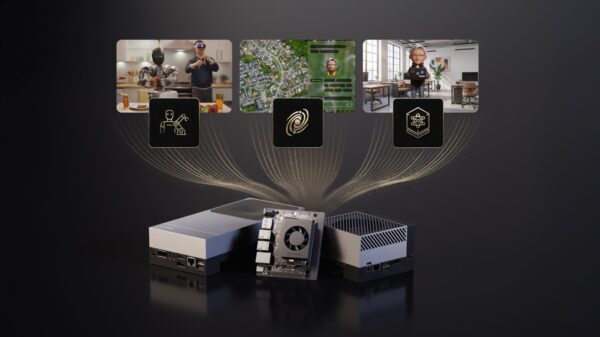
At CES 2026, the tech landscape is witnessing a significant shift as companies pivot their focus from expansive cloud data centers to localized, edge-based artificial intelligence. Ambarella (NASDAQ: AMBA), traditionally recognized for its high-definition video processing, has emerged as a leader in the “Physical AI” sector. The company unveiled its comprehensive DevZone developer ecosystem and a new suite of 4nm AI silicon, marking a strategic transformation aimed at establishing itself as a full-stack edge AI infrastructure provider. This move positions Ambarella at the forefront of what analysts are calling “The Rise of the AI PC/Edge AI,” a pivotal moment in the evolution of artificial intelligence technology.
The introduction of Ambarella’s DevZone signifies more than just software enhancements; it invites developers to detach AI capabilities from cloud reliance. With the rollout of “Agentic Blueprints”—low-code templates designed for multi-agent AI systems—Ambarella is significantly lowering entry barriers for high-performance local AI inference. This transition indicates a maturation of the edge AI market, where specialized silicon has evolved from a premium feature for autonomous vehicles to a fundamental requirement for various applications, including privacy-focused security cameras and industrial robotics.
Central to Ambarella’s technical prowess is its proprietary CVflow® architecture, now in its third generation with the flagship CV3-AD685 and the newly announced CV7 series. Unlike conventional GPUs or integrated NPUs, CVflow is a “transformer-native” architecture that optimizes energy efficiency by hard-coding high-level AI operations directly into the silicon logic. This innovation allows for substantial parallel processing while minimizing power consumption. For instance, the N1 SoC series can execute a Llama-3 (8B) model at 25 tokens per second, utilizing just 5 to 10 watts, a stark contrast to the over 50 watts required by discrete mobile GPUs to achieve similar performance.
The recently revealed specifications are impressive. The CV7 SoC, produced on Samsung Electronics’ (OTC:SSNLF) 4nm process, integrates 8K video processing capabilities alongside advanced multimodal Large Language Model (LLM) support, demonstrating 20% improved power efficiency and six times the AI performance compared to its predecessor. This architectural advancement addresses the long-standing “memory wall” that has hindered edge devices, enabling Vision-Language Models (VLMs) like LLaVA-OneVision to operate concurrently with twelve simultaneous 1080p30 video streams, facilitating real-time, on-device perception previously reliant on high-bandwidth data center connections.
Ambarella’s strategic shift directly confronts established industry titans, including NVIDIA (NASDAQ: NVDA), Qualcomm (NASDAQ: QCOM), and Intel (NASDAQ: INTC). While NVIDIA maintains its dominance in AI training and high-end workstation performance, Ambarella is focusing on “inference efficiency.” In sectors like automotive and industrial applications, the CV3-AD series is increasingly viewed as a viable alternative to energy-hungry discrete GPUs, offering a comprehensive System-on-Chip (SoC) that combines image signal processing (ISP), robust safety measures, and AI acceleration in a compact, low-power package.
This competitive dynamic is particularly relevant in the evolving “AI PC” market. As Microsoft (NASDAQ: MSFT) advances its Copilot+ frameworks, Qualcomm’s Snapdragon X2 Elite and Intel’s Panther Lake are vying for consumer laptop market share. Ambarella, however, is concentrating on the “Industrial Edge,” where requirements for privacy, low latency, and uninterrupted reliability are critical. By delivering a unified software stack via the Cooper Developer Platform, the company enables Independent Software Vendors (ISVs) to navigate the complexities of traditional NPU programming more efficiently.
Market analysts suggest that Ambarella’s transition to a “full-stack” model—melding its silicon with the Cooper Model Garden and Agentic Blueprints—creates a strategic advantage. By offering pre-validated, optimized models that are easy to implement on CVflow, the company is shortening development cycles from months to mere weeks. This disruptive approach may compel competitors to pivot towards more specialized AI acceleration tools to meet the efficiency demands of the 2026 landscape.
The broader implications of Ambarella’s strategy align with a growing industry trend favoring localized AI. The shift from “Cloud-First” to “Edge-First” is motivated by two principal factors: cost and privacy. In 2026, the financial burden of processing billions of LLM queries in the cloud has become untenable for many enterprises. Transitioning inference to local devices—be it a security camera capable of understanding natural language or a vehicle that can analyze road conditions—enormously decreases the Total Cost of Ownership (TCO).
Moreover, rising privacy concerns that dominated discussions in 2024 and 2025 have spurred demands for “Data Sovereignty.” Ambarella’s capacity to execute complex multimodal models entirely on the device ensures that sensitive visual and voice data remain within local networks. This development is a crucial milestone in democratizing AI, shifting its control from major cloud providers into everyday applications.
Looking ahead, the launch of DevZone and Agentic Blueprints indicates a future where edge devices morph from passive tools to active participants in AI workflows. Ambarella is preparing to power a new generation of “AI Gateways” in smart cities, which will manage local traffic and emergency responses efficiently. In the long term, integrating generative AI into robotics stands to benefit significantly from the energy-efficient CVflow architecture. The key challenge lies in standardizing multi-agent workflows, which Ambarella aims to address through its open-ecosystem strategy. Experts predict that by 2027, the concept of the “AI PC” will evolve beyond a specific product category, becoming a standard feature across all computing platforms, with Ambarella’s specialized silicon as a foundational element in this transition.
Ambarella’s strategic evolution is a landmark development in the trajectory of artificial intelligence. By adeptly shifting from video processing to becoming the “NVIDIA of the Edge,” the company has underscored the vital role of specialized silicon in the AI revolution. The unveiling of the DevZone at CES 2026 symbolizes a turning point where sophisticated AI capabilities become accessible to a broader developer ecosystem, independent of cloud dependencies.
The essential takeaway for 2026 is that the competition for AI supremacy has transitioned from data volume to efficient data processing. Ambarella’s emphasis on power-per-token and comprehensive developer support positions it as a key player in the global AI infrastructure landscape. In the upcoming months, attention will be focused on the initial wave of “Agentic” products powered by the CV7 and N1 series, heralding the decline of cloud dominance in the realm of intelligence.
See also Google’s Ex-G Engineer’s AI Secrets Found Lacking Value, Jury Hears
 Class Action Filed Against Musk’s xAI Over Grok’s Nonconsensual Deepfake Scandal
 Joseph Gordon-Levitt Champions Key Bill to Regulate ‘Amoral’ AI Companies in Utah
 HeyGen, LTX, and Runway: Top AI Video Platforms for 2026 Unveiled with Key Insights