
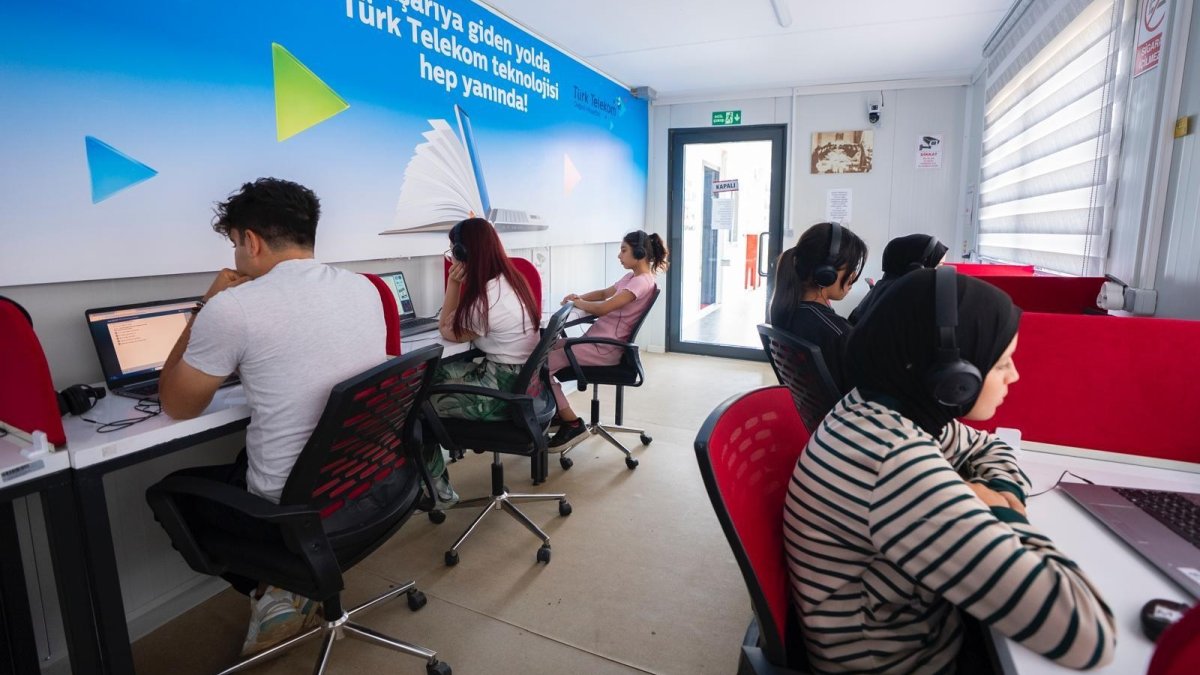
Türk Telekom, one of Türkiye’s leading telecom and tech companies, is expanding its role in the country’s digital transformation by making significant strides into the education technology (EdTech) sector. The company is deepening its strategic investments through its subsidiary SEBIT and corporate venture arm TT Ventures, transitioning from merely providing infrastructure to developing AI-powered solutions aimed at improving educational outcomes.
Recent industry data indicates that Türk Telekom is positioning itself as a comprehensive learning analytics service provider, integrating connectivity, artificial intelligence, and simulation technologies. SEBIT, recognized as Türkiye’s largest education technology company, has enhanced its leadership with AI algorithms focused on personalized learning. Platforms such as Vitamin LGS and Raunt utilize advanced data analytics to assess students’ performance gaps in real time, enabling customized content delivery and measurable academic improvements.
The impact of these investments was evident in the 2024 national high school entrance exam (LGS), where 30 Vitamin users achieved perfect scores, ranking first nationally. Additionally, SEBIT VCloud’s recognition as a finalist at the Learning Technologies Awards 2025 underscores the international acknowledgment of the company’s digital education capabilities. By 2026, major private education chains, including Ortadoğulular and Teknofen, had integrated SEBIT’s infrastructure into their digital transformation strategies, further solidifying its position in the sector.
Türk Telekom’s vision for education extends beyond its subsidiaries. Through TT Ventures’ Pilot accelerator program, the company is supporting local EdTech startups, with the total valuation of these companies reaching $576 million. The portfolio includes platforms focused on virtual and augmented reality, such as Nara. Several of these startups showcased their innovations on the global stage at CES 2025 and CES 2026 in Las Vegas, illustrating Türkiye’s growing presence in the EdTech export market.
In tandem with commercial investments, Türk Telekom prioritizes social impact initiatives aimed at promoting educational equality. The TahtApp project, which supports classroom learning for visually impaired children, expanded to 100 additional schools across 22 provinces during the 2025-2026 academic year, impacting thousands of students. Furthermore, the company has launched “100th Anniversary Libraries” across the nation, particularly in southeastern regions affected by devastating earthquakes in early 2023. These libraries provide coding and digital skills training to youth, aiming to cultivate a qualified workforce for the future.
As Türk Telekom integrates 5.5G and low-latency connectivity with AI-driven education and simulation tools, it is evolving into a data-driven education technology enabler, poised to enhance learning outcomes and shape Türkiye’s digital education landscape.
According to the latest “State of AI in Telecommunications” survey by Nvidia, telecom operators are transitioning from traditional data carriers to AI-native infrastructures, increasingly aligning with the forthcoming 6G era. The report, based on insights from global industry leaders, suggests a fundamental shift in the telecom ecosystem mindset. Notably, around 90% of respondents stated that AI integration directly boosts revenues while also reducing operational costs. The most transformative changes are anticipated in network management.
Experts contend that 6G will not merely signify higher speeds but will represent a self-managing, intelligence-embedded architecture. The Nvidia report indicates that 77% of participants believe AI will serve as the primary operating system for networks even before 6G standards are fully established, suggesting that the capabilities enabled by 5G will lead to cognitive functions through AI well ahead of the transition.
Among the critical technologies identified in the report is “Agentic AI,” capable of autonomously detecting fiber cuts, traffic congestion, or other network anomalies, and rerouting data without human intervention. This self-healing capability is expected to improve operational efficiency by 26%, yielding the highest return on investment across AI implementations in telecommunications.
The growing influence of AI on productivity and network optimization is reflected in corporate budgets, with 89% of companies planning to increase AI spending in 2026, shifting their focus from customer-facing chatbots to fully autonomous network management systems. Nvidia’s outlook for 2026 suggests that the telecommunications sector will evolve into an “intelligent pipeline,” where AI becomes a foundational layer essential for achieving the goals of ultralow latency and high energy efficiency.
In this technological landscape, operators are anticipated to transform into “invisible brains.” Bülent Kaytaz, founder of Teosol Technology, asserts that future networks, entirely cloud-based, will manage capacity in real time through AI, with hardware serving merely as “dumb antennas.” This paradigm shift emphasizes that autonomous systems will depend on intelligent, software-defined network architectures.
The burgeoning demand for online lessons has made hybrid education a permanent fixture in the post-pandemic landscape. In 2025, Türkiye experienced a surge in online learning, positioning itself as a leading adopter of EdTech solutions. Data from Novakid reveals that Türkiye surpassed 1.6 million completed lessons last year, accounting for 22.5% of the platform’s global volume and establishing the country as Novakid’s top market in lesson volume and revenue.
As families worldwide gain confidence in digital education, Türkiye’s young population is rapidly adapting to these tools, setting the stage for an entrenched hybrid education model in 2026. The growing participation levels underscore a strong commitment to digital learning, with 49% of students engaging in at least two lessons per week.
Looking ahead, the global EdTech community is gearing up for the ASU GSV Summit in April 2026, where Novakid plans to unveil a new, fully autonomous AI-based application aimed at school-aged children. CEO Max Azarov highlighted 2025 as a pivotal year for innovation, expressing a vision to redefine online education accessibility through AI and interactive tools.
The investment landscape is also shifting, with data from Carta indicating that while total capital raised has increased, the number of funding rounds has decreased, suggesting that investors are concentrating resources on fewer but stronger ventures. This more selective approach is evident in the growing trend of venture funds targeting AI-native startups, indicating a strategic evolution within the global startup ecosystem.
See also House Hearing Calls for Federal Support in AI Teacher Training Amid Rising Classroom Use
 UK Inquiry Launches to Assess AI’s Impact on Education and Learner Protections
 Janel Forde and Jennifer Sobanet Discuss AI’s Role in Higher Education at RMAIN Summit