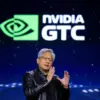
The recent sell-off in technology stocks has rendered valuations for prominent AI hardware suppliers like Nvidia and Dell Technologies significantly more attractive, with expectations of strong earnings reports from both companies in May that could propel their stock prices to new heights. This shift in market sentiment has sparked interest among investors in companies that underpin the burgeoning AI sector.
Nvidia, a leader in AI chip manufacturing, has seen robust demand for its products, particularly within its data center business, which reported an impressive $62 billion in revenue last quarter. This figure represents a remarkable 75% year-over-year increase, coupled with a gross margin of 75%. Such metrics underscore Nvidia’s strong pricing power and its potential for continued earnings growth, further solidifying its competitive position in the market.
Meanwhile, Dell Technologies is poised for significant growth as it anticipates a 50% increase in AI capital spending by 2026. Last year, Dell shipped $25 billion worth of AI servers and currently boasts a backlog of $43 billion in AI-related orders, highlighting substantial demand in this emerging market. Although Dell’s overall business is still heavily reliant on a sluggish PC market, the rapid expansion of AI servers offers a compelling case for a reevaluation of its valuation. With a current forward price-to-earnings (P/E) ratio of just 14, analysts suggest there is considerable upside potential ahead.
In broader market dynamics, recent volatility has left the S&P 500 reeling, dropping by 5% at the end of March amid investor concerns over the U.S. economy and geopolitical tensions, particularly related to the conflict in Iran. This backdrop has created a cautious atmosphere among investors, particularly regarding tech stocks. Notably, the proliferation of artificial intelligence has been a key driver for market growth, contributing to a nearly 80% surge in the S&P 500 over the past three years.
On the investment horizon, Nvidia’s stock has achieved astronomical returns, soaring nearly 460,500% since its initial public offering (IPO), transforming a $1,000 investment into approximately $4.61 million. Even over the past decade, a $1,000 investment would now be valued at about $210,000. The company’s GPUs are not just pivotal for gaming and cryptocurrency mining; they are increasingly recognized as essential to the advancement of AI development.
Nvidia’s CEO has projected that sales from its latest semiconductor platforms could reach $1 trillion annually by 2027, despite current market hesitance surrounding customer spending. This outlook suggests that Nvidia’s current valuation might present an excellent entry point for new investors, strengthening the case for its ongoing growth narrative.
Moreover, Nvidia is navigating potential acquisition talks that could reshape the personal computer market. The company has been in negotiations for over a year to acquire a significant player in the sector, a move that could significantly enhance its competitive edge and alter market dynamics. Following news of these discussions, Dell’s shares surged approximately 6%, while HP’s stock rose around 4%, reflecting investor optimism about Nvidia’s strategic positioning.
In a related development, Nvidia has recently launched the Ising series of open-source AI models aimed at advancing quantum computing technology. This initiative not only underscores Nvidia’s innovative leadership in the field but also aims to integrate AI capabilities into quantum systems effectively. The Ising Calibration model, for instance, promises to expedite the calibration of quantum processors, slashing the time required from days to mere hours, thereby enhancing operational efficiency. As the quantum computing market is projected to exceed $11 billion by 2030, Nvidia’s strategic foray into this sector could provide substantial momentum for future growth.
As the tech sector grapples with current market turbulence, Nvidia and Dell Technologies stand out as prime examples of companies positioned to capitalize on the ongoing AI revolution. Their strong financial performance and robust demand for AI solutions suggest a promising path ahead, not just for the companies themselves but also for investors looking to navigate the complexities of a rapidly evolving market landscape. The forthcoming earnings reports will be pivotal in determining whether these firms can sustain their growth trajectories amidst the broader economic uncertainties.
See also SiFive Unveils RISC-V Architecture to Overcome AI Compute Bottlenecks and Boost Efficiency
 Microsoft Research Announces 2026 Fellowship Cohort Focused on AI and Education
 North Korean Hackers Breach Zerion, Stealing $100K via AI-Driven Social Engineering