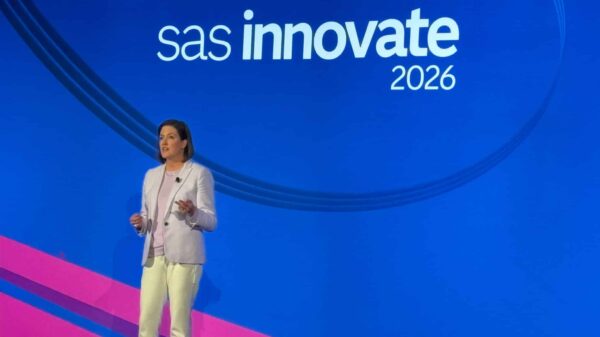
SAS Institute Inc. leveraged its SAS Innovate conference this week to unveil a comprehensive suite of product updates aimed at empowering enterprises to operationalize artificial intelligence (AI) with enhanced governance, integrated data management, and broadened agentic AI capabilities. This initiative marks a significant step as organizations seek to move beyond mere experimentation into large-scale implementations tailored to specific use cases.
The announcements prominently feature a new governance layer, improvements to the SAS Viya platform, and a growing array of industry-specific AI agents and accelerators. Central to these updates is the introduction of SAS AI Navigator, a software-as-a-service solution currently in private preview, designed to assist businesses in inventorying, monitoring, and governing AI applications across various models, agents, and business processes. The platform aims to tackle rising concerns surrounding “shadow AI,” or tools and models functioning outside the oversight of IT departments.
Research highlighted by SAS indicates that the adoption of large language models and AI agents is outpacing investments in trustworthy AI, prompting analysts to forecast an increase in compliance and security incidents tied to unauthorized AI deployments. Gartner recently predicted that by 2030, more than 40% of enterprises will face security or compliance incidents as a result of shadow AI. “AI governance is too often thought of as a compliance measure,” stated Reggie Townsend, vice president of AI ethics, governance, and social impact at SAS. “It’s a growth driver. Instead of fears of shadow AI putting the organization at risk, AI governance empowers people to push the limits of AI within a structured, transparent, and secure environment.”
The SAS AI Navigator aims to provide a comprehensive overview of AI assets throughout their lifecycle—from experimentation through deployment and eventual retirement—without necessitating that organizations standardize on a single model or toolset. The platform is anticipated to become available in the third quarter of 2026 via Microsoft Corp.’s Azure Marketplace.
SAS also introduced a series of enhancements to the SAS Viya analytics platform, which it positions as the foundation for “agentic AI” systems that integrate AI assistants, autonomous agents, and human oversight. The enhancements allow enterprises to combine the capabilities of AI copilots and agents with human judgment and governance to foster greater confidence in decision-making processes.
Notable additions to SAS Viya include the SAS Viya Copilot, a suite of embedded AI assistants engineered to function within analytics workflows rather than as standalone chat interfaces. These assistants facilitate tasks such as data exploration, model development, and decision-making through natural language, all while upholding governance controls. Furthermore, SAS introduced a server built on the open Model Context Protocol standard, enabling organizations to grant external AI agents access to SAS analytics capabilities without duplicating logic or circumventing controls. Accompanying this is the Agentic AI Accelerator, which provides frameworks and tools for constructing and deploying governed agents.
Together, these features aim to transform enterprises from isolated generative AI experiments to integrated systems that connect insights, decisions, and actions across various business processes. In addition to platform enhancements, SAS is broadening its portfolio of industry-centric AI agents, focusing particularly on complex operational scenarios. The newly developed SAS Supply Chain Agent is tailored to automate and continually optimize sales and operations planning—an intricate process typically conducted only once a month. This agent is capable of simulating scenarios, forecasting demand, and adjusting supply strategies in near real time, allowing users to interact through a conversational interface.
Updates to SAS’s data management portfolio also emerged, emphasizing the integration of governance and lineage directly into data workflows. This approach highlights the importance of running analytics where data resides, rather than transferring it between systems. Key supporting technologies include SAS SpeedyStore, a data platform that unifies transactional and analytical workloads within a single, secure database.
Moreover, SAS is extending AI assistance throughout the data lifecycle, incorporating copilots and agents that aid users in discovering, preparing, and managing data within governed environments. This strategy aims to boost trust and auditability as AI systems increasingly depend on automated decision-making. By amalgamating governance tools, embedded AI assistants, agent frameworks, and data management capabilities, SAS is positioning its platform as an end-to-end environment for constructing and managing AI systems that can scale while adhering to regulatory and operational requirements.
As enterprises navigate the complexities of AI deployment, SAS’s developments at this conference signal a significant shift towards more structured and accountable AI governance, which may ultimately drive innovation and enhance operational efficiencies across various sectors.
See also China Penalizes Three Platforms for Failing AI Content Labeling Regulations
 WellnessLiving Launches AI-Powered Marketing Suite to Boost Client Retention by 32%
 Agentic Enterprises Transform AI Deployment, Emphasizing Integrated Systems and Autonomy
 Asana Launches AI Teammates to Boost Team Productivity, Saving 15,000 Hours Annually
 Decision-Aware Machine Learning Achieves 30% Increase in Access to Essential Medicines