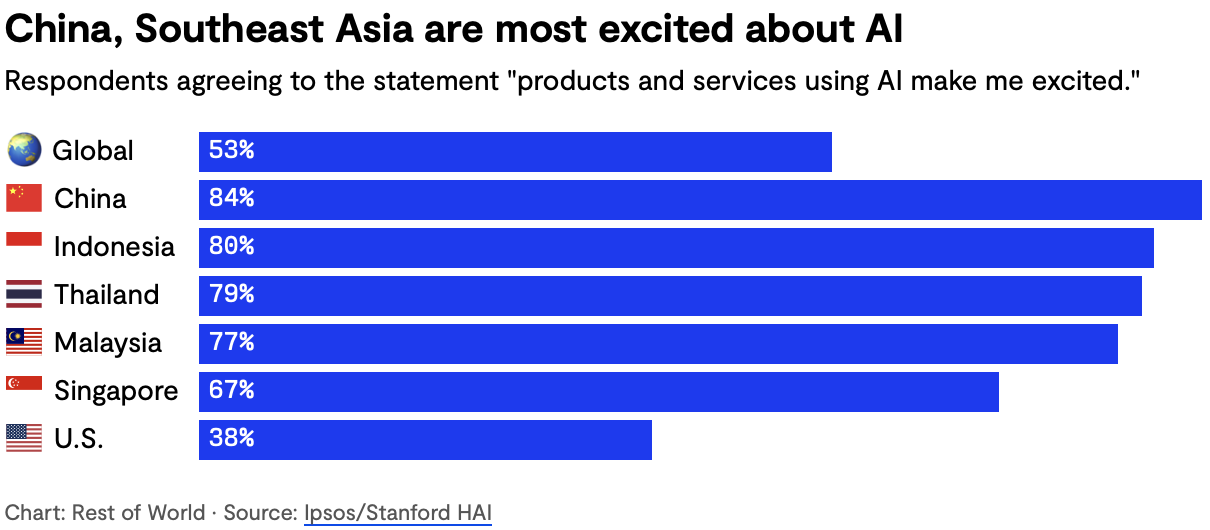
As global interest in artificial intelligence (AI) continues to surge, a recent study from Stanford University’s Human-Centered Artificial Intelligence center reveals a stark divide in sentiment toward AI across different regions. While anxiety about the technology grows, so too does optimism about its potential benefits. In the United States, however, enthusiasm appears muted in comparison to countries like China and various Southeast Asian nations. Only 38% of U.S. respondents expressed excitement about AI products and services, a striking contrast to 84% of respondents in China. The sentiment among Southeast Asians also reflects a high level of optimism, with 80% of Indonesians, 77% of Malaysians, and 79% of Thais expressing similar enthusiasm.
The underlying factors driving this divergence in sentiment may be closely tied to trust in government regulation. According to the Stanford study, trust levels vary significantly across nations, with Singapore boasting over 80% trust in its government, while the United States languishes at just 31%. This disparity suggests that confidence in government oversight may play a crucial role in shaping public perceptions of AI.
The findings raise intriguing questions about the relationship between government trust and consumer attitudes towards technology. In countries with higher trust levels, such as Singapore, the public is likely to perceive AI as a tool for progress and innovation, bolstered by the belief that regulations will ensure its safe and ethical deployment. Conversely, in the United States, increased scrutiny of both government and AI companies may lead to skepticism and hesitation. Issues surrounding data privacy, algorithmic bias, and ethical considerations have fueled this distrust, leaving many Americans wary of rapid technological advancement.
Experts posit that the higher rates of optimism in Asia may also stem from cultural attitudes towards technology and innovation. In many Southeast Asian nations, there is a strong belief that technology can drive economic growth and improve quality of life. This contrasts with the U.S. perspective, which has been increasingly critical of large tech companies and their role in society. The United States’ more extensive media coverage of technology missteps and failures may contribute to a climate of skepticism, leading to more cautious consumer attitudes toward AI.
As AI continues to advance and integrate into various sectors, the implications of these differing attitudes will become increasingly significant. In regions where optimism prevails, businesses may be more inclined to invest in AI solutions, leading to accelerated growth and innovation. Conversely, in markets characterized by skepticism, companies may face challenges in gaining consumer acceptance, potentially hindering their ability to capitalize on AI advancements.
The study highlights an evolving landscape where public perceptions of AI are shaped not only by technological advancements but also by the socio-political context in which they occur. As governments around the world grapple with the implications of AI, fostering trust will be essential in bridging the gap between innovation and public acceptance. The future of AI may well depend on not just technological capabilities but also on the robust frameworks for governance and ethical oversight that inspire confidence among consumers.
As nations navigate the complexities of AI implementation, understanding and addressing these sentiments will be crucial. It remains to be seen how governments, particularly in the United States, will respond to the growing concerns around AI and what measures they will take to enhance public trust. The path forward will likely require a concerted effort to demonstrate that AI can be harnessed as a force for good, ultimately reshaping the relationship between technology and society.
See also Google Signs $200M AI Deal with Pentagon for Classified Military Applications
 Pentagon Expands Google AI Use in Classified Operations Amid Anthropic Controversy
 Unions Warn NSW Government: AI Adoption Could Lead to Mass Job Losses Without Protections
 AI Experts Warn: Ignorance Hinders Effective Regulation as Anthropic Reveals Mythos Capability
 OnAI Launches Mobile Service, Transforming Government Administration with AI by April 30