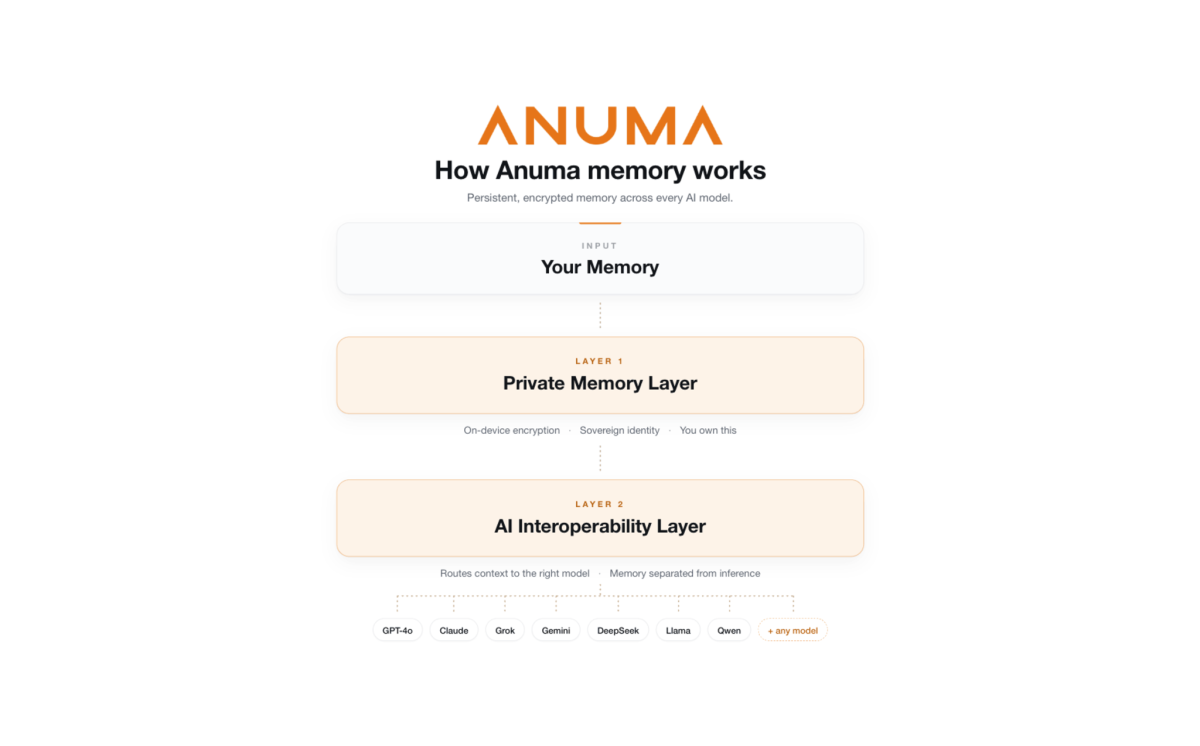
SAN FRANCISCO, April 27, 2026 (GLOBE NEWSWIRE) — Anuma, a new privacy-first AI application co-created by Basic Attention Token co-founder Ankur Nandwani, has officially opened to the public. The platform offers a single subscription that grants access to several leading AI models, including ChatGPT, Claude, Gemini, Grok, and DeepSeek, alongside a user-controlled encrypted memory that maintains context across all models. The app was tested by over 10,000 users during its beta phase.
As generative AI experiences rapid adoption, trust and data ownership have struggled to keep pace. According to the Stanford HAI’s 2026 AI Index, generative AI has achieved 53% adoption within three years, significantly outpacing previous technologies like personal computers and the internet. Concerns have arisen as lawyers warn users that conversations with chatbots can potentially be used against them in legal settings. Reports also indicate that companies like Anthropic and OpenAI are increasingly confining access to their advanced models within proprietary ecosystems, leading to a greater imbalance of power between users and service providers.
Anuma aims to address these concerns by allowing users to maintain control over their data. With one subscription, users can access a variety of AI models without losing context throughout their conversations. The platform’s unique memory structure stores user data locally on their device, encrypted and separate from model inference, effectively ensuring that users do not have to repeatedly provide personal history every time they switch models.
“Today’s AI products want to trap your context inside their own ecosystem,” said Nandwani. “We built Anuma so your memory stays yours, no matter which model you use.” The application is designed around three core principles: a unified memory across all models, access to multiple models from a single interface, and a default privacy setting that protects user data.
The memory structure in Anuma allows for seamless transitions between different AI models, carrying over preferences, project details, and conversation history. Users can also compare outputs from various models side-by-side in what the company calls Council Mode. Anuma also enables users to text AI via SMS and iMessage without needing additional downloads and provides tools for creating images, videos, and audio.
Nandwani’s background with Basic Attention Token, which powers the privacy-focused Brave browser, reinforces his commitment to user privacy. Brave has seen significant success, with 112.2 million monthly active users as of March 31, 2026. This indicates a robust market for privacy-focused products, suggesting that users will opt for stronger offerings that respect their data.
Anuma embodies this privacy-first philosophy, ensuring that user-owned memory is encrypted and never stored on its servers or utilized for training models. “Brave was created because the browser had become a surveillance tool and users had no real say in it,” Nandwani stated. “AI is heading in the same direction. A lot of people want the benefits of the best models without giving up ownership of their memory, and Anuma gives them that choice.”
The platform features a free tier that includes 100 credits per month and access to all major functionalities, such as encrypted memory and multi-model chat, with no credit card required for sign-up. Paid plans include a Starter option priced at $9.99 per month and a Pro version at $19.99 per month.
Anuma is now available on the web, with mobile applications for iOS and Android expected to launch soon. Users can access AI services through text messaging as well, broadening the platform’s usability.
As the landscape of artificial intelligence continues to evolve, Anuma positions itself as a leading solution for privacy-oriented users, promising a secure and versatile environment for interacting with AI technology. By allowing users to maintain control over their data while accessing a variety of models, Anuma may set a new standard for user-centric AI applications.
See also Grok, Runway, and Kling Transform AI Video Landscape as Sora’s Closure Shifts Dynamics
 AI Will Enhance iPhone’s Role as a Personal Digital Passport, Says Perplexity CEO
 Microsoft Warns Legacy Banks Face Pressure as AI Transforms Financial Transactions
 Google DeepMind Reveals LLMs Can’t Achieve Consciousness, Challenging AGI Claims
 Meta’s AI Acquisition Fails as China’s DeepSeek V4 Struggles to Compete