






















































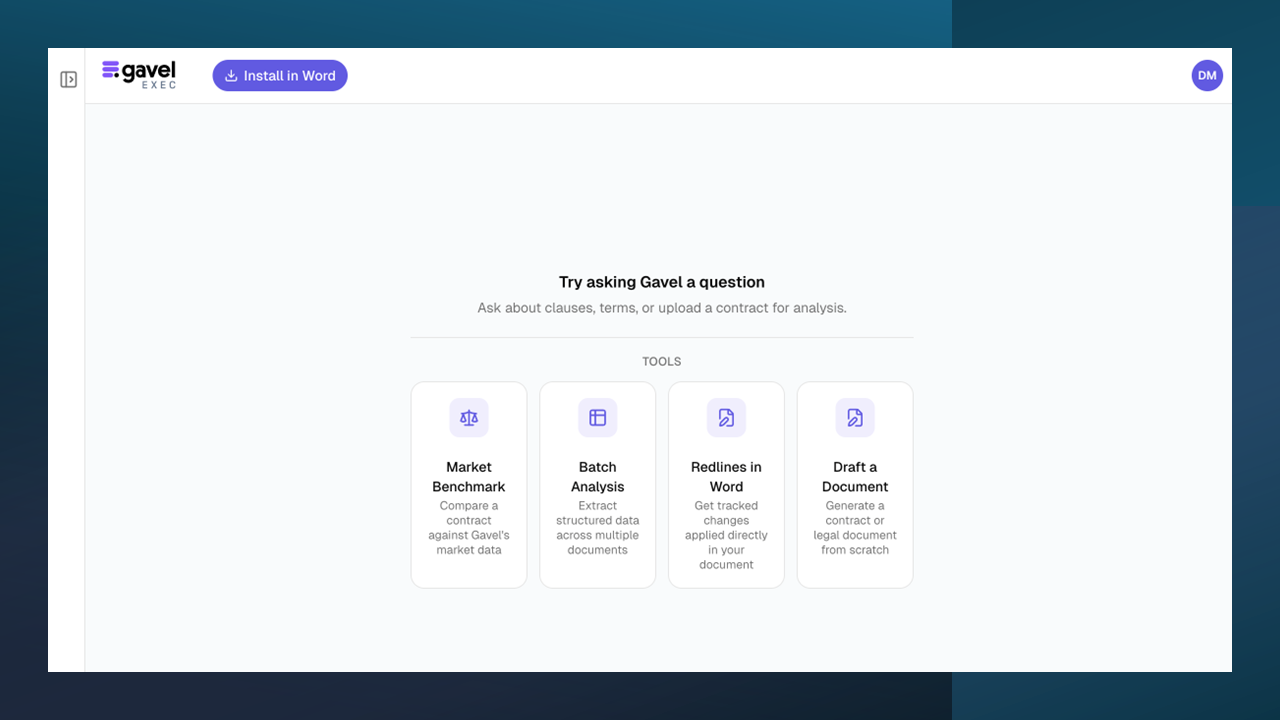
Gavel, the Los Angeles-based legal AI company, has launched Gavel Exec for Web, a browser-based version of its AI contract review and drafting tool, which previously functioned mainly as an add-in for Microsoft Word. This expansion aims to enhance accessibility and usability for legal professionals, allowing them to interact with an AI specifically designed for legal tasks.
The new platform enables lawyers to engage in conversation with the AI to discuss legal issues, benchmark documents against industry standards, and conduct batch analyses of contract portfolios. This move positions Gavel more directly against other enterprise legal AI platforms that have traditionally dominated the contract review space for law firms and in-house teams, while maintaining its product-led, self-serve approach.
Lawyers can access Gavel Exec for Web by signing up at exec.gavel.io, without the need for a sales call or credit card. Current users of Gavel Exec will receive access to the new web platform under their existing plans and can continue using the Word add-in as well.
“This is a step change for what Gavel can do, and a step change for the market,” stated Dorna Moini, Gavel’s CEO. She emphasized that the new product is an end-to-end platform for legal document drafting, built by lawyers and grounded in legal data. The capabilities of Gavel Exec for Web include batch analysis of contracts, market benchmarking, long-form drafting, multi-document analysis, and conversational AI specifically aimed at legal problem-solving.
The batch analysis feature allows users to examine multiple contracts simultaneously, presenting the findings in a structured format that highlights key terms and enables the drafting of memoranda on major issues. Gavel promotes this functionality for various applications, including due diligence and policy audits. Meanwhile, the market benchmarking capability allows users to compare clauses or entire documents against established standards, segmented by industry and company size.
In addition to these features, Gavel Exec for Web includes a new hybrid search architecture, which supports searching across collections of up to 1GB. This system combines semantic search to find conceptually similar clauses across differently worded documents with traditional full-text search, essential for pinpointing exact language and defined terms.
“Lawyers need to know when a precedent uses the exact same words, when a clause is merely similar, and when an external source supports a factual statement,” explained Pierre Martin, Gavel’s chief technology officer. Internal testing by the company reportedly showed search accuracy improvements of up to 93% compared to perfect results, with search latency reportedly cut in half, although these figures have not been independently verified.
Gavel’s approach challenges the conventional sales cycles and procurement processes that often restrict access to advanced legal AI tools primarily to larger firms. Moini, who previously worked as a litigator at Sidley Austin, has criticized the prevailing venture models that lead to inflated valuations within the legal AI sector. By allowing lawyers to evaluate the product independently without lengthy sales discussions, Gavel aims to democratize access to its technology.
“We have a team that deeply understands both the legal field and AI technology, and we’ve built Gavel to meet and exceed the expectations that lawyers have for legal automation and AI,” Moini said, underscoring the platform’s commitment to serving firms of all sizes.
Gavel reports that it is currently utilized by nearly 2,000 legal organizations across 23 countries. Originally known as Documate until its rebranding in 2023, the company has built a reputation for its no-code document automation platform. Gavel Exec was launched in 2025 as a Word-based AI tool tailored for transactional lawyers, powered by firm-specific playbooks and precedents, while both Gavel Exec and Gavel Workflows continue to be available as independent offerings.
As Gavel expands its capabilities and accessibility, it reflects a broader trend in the legal industry towards embracing technology to streamline document processes and improve efficiency. The move to a web-based platform signifies a growing recognition of the need for flexible, user-friendly legal tech solutions that cater to a diverse range of practitioners.
See also Canberra’s AI Employment Forum Launched, Union Veto Rights Excluded by Minister Rishworth
 NYC Cancels AI-Themed High School Amid Controversy Over Merit-Based Admissions
 High Five Expands EOR Services into Vietnam, Launches Autonomous AI Recruitment Agents
 Chinese Scientific Groups Launch Initiative for Neutral Global AI Governance Amid Rising Tensions
 ADGM Report Reveals AI and Tokenization’s Role in Reshaping Digital Finance Ecosystem















