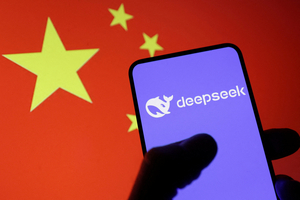
China’s rapid advancements in generative artificial intelligence (AI) are intensifying competition with the United States while presenting South Korea with critical strategic choices. Following the global impact of DeepSeek a year ago, which indicated that China had significantly narrowed the gap in AI technology, the emerging question is not if China can compete, but whether it is poised to define the architecture of the next AI order.
Ahn Jun-mo, a professor of public administration at Korea University, emphasized the distinction between simply adopting AI technologies and defining their architecture. “Countries that set the standards have the power to shape ecosystems, while others must operate within them,” he stated. This shift in focus from mere benchmark scores to ecosystem control marks a pivotal change in the competitive landscape.
What initially seemed like a symbolic breakthrough has evolved into a sustained structural momentum for Chinese developers. Over the past year, they have accelerated model release cycles, expanded open-weight ecosystems, and enhanced competition metrics by emphasizing scale, deployment, and influence. The debut of DeepSeek was widely interpreted as a geopolitical signal, reflecting China’s ability to navigate tightening US semiconductor restrictions by leveraging widely used research components such as Google’s SigLIP vision encoder and OpenAI’s Triton framework. This strategy allowed Chinese teams to reduce development time while conserving computing resources and integrating reinforcement learning more effectively into model reasoning.
Major Chinese AI models are now being updated every one to two months. Notable examples include Moonshot AI’s Kimi K2.5, which utilizes distributed reasoning agents, and Alibaba’s Qwen3-Max-Thinking, which excels in complex reasoning benchmarks. Zhipu AI’s GLM-4.7-Flash achieved over 1 million downloads on the AI research platform Hugging Face within just two weeks, while Baidu’s Ernie 5.0 has reported more than 200 million monthly users.
Even leaders in the US AI space are recognizing this shift. Google DeepMind CEO Demis Hassabis acknowledged that the performance gap between Chinese frontier models and US systems is narrowing, with discrepancies now measured in months rather than years. Shin Jin-woo, an endowed chair professor at KAIST, echoed this sentiment, suggesting that the time required to absorb and adopt publicly available technologies has decreased to about six months. However, he cautioned that ecosystem leadership remains a separate issue, highlighting that while China has the technological capability to lead segments of the industry, it has not yet matched the US in overall benchmarks.
Despite its structural advantages in GPU clusters, alignment research, and global cloud infrastructure, the competitive focus is shifting. An industry expert noted, “The competition is moving away from isolated benchmark scores toward ecosystem control,” suggesting that scale and capital mobilization will become more critical than marginal performance improvements.
The statistics reflect this transition: downloads of Chinese open-weight models on Hugging Face skyrocketed from approximately 1 million in January 2024 to over 818 million by January 2025. A November report from the Massachusetts Institute of Technology and Hugging Face found that Chinese-developed models accounted for 17 percent of newly generated open-model downloads on the platform over the past year, surpassing the 15.8 percent share of US-developed models—marking a historic first for Chinese models.
China’s AI market is currently valued at around 900 billion yuan (approximately $131 billion), with projections suggesting it could reach up to $1.4 trillion by 2030. Alibaba has committed to investing 380 billion yuan in AI and cloud infrastructure over the next three years, and China leads the world in AI patent filings, particularly in areas such as computer vision, natural language processing, and speech technologies.
This strategic acceleration aligns with China’s long-term state planning, having designated AI as a key industry in 2016 and establishing the Next Generation Artificial Intelligence Development Plan in 2017, which aims for global leadership by 2030. For South Korea, the implications of China’s advancements extend beyond regional dynamics; they signal a fundamental structural challenge.
While South Korea excels in semiconductors, telecommunications, and applied AI services, it currently lacks a globally dominant foundational model capable of shaping open ecosystems. Projections indicate that South Korea’s AI market will reach 3.4 trillion won ($2.31 billion) by 2025—a mere fraction of China’s scale.
Ahn reiterated, “The difference between adopting AI and defining its architecture is huge.” The critical question for South Korea is not whether it can effectively utilize AI, but whether it intends to participate in shaping any part of its foundational architecture or will instead operate within standards established elsewhere.
What began as an unexpected challenge with DeepSeek has transformed into a systemic expansion for China’s AI sector, driven by scale, policy alignment, and an expansive ecosystem reach. The competition now hinges less on benchmark supremacy and more on which models gain early adoption, which ecosystems attract developers, and which infrastructures solidify as the default standards.
See also Pentagon’s Retaliation Against Anthropic Violates First Amendment Rights, Claims FIRE
 DeepMind’s Demis Hassabis Reflects on AlphaGo’s ‘Move 37’ and Its Path to AGI
 Nvidia Launches NemoClaw: Open-Source AI Agent Platform for All Companies
 AI Content Creation Market Surges to $10B, Driven by OpenAI and Major Tech Giants
 Meta Acquires Moltbook, Expanding AI Agents’ Capabilities for Businesses and Users