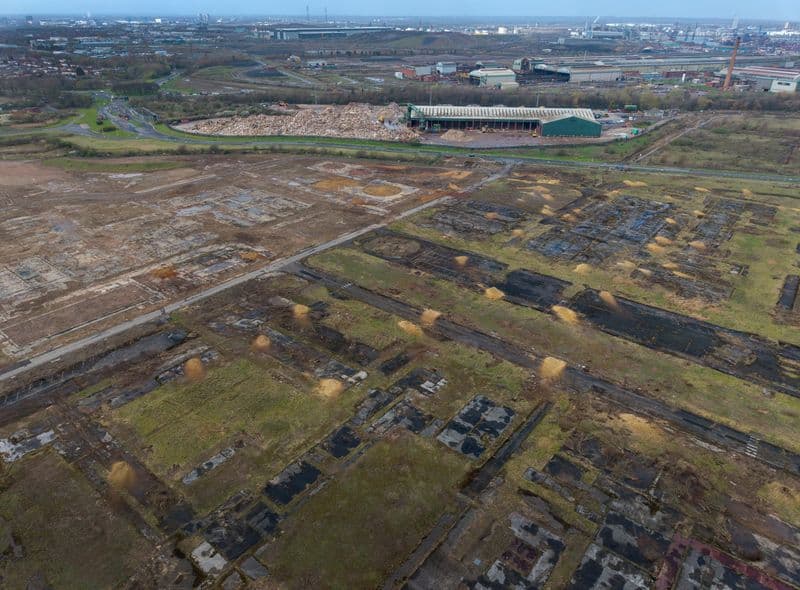
WILTON, England, April 24 (Reuters) – Land left dormant by the decline of the chemical industry in northeastern England has taken on a new lustre. Blessed with power plants, water, and a grid connection, the Wilton International site in Teesside is poised to become a cutting-edge AI data center campus. However, it is not the only site making such transformations.
Across Britain, industrial site owners, speculative investors, property developers, and even farmers are enhancing their land credentials to capitalize on the billions of dollars tech giants plan to invest in AI data centers. According to construction analytics group Barbour ABI, proposals for 119 data centers have been submitted across varied locations, including a disused car plant, an old paint factory, a former Travelodge hotel, and a retail center near Heathrow Airport.
Momentum surged last year following a banquet hosted by King Charles for Donald Trump and prominent tech executives, during which companies such as Google, Microsoft, and Nvidia pledged billions towards Britain’s digital infrastructure. This AI gold rush has not only spawned a new sector of aspiring data center developers but has also disrupted land valuations and created a bottleneck in the lengthy queue for grid connections, as revealed in interviews with over 20 data center operators, advisers, lawyers, and investors.
“The demand that’s come through in the last couple of years – really because of AI – has exploded,” said Andrew Groves at real estate adviser Bidwells. “Speculators and promoters have obviously seen it as an opportunity to make greater returns.”
While financial services require data centers to be close by for speed, AI demands processing power, allowing data centers to be built further from urban centers. This shift is breathing new life into less expensive industrial sites in Britain, far removed from London’s inflated property prices, and attracting interest from rural landowners seeking better returns than farming.
The Concept of ‘Powered Land’
Wilton serves as a prime example of this trend. The majority owner, utilities company Sembcorp UK, has been catering to petrochemical clients for decades. Now, as the industry has declined, it finds itself with surplus land and power potential. The site qualifies as “powered land”—a plot equipped with its own power generation or an existing high-voltage grid connection, or both.
Collaborating with data center developer Digital Reef, Sembcorp aims to attract a major tech tenant, possibly a hyperscaler, to establish a data center on the site, which is located in one of Britain’s most economically deprived areas. “We’re trying to develop something quite quickly, and bring jobs and industry and investment back,” said Mike Patrick, CEO of Sembcorp UK, a subsidiary of Singapore’s Sembcorp Industries.
Hyperscalers—companies that provide extensive cloud computing capacity for AI, including Amazon, Apple, Google, Meta, and Microsoft—require vast amounts of power. “Wilton is almost uniquely placed in that it already has a large grid connection and on-site power assets,” commented Sembcorp UK Business Development Director Peter Ireton. “We think we can attract a large off-taker.”
However, many sites aspiring to become data centers lack adequate power sources. This deficiency has led to a surge in applications for grid connections, with wait times extending to 12 to 15 years due to necessary upgrades in transmission circuits. Britain’s energy department reported that demand for connections soared by 460% in the first six months of 2025, with requests totaling 96 gigawatts of capacity for the high-voltage network and an additional 29 GW for local networks.
For perspective, Britain’s total generation capacity is estimated at about 72 GW, while last year’s peak demand reached just under 46 GW. The National Energy System Operator disclosed in March that it had identified 140 data centers in the main queue, representing approximately 50 GW of capacity. This suggests that speculative activities are driving demand beyond what the network can accommodate, delaying viable projects and hampering the energy transition.
“You’ve been seeing an awful lot of people speculating, spending time trying to get power onto a site,” said Tom Glover, head of data centers for EMEA at U.S. real estate firm JLL.
In response to these challenges, the National Energy System Operator has proposed amendments to its application process to prioritize strategic sectors, including data centers, and filter out speculative applications. A similar initiative implemented last year to streamline the queue for clean power projects successfully halved those requests.
As demand for land suitable for data centers rises, property values are climbing. Brokers report that land with a reliable power supply for data centers has historically commanded a premium, which has only increased due to AI demand and grid congestion in recent years. According to British real estate company Savills, industrial land in London can sell for between £4.5 million and £6 million an acre, while land suitable for data centers can fetch between £8 million and £15 million. A report by real estate adviser Colliers highlighted that powered land in the United States can sell for up to 2.5 times more than other industrial land, and even more in tech-heavy regions like northern Virginia and northern California.
The landscape of U.K. real estate is shifting dramatically, influenced by the rapid rise of AI and the demand for data centers. As stakeholders navigate these changes, the implications for local economies, land use, and the broader technology sector will continue to unfold.
See also Google Cloud Urges Financial Firms to Embrace Governance in Agentic AI Deployments
 AI-Powered Embedded Finance Risks Bias and Ethical Challenges, Urges Regulatory Reforms
 Bittensor’s TAO Token Faces Challenges to Achieve Millionaire-Maker Status