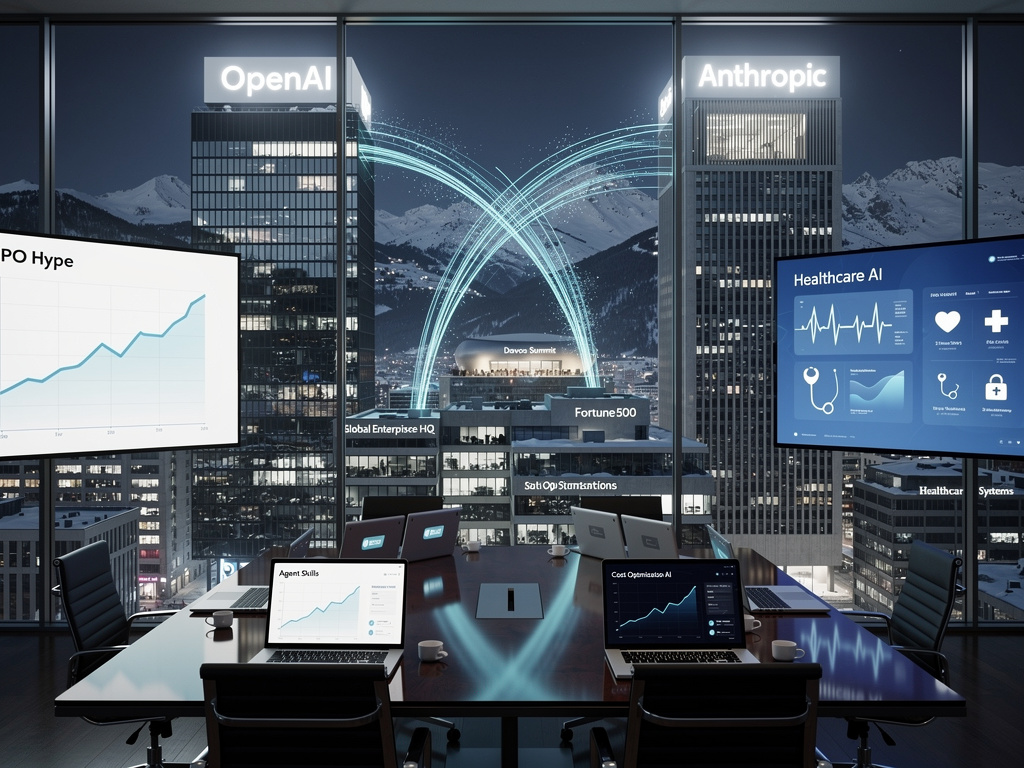
As artificial intelligence (AI) transitions into its most commercial phase, OpenAI and Anthropic are intensifying competition for lucrative enterprise contracts. The two companies made their case for advanced tools at the World Economic Forum in Davos, where executives revealed that enterprise revenue constitutes about 40% of OpenAI’s business and a remarkable 80% of Anthropic’s. This shift highlights the urgency for AI labs to monetize cutting-edge technologies amid rising compute costs and increasing investor scrutiny.
During the event, OpenAI’s chief strategy officer, Jason Kwon, emphasized the company’s commitment to “deepening our enterprise relationships.” Meanwhile, Anthropic CEO Dario Amodei detailed plans to expand AI deployments within Fortune 500 firms. Both companies view corporate clients as essential for long-term sustainability, with OpenAI focusing on sectors like finance and healthcare, and Anthropic pushing its Claude models into regulated industries.
The competition escalated as Anthropic launched its “Agent Skills,” an open framework for AI agents that has attracted users including Microsoft, OpenAI itself, Atlassian, and Figma. This development positions Anthropic as a potential standard-setter in enterprise automation, challenging OpenAI’s earlier dominance in workplace AI.
Financial pressures are mounting as both companies prepare for what executives describe as a “reckoning” by 2026. Anthropic has recently revised its 2025 gross margin forecast down to 40% from 50%, citing soaring AI inference costs. The company anticipates its revenue will surge from $1 billion in 2024 to $10 billion in 2025 and reach $26 billion by 2026. OpenAI faces similar challenges; CFO Sarah Friar discussed the scarcity of compute resources on a company podcast, emphasizing that demand significantly exceeds supply.
Healthcare is emerging as a critical battleground for both firms. Anthropic’s launch of Claude for Healthcare has raised concerns among software investors, while both companies are eager to position AI as a transformative force in the sector. A recent Bloomberg newsletter highlighted executives’ optimism regarding potential regulatory breakthroughs that could facilitate widespread AI adoption.
Strategic partnerships are crucial for expansion in this competitive landscape. Anthropic has deepened its collaboration with Accenture, with plans to train 30,000 professionals on Claude and develop tools for CIOs to enhance code generation. The newly formed Accenture Anthropic Business Group aims to help enterprises transition from pilot projects to full-scale implementations. OpenAI, on the other hand, is focusing on user enablement for progress in 2026, emphasizing that it will not only rely on model improvements.
In a bid to boost adoption, Anthropic has introduced an enterprise search feature that integrates company knowledge into Claude projects. Surveys from ZDNet indicate that Anthropic is quietly gaining traction in the enterprise AI sector, with its agentic tools marking a growing niche. OpenAI counters this with custom integrations for financial data, as evidenced by recent announcements in the financial services domain.
Speculation about potential initial public offerings (IPOs) is intensifying, with buzz surrounding both OpenAI and Anthropic, alongside SpaceX, for 2026. According to The New York Times, these listings could inject significant capital into Silicon Valley, contingent on the realization of profitability. Anthropic recently announced a $13 billion funding round at a $183 billion valuation, aimed at bolstering capacity and safety research amid competitive pressures.
Both companies are shifting their focus to address high operational costs, with analyses from WebProNews suggesting an increasing reliance on avenues such as ads, enterprise software, and AI agents. The Tekedia forum characterizes this phase as one of “commercial discipline,” with both firms securing multi-year contracts to navigate compute shortages effectively.
Product innovations are becoming a key differentiator in this race. Anthropic is rolling out integrations and research betas for its enterprise plans, enabling clients to build custom tools tailored to their needs. The introduction of connectors for healthcare and finance, along with master control protocols for data providers, targets high-value sectors. OpenAI has also engaged in discussions, such as a podcast featuring Vinod Khosla from Khosla Ventures, focusing on equitable AI access through enterprise scaling.
As 2026 approaches, the execution of enterprise strategies will likely determine which company ascends to dominance. Anthropic’s engineering blog has outlined ongoing improvements in performance, particularly after the success of Claude Opus 4.5, which has outperformed human capabilities. While the company pursues broader ambitions, including partnerships with organizations like Teach For All for educational initiatives, the corporate sector remains the ultimate prize for both firms.
See also Italy Enacts National AI Law, Establishing Pioneering Regulatory Framework and Compliance Standards
 Pagaya’s AI Partnership with Achieve: A Game-Changer for Investment Strategy?
 Cohere’s Joëlle Pineau Champions Business-Driven AI Over Superintelligence
 Invest in AI: Top 4 Stocks Poised to Dominate $3 Trillion Robotaxi Market by 2040
 Alibaba Accelerates AI Hardware Push with T-Head Listing and Nuclear Power JV