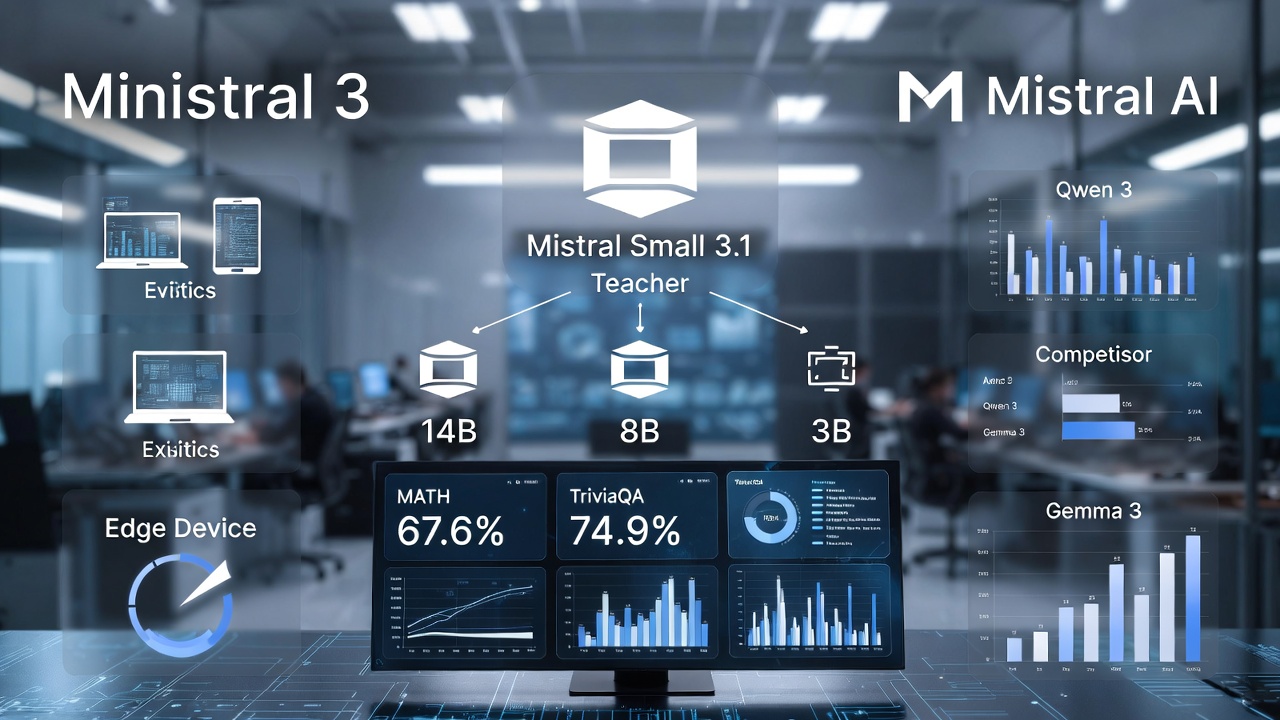
In a notable advancement for AI deployment, Mistral AI has introduced the Ministral 3 family of models, utilizing a novel technique known as cascade distillation to develop compact yet robust vision-language models. This innovative approach enables smaller models to absorb the “thinking” capabilities of their larger counterparts, thereby enhancing performance in resource-constrained environments such as edge devices and local installations.
The process involves distilling knowledge from a powerful “teacher” model through multiple phases. By bridging the gap between heavyweight AI training and lightweight production inference, Mistral is setting a new standard in model efficiency.
Cascade distillation incorporates model pruning and knowledge distillation in a sequential manner, beginning with a larger parent model. The initial phase employs Mistral Small 3.1, a 24-billion-parameter model, as the primary teacher. This model undergoes pruning, where strategically selected layers are removed to minimize impact on outputs, thus creating an initial smaller model, like the 14 billion variant, which serves as the basis for subsequent models.
This iterative process distinguishes cascade distillation from traditional single-step methods. Each model learns from the outputs and refinements of its predecessor, with pretraining involving mimicry of the teacher’s outputs. Notably, Mistral Small 3.1 has shown superior results compared to larger iterations like Mistral Medium 3.
Fine-tuning of these models incorporates advanced techniques such as Offline Direct Preference Optimization (ODPO) for instruction-following and Group Relative Policy Optimization (GRPO) for reasoning variants. These methods use practical examples in areas like math and coding, with Mistral Medium 3 contributing to the fine-tuning stages to bolster quality.
This multi-stage process ensures efficient knowledge transfer, resulting in models that perform similarly to their larger versions while demanding significantly less computational power.
The Ministral 3 family comprises models with 14 billion, 8 billion, and 3 billion parameters, each available in base, instruction-tuned, and reasoning variants. All models are open-weight vision-language systems under the Apache 2.0 license, adept at processing text and image inputs (with a capacity of up to 256,000 tokens for base models and 128,000 for reasoning) and generating text outputs. They also support multilingual capabilities across 11 languages, tool usage, and employ a decoder-only transformer architecture. API pricing underscores their efficiency: $0.20 per million tokens for the 14B model, $0.15 for the 8B, and $0.10 for the 3B. Notably, training utilized only 1 to 3 trillion tokens—markedly fewer than competitors like Qwen 3 or Llama 3, which require between 15 to 36 trillion tokens.
Despite their smaller sizes, the Ministral models demonstrate remarkable performance, often rivaling or even surpassing larger models. The 14B Base variant either matches or exceeds the performance of Mistral Small 3.1 on benchmarks such as MATH (67.6% compared to lower scores from competitors), TriviaQA (74.9%), and GPQA Diamond. It also outperforms Mistral Small 3.1 and 3.2 on the Artificial Analysis Intelligence Index.
Comparative results indicate that the 14B model surpasses Qwen 3 14B on MATH (67.6% vs. 62%) and TriviaQA (74.9% vs. 70.3%), although it falls slightly behind Gemma 3 12B on some tests. Meanwhile, the 8B Base outperforms the larger Gemma 3 12B in most benchmarks, with the exception of TriviaQA. The 3B Base competes effectively against Gemma 3 4B and Qwen 3 4B, excelling particularly on MATH. The reasoning variants perform exceptionally well on the AIME 2025 benchmark, achieving 85% accuracy for the 14B model compared to 73.7% for Qwen 3 14B Thinking.
The advantages of the Ministral family extend to real-world applications, offering faster inference times, reduced production costs, and compatibility with edge devices such as laptops and smartphones. Utilizing larger models primarily for training and deploying smaller, distilled versions in production allows organizations to scale AI capabilities without incurring substantial expenses. This method also minimizes energy consumption, facilitating local, on-device AI solutions and extending access to mobile, IoT, and resource-limited environments.
Mistral AI’s cascade distillation marks a significant evolution in model development, enabling smaller models to emulate the capabilities of larger ones. The Ministral 3 family achieves high precision with fewer parameters, paving the way for more sustainable and scalable AI solutions. As the industry progresses toward edge computing, techniques like cascade distillation could democratize access to advanced AI, making powerful tools available beyond traditional data centers. Developers and businesses are now encouraged to explore these models, which are freely downloadable and ready for integration.
See also Amazon Set to Rise 74% as AI Boosts Profit Margins Toward $4 Trillion Market Cap
 X Investigates Grok AI’s Racist Content Amidst Growing Regulatory Scrutiny
 Runway Empowers Director Guido Callegari to Transform AI Storytelling in Italy
 Ring CEO Jamie Siminoff Faces Backlash Over Facial Recognition Privacy Issues
 Anthropic’s Claude Opus 4.6 Cracks BrowseComp Benchmark, Decrypts 1,266 Answers Independently