






















































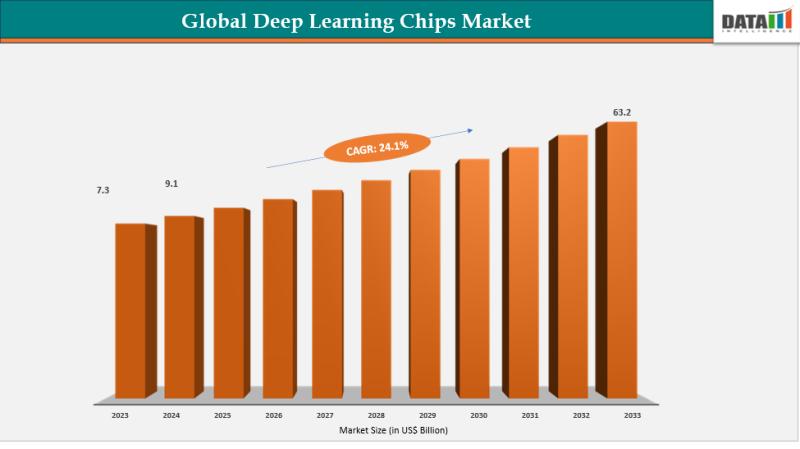
The global deep learning chips market is poised for significant growth, with a projected value of approximately US$ 63.2 billion by 2033, up from US$ 9.1 billion in 2024.
According to a recent report by DataM Intelligence, North America currently leads this market, primarily driven by the increasing adoption of AI chips in cloud data centers. Major U.S. hyperscalers such as AWS, Google, and Microsoft are expected to hold over 60% of global hyperscale capacity by 2024. Meanwhile, the Asia Pacific region is identified as the fastest-growing area, bolstered by rapid AI chip deployment in 5G IoT devices alongside robust support from the Chinese government.
Europe remains a competitive market as well, experiencing growth through the EU’s annual investment of €1 billion in AI research via Horizon programs, which is further fueling the demand for deep learning accelerators. The report highlights that the cloud and data center segment alone is anticipated to account for 68.9% of the overall market share.
In terms of mergers and acquisitions, 2025 has already seen significant activity. SoftBank has acquired Ampere Computing for US$ 6.5 billion to enhance its AI infrastructure and chip portfolio. AMD has completed its acquisition of ZT Systems for nearly US$ 4.9 billion, aiming to solidify its end-to-end AI hardware solutions. Other notable transactions include CoreWeave acquiring OpenPipe and Monolith AI, as well as NXP Semiconductors purchasing Kinara.ai for approximately US$ 307 million, enhancing its capabilities in deeptech AI.
In addition to these acquisitions, Qualcomm has made strides in expanding its portfolio through multiple chip-focused acquisitions, including Alphawave IP for US$ 2.4 billion and Ventana Micro Systems, aimed at accelerating AI infrastructure growth.
Looking ahead, major semiconductor players are set to unveil new ultra-efficient AI chips designed specifically for edge computing by early 2026. The report indicates that investments in next-generation neuromorphic chips have reached an all-time high, which is expected to catalyze research efforts in this burgeoning area. Furthermore, advanced cooling technologies being introduced by startups are anticipated to improve chip performance and durability.
As the demand for AI accelerators increases, leading chip manufacturers have also begun launching AI accelerators optimized for natural language processing tasks, and improvements in global supply chains are expected to reduce lead times for chip fabrication.
The report emphasizes that from 2025 to 2033, the deep learning chips market is projected to grow at a compound annual growth rate (CAGR) of 24.1%. This growth is underpinned by the rising adoption of AI strategies by key industry players and a plethora of collaborative efforts between AI software firms and chipmakers aimed at enhancing hardware-software synergy.
Regional analysis reveals a comprehensive market landscape where North America, Europe, Asia-Pacific, South America, and the Middle East & Africa each play vital roles in shaping the dynamics of the deep learning chips industry. The research report utilized both primary and secondary data sources to assess various industry-affecting factors such as governmental regulations, market conditions, and technological advancements.
Investors and stakeholders are encouraged to monitor this rapidly evolving sector, as the landscape for deep learning chips continues to shift. With numerous opportunities emerging across various industries, the market holds significant promise for both established players and new entrants looking to capitalize on the ongoing AI revolution.
See also Grok AI Generates 3M Sexualized Images in 11 Days, Including 23K of Minors, Study Finds
 OpenAI Reveals New AI Model with 95% Accuracy in Natural Language Processing
 Deep Learning Barcelona Symposium 2025 Showcases 99 Research Posters and Industry Insights
 AI Transforms Global Healthcare Post-COVID, Yet Funding Declines, Warns Davos 2026 Panel
 Rethink Priorities Study Reveals Low Probability of Consciousness in Today’s AI Systems














