






















































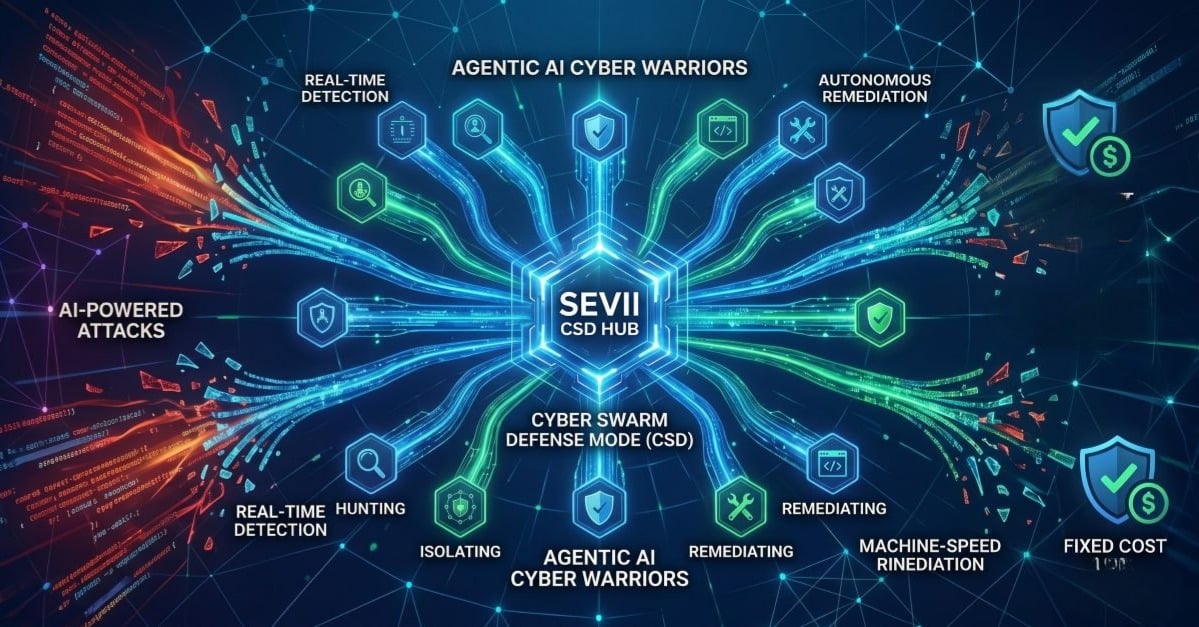
Sevii this week announced a breakthrough in cybersecurity capabilities, unveiling a technology that can thwart cyberattacks in minutes. Utilizing swarms of artificial intelligence (AI) agents, the new feature has been integrated into Sevii’s application detection and response (ADR) platform. The company aims to equip cybersecurity teams with enhanced tools to combat increasingly sophisticated cyber threats.
According to CEO Curt Aubley, Sevii has harnessed multiple AI models to create specialized agents, referred to as “Agentic AI Cyber Warriors.” These agents perform specific cybersecurity tasks only as required, optimizing resource use. The newly introduced Cyber Swarm Defense Mode (CSD) allows teams to deploy these AI swarms efficiently and cost-effectively, minimizing unnecessary resource consumption.
Built on the proprietary Myrmidon Defense Technology (MDT), Sevii’s technology employs a set of unique algorithms designed to orchestrate security operations at scale. This capability is governed by a framework that enables autonomous processing for real-time hunting, isolating, and remediation of threats, based on service-level objectives defined by cybersecurity teams.
Aubley further emphasized that this fixed cost model, which charges organizations based on the assets being protected rather than the number of AI tokens consumed, represents a significant shift in how cybersecurity services are priced. The overarching goal is to empower cybersecurity teams to respond to threats with the same agility and speed that military drones are deployed, as malware and cyberattacks are increasingly launched at machine speed by adversaries leveraging AI.
“AI is fundamentally changing cybersecurity in ways that humans cannot manage efficiently,” Aubley stated. He highlighted the urgent need for cybersecurity teams to respond to attacks within minutes, a feat now achievable primarily through AI. “We need to detect and respond in less than 15 minutes, without human intervention,” he added, pointing to the increasing complexity and speed of cyber threats.
The cybersecurity landscape is evolving rapidly; adversaries are expected to utilize advanced AI models to discover vulnerabilities in applications. Once these vulnerabilities are identified, they can also create tailored exploits in mere minutes. In this context, Sevii argues for a strategy that pits AI against AI, likening the current situation to an arms race between defenders and attackers.
Aubley maintained that the capability for instant response is becoming non-negotiable, as traditional methods of analyzing each attack are no longer viable. Instead, cybersecurity teams will need to rely on AI to analyze and learn from attacks post-factum. This approach aims to reduce the size of cybersecurity teams necessary for defending ever-expanding digital infrastructures. “The simple fact is that there are not enough cybersecurity professionals available to defend these environments,” he noted.
As the role of cybersecurity professionals continues to evolve with the rise of AI, Aubley highlighted the pressing need for a shift in training methodologies. New hires will require a deeper understanding of Level 2 and Level 3 functions, as many Level 1 tasks will soon be automated. Organizations that have not yet adapted to these realities of AI-driven cybersecurity are at risk of being overtaken by the rapid pace of change.
Ultimately, the growing dependence on AI for cybersecurity underscores a broader significance: the industry must act swiftly to confront the new challenges posed by digital threats. Many organizations may not yet fully comprehend the urgency of the situation, but time is running out for those that hesitate to embrace these transformative technologies.
See also AI-Driven Cyberattacks Surge 22% as NCC Report Highlights Threat to CISOs
 Australia Post Partners with Alpha Level to Enhance Cyber Threat Detection Using AI
 Asian Banks Tighten Cybersecurity as Anthropic’s Mythos Reveals Major Vulnerabilities
 Anthropic’s Claude Model Discovers 1,000+ Vulnerabilities in Major Software Systems






