






















































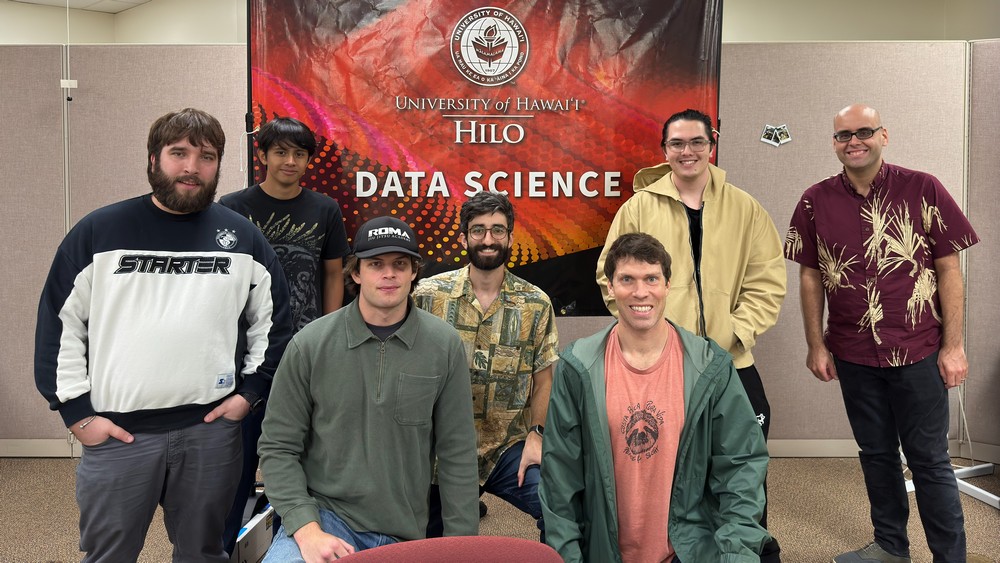
Computer scientist Travis Mandel has secured a $5,000 grant from the Office of the Chancellor to transform the University of Hawaiʻi at Hilo’s Data Science Laboratory into the Scientist-Centered Artificial Intelligence Laboratory (SCAIL). This rebranding reflects a commitment to using AI to enhance scientific research, rather than replace the scientists themselves.
The evolution of the lab, which Mandel founded in 2017 alongside the university’s data science program, comes as a response to an increasing integration of AI into various research disciplines across the campus. As an associate professor and coordinator for the data science program, Mandel has focused on human-in-the-loop AI methodologies, which allow for human input to refine algorithms and improve model accuracy.
“Data science is the best way to do science if you’re motivated by important real-world problems,” said Mandel, highlighting the lab’s foundational ethos. Initially, his work concentrated on embedding AI within educational video games. However, as interest in AI grew among fellow researchers, Mandel adapted his approach to meet their needs, bridging gaps in expertise.
Collaboration is central to SCAIL’s mission. Mandel has partnered with various faculty members, including Associate Professor of Marine Science John Burns, who leads the Multiscale Environmental Graphical Analysis (MEGA) Lab, and Associate Professor of Data Science and Business Sukhwa Hong, who, along with Assistant Professor Chenbo Shi, is developing new AI applications in business analytics. Furthermore, Mandel is engaging with experts like Professor Ryan Perroy, who conducts mapping work at the Spatial Data Analysis and Visualization Lab, as well as climate scientists at UH Mānoa.
One notable project involved using computer vision to track invasive species and monitor Rapid ʻŌhiʻa Death in Hawaii’s forests, a collaboration with Perroy that exemplified the lab’s practical applications of machine learning. “I think that’s been one of the things I’ve loved about being at UH Hilo,” Mandel remarked. “It’s very easy to collaborate, especially being in data science.”
The new identity of SCAIL signifies a shift towards a more collaborative and supportive environment for researchers. According to Mandel, “The name helps to let students know this is an important center of research on campus. It reflects the fact that we’re very focused on not just AI, but AI that helps scientists do their job better.”
With the grant funding, Mandel plans to enhance the laboratory’s facilities, which have recently established a permanent location on the second floor of Mookini Library. Upgrades will include improved furniture and a standing desk to promote healthier working habits, creating a welcoming atmosphere conducive to both research and collaboration.
“I want to make it a functional research lab, but I also want it to be somewhere that students enjoy coming,” he said. This approach aligns with Mandel’s teaching philosophy, which emphasizes hands-on learning experiences for students engaged in research projects.
The lab currently accommodates five undergraduate students and one high school student, all working on diverse projects that leverage AI to assist in scientific inquiries. Mandel emphasizes the importance of challenging students intellectually through their work, often presenting problems that rival industry standards in complexity.
Importantly, SCAIL is designed to be inclusive. Mandel encourages students from various majors to participate, asserting that technical skills in data science and AI can benefit a wide range of fields. The data science certificate offered by the program requires only a year of coursework, providing ample opportunity for students to gain practical experience.
As he reflects on the future of the lab, Mandel expresses optimism that enhanced facilities will attract more students to the program. “The payoff will come when students come by and see the space and realize there’s some really cool cutting-edge AI stuff being done here,” he noted. “Maybe I want to come to UH Hilo so I can learn more about what’s going on.”
See also New Study Reveals Generative AI Risks Cultural Homogenization of Human Thought
 LiTo Unveils 3D Latent Representation for Enhanced View-Dependent Object Rendering
 AI Research Reveals Blind Spots in Game-Playing Strategies, Impacting Future Developments
 China Leads AI Hardware Innovation, Says IDC Executive at Mobile World Congress
 Marvell Invests in Mojo Vision’s Micro-LED AI Tech for Next-Gen Data Center Connectivity






