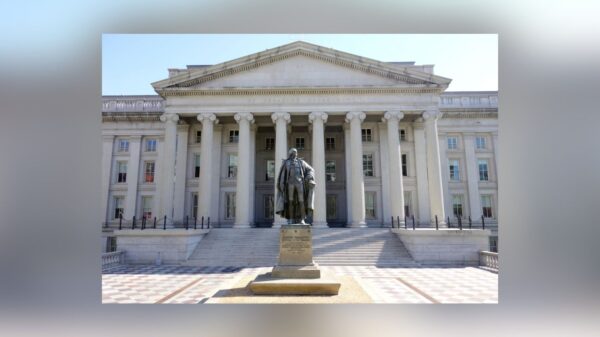
The cryptocurrency market is undergoing a transformative shift as compliance standards evolve, particularly with the recent advancements in artificial intelligence (AI) fraud detection. Kraken’s AI-driven models have achieved a remarkable 99.3% accuracy in detecting fraudulent activities, while AnChain.AI has dramatically reduced analysis times by nearly 97%. Adding to this momentum, the U.S. Treasury has endorsed AI as the future of crypto oversight, signaling a new compliance landscape that will influence which projects attract institutional investment.
Currently, Ethereum is trading at $2,072, with many investors eyeing a potential rise to $4,000. In contrast, Dogecoin remains stable at $0.090, buoyed by loyal community support but lacking any structural catalysts to drive institutional interest. This week’s developments in AI compliance could redefine the competitive landscape for cryptocurrencies, determining which projects will gain favor among institutional investors.
The treasury’s endorsement implies that traditional compliance methods may soon be obsolete on an institutional scale. According to Bloomberg, exchanges that utilize AI-powered monitoring will be better positioned to earn the trust of institutional investors. As projects like Pepeto leverage SolidProof audits and verified infrastructure, they are poised to benefit significantly from these new compliance standards.
Pepeto, currently in presale at $0.000000186, offers a unique entry point for investors keen on capitalizing on the shifting compliance landscape. The ecosystem includes PepetoSwap, a cross-chain decentralized exchange, and a bridge connecting Ethereum, BNB Chain, and Solana. The founder of Pepeto previously launched a token that reached a market cap of $7 billion, and the platform has undergone a SolidProof audit that meets the U.S. Treasury’s newfound compliance expectations.
Every dollar invested in Pepeto is expected to drive the price floor higher, benefiting early investors, particularly those taking advantage of the current 200% APY staking option. This compounding yield enhances the investment’s appeal as AI compliance becomes a crucial factor in valuation.
In contrast, DeepSnitch AI, which has raised approximately $2.1 million, has developed tools such as contract analysis and a live alert dashboard. However, the lack of a published audit from a recognized firm could hinder its ability to attract institutional volume. Analysts suggest that DeepSnitch AI’s market potential may be limited, with an estimated return ceiling of around 2x, constrained by a narrow addressable market that the Treasury’s AI compliance does not significantly expand.
Ethereum’s existing infrastructure is seen as favorable in light of the new compliance standards. With 36 million ETH staked, Ethereum is well-positioned to capture institutional inflows, especially as analysts project that ETH could reach $4,000. While ETH presents a solid investment opportunity, particularly for long-term stability, the presale potential of Pepeto may offer more significant short-term returns.
In stark contrast, Dogecoin’s market position appears tenuous under the new compliance framework. Trading at $0.090, the meme coin is primarily supported by community loyalty but lacks the necessary exchange infrastructure or audit verification to attract institutional investment in an era where compliance is paramount.
As the crypto landscape evolves, the recent endorsement of AI compliance by the U.S. Treasury suggests a future where adherence to advanced oversight will be essential for all exchanges. Investors who position themselves now with assets meeting these new standards, such as those in Pepeto, may find themselves reaping significant rewards within months as the market adapts to this compliance-driven environment.
The presale for Pepeto is ongoing, and potential investors are urged to explore the official website before this opportunity closes. The integration of AI compliance into the cryptocurrency market could redefine investment strategies, compelling traditional and new investors alike to reconsider their portfolios.
See also AI Governance Falters Without Exposure Management, Endangering Enterprise Risk Control
 AI Liability Evolving: WTW Reveals Key Gaps and Risks for Insurers and Corporations
 Fortinet Launches FortiOS 8.0, Enhancing AI Governance and Quantum-Safe Protection
 HubSpot Tightens Legal Framework Amid Strong Q4 2025 AI-Driven Growth Results
 AI Industry Urged to Lead in Safety Standards Following Tumbler Ridge Incident