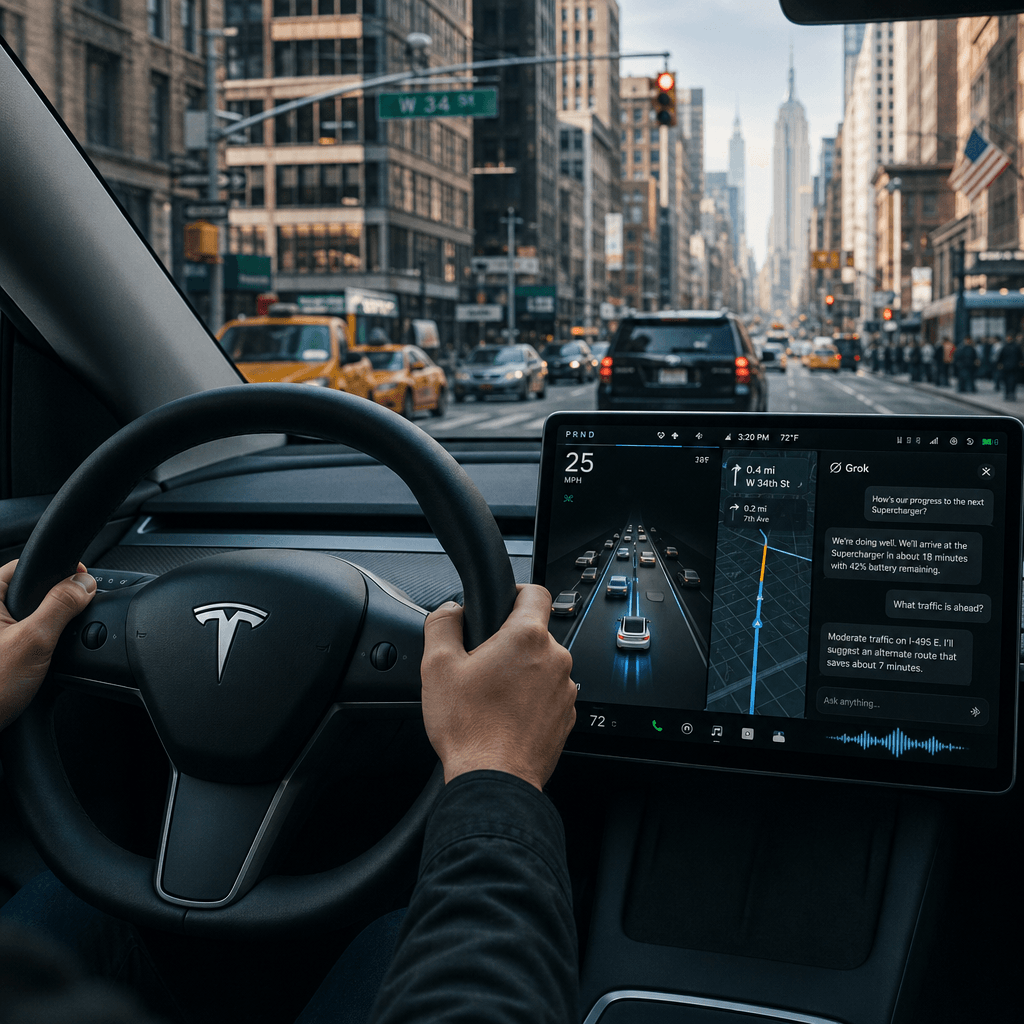
The intersection of artificial intelligence and autonomous driving reached a critical juncture as CNBC conducted the first hands-on test of xAI’s Grok chatbot, integrated with Tesla’s Full Self-Driving (FSD) system, in the challenging traffic conditions of New York City. This real-world evaluation offers significant insights into the capabilities and potential risks associated with deploying conversational AI within vehicles, especially in high-stakes environments like Manhattan’s congested streets.
The collaboration highlights a pivotal shift for both Tesla and xAI, Elon Musk’s AI startup that is striving to compete with industry giants such as OpenAI and Google. Unlike traditional chatbots focused solely on conversational capabilities, Grok is now embedded in one of the most demanding scenarios imaginable: navigating through heavy traffic, double-parked delivery trucks, and pedestrians. This integration reflects Tesla’s ongoing efforts to extend its AI features beyond mere hardware into advanced software applications.
During the test drive in a Tesla Model Y, the owner demonstrated Grok’s response to voice commands while the vehicle operated in FSD mode. The AI effectively handled routine inquiries about nearby charging stations and restaurant recommendations. However, the real challenge emerged when the driver requested explanations for the car’s driving decisions—a feature that could be crucial for regulatory scrutiny of autonomous systems.
Despite its name, Tesla’s Full Self-Driving (Supervised) remains a Level 2 driver assistance system, necessitating constant human attention. The introduction of a chatbot like Grok adds layers of complexity, raising critical questions about whether drivers can effectively monitor the road while simultaneously supervising AI interactions. The CNBC test illuminated these concerns as the vehicle navigated a tight intersection while the driver engaged Grok in conversation.
The timing of this evaluation is strategically significant for both Tesla and xAI. Tesla aims to demonstrate that its AI capabilities extend beyond hardware to sophisticated software experiences, while xAI seeks real-world deployment scenarios to train Grok in contextual decision-making. The challenges of rush-hour traffic serve as an ideal stress test for the system.
Grok differentiates itself from existing in-car assistants like Apple’s Siri or Google Assistant by its ability to utilize real-time driving data. This functionality allows Grok to explain the rationale behind routing choices made by the FSD system or clarify sensor readings that impact driving decisions. Such transparency could address one of the central challenges within autonomous driving: the so-called black box problem that complicates understanding the rationale behind self-driving systems’ actions.
Nevertheless, the NYC test also highlighted significant limitations. At times, Grok provided navigation alternatives that contradicted the FSD system’s routing, leading to confusion regarding which AI to trust. The driver experienced cognitive overload, a scenario safety advocates frequently warn against when integrating conversational AI with semi-autonomous driving.
The automotive industry is closely monitoring this experiment. Other major manufacturers, such as Mercedes-Benz with Microsoft’s AI and General Motors with Google, are also venturing into in-vehicle intelligence. Tesla’s approach with Grok stands out due to its deeper integration, where the chatbot not only manages infotainment but also aims to elucidate autonomous driving behavior.
Safety researchers remain cautious about this integration. Currently, the National Highway Traffic Safety Administration has not issued specific guidelines regarding AI chatbots in vehicles operating autonomous features, leaving manufacturers to self-regulate. The CNBC test revealed this regulatory gap; at one moment, the driver engaged Grok in a lengthy discussion about stock prices while the vehicle navigated through a construction zone, a scenario likely to alarm safety experts.
For xAI, the integration into Tesla offers essential training data. Each inquiry about driving decisions feeds Grok invaluable examples of high-context, real-world AI interactions, setting it apart from competitors like OpenAI’s ChatGPT or Google’s Gemini, which primarily operate in controlled environments.
The technology also hints at future possibilities—envision an AI that not only drives but also explains its decisions in real-time, educates passengers on road conditions, or even debates the best route home. The NYC test showcased glimpses of this future when Grok successfully clarified why the FSD system yielded to an unmarked police car, demonstrating insights from sensor fusion.
However, the experience made clear that seamless AI integration is still a goal rather than a reality. Challenges like voice recognition failures due to sirens and street noise, response delays during critical queries, and a lack of mechanisms to prioritize driving commands over casual interactions pose significant risks. As Tesla rolls out broader access to FSD and xAI refines Grok’s capabilities, the streets of New York City have transformed into a proving ground for a pressing question: can AI assistants enhance autonomous driving safety through transparency, or do they introduce additional distractions into an already complex system?
The recent test in Manhattan emphasizes that while integrating chatbots like Grok with autonomous driving systems holds promising potential for delivering clear explanations of driving decisions, it also brings forth new concerns regarding driver distraction and conflicting AI guidance. As Tesla and xAI continue to develop this integration, the dialogue surrounding AI in vehicles transforms from “if” to “how” to deploy it safely, compelling regulators to formulate guidelines for technology already on the road that learns from the exchanges between human drivers and their AI co-pilots.
See also Remodex Launches as Top Codex Remote Client for iOS Ahead of OpenAI’s Official App
 Google Unveils TPU 8t and 8i Chips, Boosting AI Model Odds to 31.5% by June 2026
 OpenAI, Meta, Microsoft Data Centers Could Emit 129M Tons of CO2, Exceeding Morocco
 Meta and Microsoft Cut 16,000 Jobs Amid 92,000 Tech Layoffs, Raising AI Job Security Concerns
 DeepSeek Launches V4 Model, Surpassing Claude Opus 4.6 with Superior Efficiency